Thank you for visiting SNEWPapers!
Sign up free
Literary
August 3, 1905
The San Angelo Press
San Angelo, Tom Green County, Texas
What is this article about?
An overworked narrator visits his fiancée Margaret and her mother at Cousin Jim's house amid local burglar fears. A night of tense misunderstandings involving a lurking figure, unlocked doors, and a man in the cellar resolves humorously when the 'burglar' proves to be the deaf-mute servant Robert, locked in accidentally, with a policeman's help.
Merged-components note: Continuation of the short story 'Worried' across components on page 5; merged for complete narrative unit.
Clipping
OCR Quality
75%
Good
Full Text
Worried
Flight
of Mice to
Office
Care
but
can
HOWARD FIELDING
The
Mr. Steright, 1904, by Charles W. Hooke
will be
good man
a good representative girl in the world and
teenth district other came into the city
Congress
Tuesday and very obliging
possesses the ed me up in my office
as we just I was not quite at my best
sary to m.
They were so kind as to
of the
as true that I had been over-
express their sympathy.
these
g for a month or more, that my
them
was unsteady and that there
the dark crescents under my eyes us
th
result of strenuous devotion to busi-
ness extending into the midnight hours.
In fact, my attempt to make the most
of a streak of good luck had been so
violent that I was on the verge of col-
lapse. But I made light of it to the
aforementioned young lady and her
mother.
Mrs. Stanwood regarded me with an
almost maternal solicitude.
"I was thinking that you might come
out and stay with us over Sunday." re-
sponded Mrs. Stanwood.
"You know
we shall have Cousin Jim's house all to
ourselves"_
It was all settled in a moment.
A
sweet decisiveness is one of Marga-
ret's thousand charms, and upon this
occasion, as often before and since,
she saved me the trouble of making up
my mind. Of course I knew that I
ought not to accept this invitation, and
of course I forgot an important busi-
ness engagement which I had sinfully
made for Sunday afternoon.
I had all kinds of trouble changing
that appointment, but managed to do
it without other loss than that which
is measured in nerve force.
Margaret was waiting for me at the
station in a hired equipage, and she
urged the driver of the ancient nag to
make all possible haste.
"Your train's a little late," said she
to me in explanation, "and I promised
Uncle Henry that I would come back
as soon as I could."
Uncle Henry is Mrs. Stanwood's
brother. He is a man whose fortunes
had been declining of late and he had
been reduced to the necessity of tak-
ing boarders. Mrs. Stanwood and Mar
garet had spent a couple of months in
his house, partly as a measure of econ-
omy and partly to help him along. Un-
cle Henry's son, James, is married and
has a home of his own in Springvale,
and I had understood that he and his
family were to be away and that Mar-
garet and her mother were to take
care of the house. It would have suit-
ed me much better to be entertained at
Cousin Jim's in that gentleman's ab-
sence, because there were too many
people at Uncle Henry's to suit the in-
clinations of a nervous man who has
planned to spend a quiet Sunday with
his fiancee.
Nevertheless I asked as
cheerfully as possible if we were going
to Uncle Henry's.
"Oh, no," replied Margaret.
"Uncle
Henry is at Cousin Jim's with mam-
ma. She felt a little nervous
there
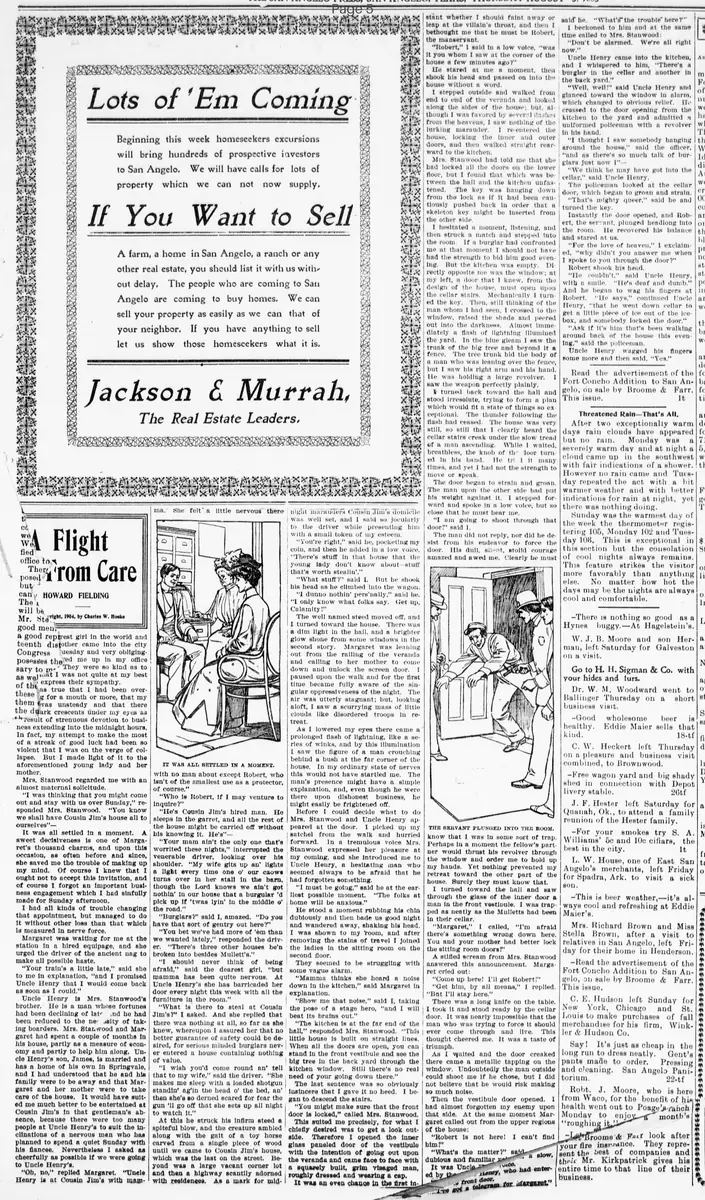
IT WAS ALL SETTLED IN A MOMENT.
with no man about except Robert, who
isn't of the smallest use as a protector,
of course."
"Who is Robert, if I may venture to
inquire?"
"He's Cousin Jim's hired man. He
sleeps in the garret, and all the rest of
the house might be carried off without
his knowing it. He's"-
"Your mam ain't the only one that's
worrited these nights," interrupted the
venerable driver, looking over his
shoulder. "My wife gits up an' lights
a light every time one o' our caows
turns over in her stall in the barn,
though the Lord knows we ain't got
nothin' in our house that a burgular 'd
pick up if 'twas lyin' in the middle o'
the road."
"Burglars?" said I, amazed. "Do you
have that sort of gentry out here?"
"You bet we've had more of 'em than
we wanted lately," responded the driv-
er.
"There's three other houses be'n
broken into besides Mullett's."
"I
should never
think
of
being
afraid," said the dearest girl,
"but
mamma has been quite nervous.
At
Uncle Henry's she has barricaded her
door every night this week with all the
furniture in the room.
"What is there to steal at Cousin
Jim's?" I asked. And she replied that
there was nothing at all, so far as she
knew, whereupon I assured her that no
better guarantee of safety could be de-
sired, for serious minded burglars nev-
er entered a house containing nothing
of value.
"I wish you'd come round an' tell
that to my wife," said the driver. "She
makes me sleep with a loaded shotgun
standin' ag'in the head o' the bed, an'
then she's so derned scared for fear the
gun 'll go off that she sets up all night
to watch it."
At this he struck his infirm steed a
spiteful blow, and the creature ambled
along with the gait of a toy horse
carved from a single piece of wood
until we came to Cousin Jim's house,
which was the last on the street. Be-
yond was a large vacant corner lot
and then a highway scantily adorned
with residences. As a mark for mid-
night marauders Cousin Jim's domicile
was well set, and I said so jocularly
to the driver while presenting him
with a small token of my esteem.
"You're right," said he, pocketing my
coin, and then he added in a low voice,
"There's stuff in that house that the
young lady don't know about-stuff
that's worth stealin'."
"What stuff?" said I. But he shook
his head as he climbed into the wagon.
"I dunno nothin' pers'nally," said he.
"I only know what folks say. Get up.
Calamity!"
The well named steed moved off, and
I turned toward the house. There was
a dim light in the hall, and a brighter
glow shone from some windows in the
second story.
Margaret was leaning
out from the railing of the veranda
and calling to her mother to come
down and unlock the screen door. I
paused upon the walk and for the first
time became fully aware of the sin-
gular oppressiveness of the night. The
air was utterly stagnant; but, looking
aloft, I saw a scurrying mass of little
clouds like disordered troops in re-
treat.
As I lowered my eyes there came a
prolonged flash of lightning, like a se-
ries of winks, and by this illumination
I saw the figure of a man crouching
behind a bush at the far corner of the
house. In my ordinary state of nerves
this would not have startled me. The
man's presence might have a simple
explanation, and, even though he were
there upon
dishonest business,
he
might easily be frightened off.
Before I could decide what to do
Mrs. Stanwood and Uncle Henry up-
peared at the door. I picked up my
satchel from the walk and hurried
forward.
In a tremulous voice Mrs.
Stanwood expressed her pleasure at
my coming, and she introduced me to
Uncle Henry, a hesitating man who
seemed always to be afraid that he
had forgotten something.
"I must be going," said he at the ear-
liest possible moment.
"The folks at
home will be anxious."
He stood a moment rubbing his chin
dubiously and then bade us good night
and wandered away, shaking his head.
I was shown to my room, and after
removing the stains of travel I joined
the ladies in the sitting room on the
second floor.
They seemed to be struggling with
some vague alarm.
"Mamma thinks she heard a noise
down in the kitchen," said Margaret in
explanation.
"Show me that noise," said I, taking
the pose of a stage hero, "and I will
beat its brains out."
"The kitchen is at the far end of the
hall," responded Mrs. Stanwood. "This
little house is built on straight lines.
When all the doors are open, you can
stand in the front vestibule and see the
big tree in the back yard through the
kitchen window. Still there's no real
need of your going down there.
The last sentence was so obviously
insincere that I gave it no heed. I be-
gan to descend the stairs.
"You might make sure that the front
door is locked," called Mrs. Stanwood.
This suited me precisely, for what I
chiefly desired was to get a look out-
side.
Therefore I opened the inner
glass paneled door of the vestibule
with the intention of going out upon
the veranda and came face to face with
a squarely built, grim visaged man,
roughly dressed and wearing a cap.
It was an even chance in the first in-
stant whether I should faint away or
leap at the villain's throat, and then I
bethought me that he must be Robert,
the manservant.
"Robert," I said in a low voice, "was
it you whom I saw at the corner of the
house a few minutes ago?'
He stared at me a moment, then
shook his head and passed on into the
house without a word.
I stepped outside and walked from
end to end of the veranda and looked
along the sides of the house; but, al-
though I was favored by several flashes
from the heavens, I saw nothing of the
lurking marauder. I re-entered the
house, locking the inner and outer
doors, and then walked straight rear-
ward to the kitchen.
Mrs. Stanwood had told me that she
had locked all the doors on the lower
floor, but I found that which was be-
tween the hall and the kitchen unfas-
tened. The key was hanging down
from the lock as if it had been cau-
tiously pushed back in order that a
skeleton key might be inserted from
the other side.
I hesitated a moment, listening, and
then struck a match and stepped into
the room. If a burglar had confronted
me at that moment I should not have
had the strength to bid him good even-
ing. But the kitchen was empty. Di-
rectly opposite me was the window; at
my left, a door that I knew, from the
design of the house, must open upon
the cellar stairs. Mechanically I turn-
ed the key. Then, still thinking of the
man whom I had seen, I crossed to the
window, raised the shade and peered
out into the darkness. Almost imme-
diately a flash of lightning illumined
the yard. In the blue gleam I saw the
trunk of the big tree and beyond it a
fence. The tree trunk hid the body of
a man who was leaning over the fence,
but I saw his right arm and his hand.
He was holding a large revolver.
I saw the weapon perfectly plainly.
I turned back toward the hall and
stood irresolute, trying to form a plan
which would fit a state of things so ex-
ceptional. The thunder following the
flash had ceased. The house was very
still, so still that I clearly heard the
cellar stairs creak under the slow tread
of a man ascending. While I waited,
breathless, the knob of the door turn-
ed in his hand. He tried it many
times, and yet I had not the strength to
move or speak.
The door began to strain and groan.
The man upon the other side had put
his weight against it. I stepped for-
ward and spoke in a low voice, but so
close that he must hear me.
"I am going to shoot through that
door!" said I.
The man did not reply, nor did he de-
sist from his endeavor to force the
door. His dull, silent, stolid courage
amazed and awed me. Clearly he must
THE SERVANT PLUNGED INTO THE ROOM.
know that I was in some sort of trap.
Perhaps in a moment the fellow's part-
ner would thrust his revolver through
the window and order me to hold up
my hands. Yet nothing prevented my
retreat toward the other part of the
house. Surely they must know that.
I turned toward the hall and saw
through the glass of the inner door a
man in the front vestibule. I was trap-
ped as neatly as the Mulletts had been
in their cellar.
"Margaret," I called,
"I'm afraid
there's something wrong down here.
You and your mother had better lock
the sitting room doors!"
A stifled scream from Mrs. Stanwood
answered this announcement. Marga-
ret cried out:
"Come up here! I'll get Robert!"
"Get him, by all means," I replied.
"But I'll stay here."
There was a long knife on the table.
I took it and stood ready by the cellar
door. It was nearly impossible that the
man who was trying to force it should
ever come through and live. This
thought cheered me. It was a taste of
triumph.
As I waited and the door creaked
there came a metallic tapping on the
window. Undoubtedly the man outside
could shoot me if he chose, but I did
not believe that he would risk making
so much noise.
Then the vestibule door opened. I
had almost forgotten my enemy upon
that side. At the same moment Mar-
garet called out from the upper regions
of the house:
"Robert is not here! I can't find
him!"
"What's the matter?" said
a dubious and familiar
voice.
It was Uncle
Henry, who had entered
by the
front
door.
"What's the trouble here?"
I beckoned to him and at the same
time called to Mrs. Stanwood:
"Don't be alarmed. We're all right
now."
Uncle Henry came into the kitchen
and I whispered to him, "There's a
burglar in the cellar and another in
the back yard."
"Well, well!" said Uncle Henry and
glanced toward the window in alarm,
which changed to obvious relief. He
crossed to the door opening from the
kitchen to the yard and admitted a
uniformed policeman with a revolver
in his hand.
"I thought I saw somebody hanging
around the house," said the officer.
"and as there's so much talk of bur-
glars just now I"-
"I think he may have got into the
cellar," said Uncle Henry.
The policeman looked at the cellar
door, which began to groan and strain.
"That's mighty queer," said he and
turned the key.
Instantly the door opened, and Rob-
ert, the servant, plunged headlong into
the room. He recovered his balance
and stared at us.
"For the love of heaven," I exclaim-
ed, "why didn't you answer me when
I spoke to you through the door?"
Robert shook his head.
"He couldn't," said Uncle Henry
with a smile. "He's deaf and dumb."
And he began to wag his fingers at
Robert. "He says," continued Uncle
Henry, "that he went down cellar to
get a little piece of ice out of the ice
box, and somebody locked the door."
"Ask if it's him that's been walking
around back of the house this even-
ing," said the policeman.
Uncle Henry wagged his fingers
some more and then said, "Yes."
Flight
of Mice to
Office
Care
but
can
HOWARD FIELDING
The
Mr. Steright, 1904, by Charles W. Hooke
will be
good man
a good representative girl in the world and
teenth district other came into the city
Congress
Tuesday and very obliging
possesses the ed me up in my office
as we just I was not quite at my best
sary to m.
They were so kind as to
of the
as true that I had been over-
express their sympathy.
these
g for a month or more, that my
them
was unsteady and that there
the dark crescents under my eyes us
th
result of strenuous devotion to busi-
ness extending into the midnight hours.
In fact, my attempt to make the most
of a streak of good luck had been so
violent that I was on the verge of col-
lapse. But I made light of it to the
aforementioned young lady and her
mother.
Mrs. Stanwood regarded me with an
almost maternal solicitude.
"I was thinking that you might come
out and stay with us over Sunday." re-
sponded Mrs. Stanwood.
"You know
we shall have Cousin Jim's house all to
ourselves"_
It was all settled in a moment.
A
sweet decisiveness is one of Marga-
ret's thousand charms, and upon this
occasion, as often before and since,
she saved me the trouble of making up
my mind. Of course I knew that I
ought not to accept this invitation, and
of course I forgot an important busi-
ness engagement which I had sinfully
made for Sunday afternoon.
I had all kinds of trouble changing
that appointment, but managed to do
it without other loss than that which
is measured in nerve force.
Margaret was waiting for me at the
station in a hired equipage, and she
urged the driver of the ancient nag to
make all possible haste.
"Your train's a little late," said she
to me in explanation, "and I promised
Uncle Henry that I would come back
as soon as I could."
Uncle Henry is Mrs. Stanwood's
brother. He is a man whose fortunes
had been declining of late and he had
been reduced to the necessity of tak-
ing boarders. Mrs. Stanwood and Mar
garet had spent a couple of months in
his house, partly as a measure of econ-
omy and partly to help him along. Un-
cle Henry's son, James, is married and
has a home of his own in Springvale,
and I had understood that he and his
family were to be away and that Mar-
garet and her mother were to take
care of the house. It would have suit-
ed me much better to be entertained at
Cousin Jim's in that gentleman's ab-
sence, because there were too many
people at Uncle Henry's to suit the in-
clinations of a nervous man who has
planned to spend a quiet Sunday with
his fiancee.
Nevertheless I asked as
cheerfully as possible if we were going
to Uncle Henry's.
"Oh, no," replied Margaret.
"Uncle
Henry is at Cousin Jim's with mam-
ma. She felt a little nervous
there
IT WAS ALL SETTLED IN A MOMENT.
with no man about except Robert, who
isn't of the smallest use as a protector,
of course."
"Who is Robert, if I may venture to
inquire?"
"He's Cousin Jim's hired man. He
sleeps in the garret, and all the rest of
the house might be carried off without
his knowing it. He's"-
"Your mam ain't the only one that's
worrited these nights," interrupted the
venerable driver, looking over his
shoulder. "My wife gits up an' lights
a light every time one o' our caows
turns over in her stall in the barn,
though the Lord knows we ain't got
nothin' in our house that a burgular 'd
pick up if 'twas lyin' in the middle o'
the road."
"Burglars?" said I, amazed. "Do you
have that sort of gentry out here?"
"You bet we've had more of 'em than
we wanted lately," responded the driv-
er.
"There's three other houses be'n
broken into besides Mullett's."
"I
should never
think
of
being
afraid," said the dearest girl,
"but
mamma has been quite nervous.
At
Uncle Henry's she has barricaded her
door every night this week with all the
furniture in the room.
"What is there to steal at Cousin
Jim's?" I asked. And she replied that
there was nothing at all, so far as she
knew, whereupon I assured her that no
better guarantee of safety could be de-
sired, for serious minded burglars nev-
er entered a house containing nothing
of value.
"I wish you'd come round an' tell
that to my wife," said the driver. "She
makes me sleep with a loaded shotgun
standin' ag'in the head o' the bed, an'
then she's so derned scared for fear the
gun 'll go off that she sets up all night
to watch it."
At this he struck his infirm steed a
spiteful blow, and the creature ambled
along with the gait of a toy horse
carved from a single piece of wood
until we came to Cousin Jim's house,
which was the last on the street. Be-
yond was a large vacant corner lot
and then a highway scantily adorned
with residences. As a mark for mid-
night marauders Cousin Jim's domicile
was well set, and I said so jocularly
to the driver while presenting him
with a small token of my esteem.
"You're right," said he, pocketing my
coin, and then he added in a low voice,
"There's stuff in that house that the
young lady don't know about-stuff
that's worth stealin'."
"What stuff?" said I. But he shook
his head as he climbed into the wagon.
"I dunno nothin' pers'nally," said he.
"I only know what folks say. Get up.
Calamity!"
The well named steed moved off, and
I turned toward the house. There was
a dim light in the hall, and a brighter
glow shone from some windows in the
second story.
Margaret was leaning
out from the railing of the veranda
and calling to her mother to come
down and unlock the screen door. I
paused upon the walk and for the first
time became fully aware of the sin-
gular oppressiveness of the night. The
air was utterly stagnant; but, looking
aloft, I saw a scurrying mass of little
clouds like disordered troops in re-
treat.
As I lowered my eyes there came a
prolonged flash of lightning, like a se-
ries of winks, and by this illumination
I saw the figure of a man crouching
behind a bush at the far corner of the
house. In my ordinary state of nerves
this would not have startled me. The
man's presence might have a simple
explanation, and, even though he were
there upon
dishonest business,
he
might easily be frightened off.
Before I could decide what to do
Mrs. Stanwood and Uncle Henry up-
peared at the door. I picked up my
satchel from the walk and hurried
forward.
In a tremulous voice Mrs.
Stanwood expressed her pleasure at
my coming, and she introduced me to
Uncle Henry, a hesitating man who
seemed always to be afraid that he
had forgotten something.
"I must be going," said he at the ear-
liest possible moment.
"The folks at
home will be anxious."
He stood a moment rubbing his chin
dubiously and then bade us good night
and wandered away, shaking his head.
I was shown to my room, and after
removing the stains of travel I joined
the ladies in the sitting room on the
second floor.
They seemed to be struggling with
some vague alarm.
"Mamma thinks she heard a noise
down in the kitchen," said Margaret in
explanation.
"Show me that noise," said I, taking
the pose of a stage hero, "and I will
beat its brains out."
"The kitchen is at the far end of the
hall," responded Mrs. Stanwood. "This
little house is built on straight lines.
When all the doors are open, you can
stand in the front vestibule and see the
big tree in the back yard through the
kitchen window. Still there's no real
need of your going down there.
The last sentence was so obviously
insincere that I gave it no heed. I be-
gan to descend the stairs.
"You might make sure that the front
door is locked," called Mrs. Stanwood.
This suited me precisely, for what I
chiefly desired was to get a look out-
side.
Therefore I opened the inner
glass paneled door of the vestibule
with the intention of going out upon
the veranda and came face to face with
a squarely built, grim visaged man,
roughly dressed and wearing a cap.
It was an even chance in the first in-
stant whether I should faint away or
leap at the villain's throat, and then I
bethought me that he must be Robert,
the manservant.
"Robert," I said in a low voice, "was
it you whom I saw at the corner of the
house a few minutes ago?'
He stared at me a moment, then
shook his head and passed on into the
house without a word.
I stepped outside and walked from
end to end of the veranda and looked
along the sides of the house; but, al-
though I was favored by several flashes
from the heavens, I saw nothing of the
lurking marauder. I re-entered the
house, locking the inner and outer
doors, and then walked straight rear-
ward to the kitchen.
Mrs. Stanwood had told me that she
had locked all the doors on the lower
floor, but I found that which was be-
tween the hall and the kitchen unfas-
tened. The key was hanging down
from the lock as if it had been cau-
tiously pushed back in order that a
skeleton key might be inserted from
the other side.
I hesitated a moment, listening, and
then struck a match and stepped into
the room. If a burglar had confronted
me at that moment I should not have
had the strength to bid him good even-
ing. But the kitchen was empty. Di-
rectly opposite me was the window; at
my left, a door that I knew, from the
design of the house, must open upon
the cellar stairs. Mechanically I turn-
ed the key. Then, still thinking of the
man whom I had seen, I crossed to the
window, raised the shade and peered
out into the darkness. Almost imme-
diately a flash of lightning illumined
the yard. In the blue gleam I saw the
trunk of the big tree and beyond it a
fence. The tree trunk hid the body of
a man who was leaning over the fence,
but I saw his right arm and his hand.
He was holding a large revolver.
I saw the weapon perfectly plainly.
I turned back toward the hall and
stood irresolute, trying to form a plan
which would fit a state of things so ex-
ceptional. The thunder following the
flash had ceased. The house was very
still, so still that I clearly heard the
cellar stairs creak under the slow tread
of a man ascending. While I waited,
breathless, the knob of the door turn-
ed in his hand. He tried it many
times, and yet I had not the strength to
move or speak.
The door began to strain and groan.
The man upon the other side had put
his weight against it. I stepped for-
ward and spoke in a low voice, but so
close that he must hear me.
"I am going to shoot through that
door!" said I.
The man did not reply, nor did he de-
sist from his endeavor to force the
door. His dull, silent, stolid courage
amazed and awed me. Clearly he must
THE SERVANT PLUNGED INTO THE ROOM.
know that I was in some sort of trap.
Perhaps in a moment the fellow's part-
ner would thrust his revolver through
the window and order me to hold up
my hands. Yet nothing prevented my
retreat toward the other part of the
house. Surely they must know that.
I turned toward the hall and saw
through the glass of the inner door a
man in the front vestibule. I was trap-
ped as neatly as the Mulletts had been
in their cellar.
"Margaret," I called,
"I'm afraid
there's something wrong down here.
You and your mother had better lock
the sitting room doors!"
A stifled scream from Mrs. Stanwood
answered this announcement. Marga-
ret cried out:
"Come up here! I'll get Robert!"
"Get him, by all means," I replied.
"But I'll stay here."
There was a long knife on the table.
I took it and stood ready by the cellar
door. It was nearly impossible that the
man who was trying to force it should
ever come through and live. This
thought cheered me. It was a taste of
triumph.
As I waited and the door creaked
there came a metallic tapping on the
window. Undoubtedly the man outside
could shoot me if he chose, but I did
not believe that he would risk making
so much noise.
Then the vestibule door opened. I
had almost forgotten my enemy upon
that side. At the same moment Mar-
garet called out from the upper regions
of the house:
"Robert is not here! I can't find
him!"
"What's the matter?" said
a dubious and familiar
voice.
It was Uncle
Henry, who had entered
by the
front
door.
"What's the trouble here?"
I beckoned to him and at the same
time called to Mrs. Stanwood:
"Don't be alarmed. We're all right
now."
Uncle Henry came into the kitchen
and I whispered to him, "There's a
burglar in the cellar and another in
the back yard."
"Well, well!" said Uncle Henry and
glanced toward the window in alarm,
which changed to obvious relief. He
crossed to the door opening from the
kitchen to the yard and admitted a
uniformed policeman with a revolver
in his hand.
"I thought I saw somebody hanging
around the house," said the officer.
"and as there's so much talk of bur-
glars just now I"-
"I think he may have got into the
cellar," said Uncle Henry.
The policeman looked at the cellar
door, which began to groan and strain.
"That's mighty queer," said he and
turned the key.
Instantly the door opened, and Rob-
ert, the servant, plunged headlong into
the room. He recovered his balance
and stared at us.
"For the love of heaven," I exclaim-
ed, "why didn't you answer me when
I spoke to you through the door?"
Robert shook his head.
"He couldn't," said Uncle Henry
with a smile. "He's deaf and dumb."
And he began to wag his fingers at
Robert. "He says," continued Uncle
Henry, "that he went down cellar to
get a little piece of ice out of the ice
box, and somebody locked the door."
"Ask if it's him that's been walking
around back of the house this even-
ing," said the policeman.
Uncle Henry wagged his fingers
some more and then said, "Yes."
What sub-type of article is it?
Prose Fiction
What themes does it cover?
Social Manners
What keywords are associated?
Burglar Scare
False Alarm
Deaf Servant
Nervous Visit
Humorous Misunderstanding
What entities or persons were involved?
Howard Fielding
Literary Details
Author
Howard Fielding