Thank you for visiting SNEWPapers!
Sign up free
Literary
July 30, 1822
American Watchman And Delaware Advertiser
Wilmington, New Castle County, Delaware
What is this article about?
Short story of Allan Bruce, who loses his sight before marrying Fanny Raeburn. Despite family opposition, they wed and thrive through industry and community aid. Ten years later, surgery restores his vision, allowing him to see his wife and children for the first time.
Clipping
OCR Quality
98%
Excellent
Full Text
From "Lights and Shadows of Scottish Life"
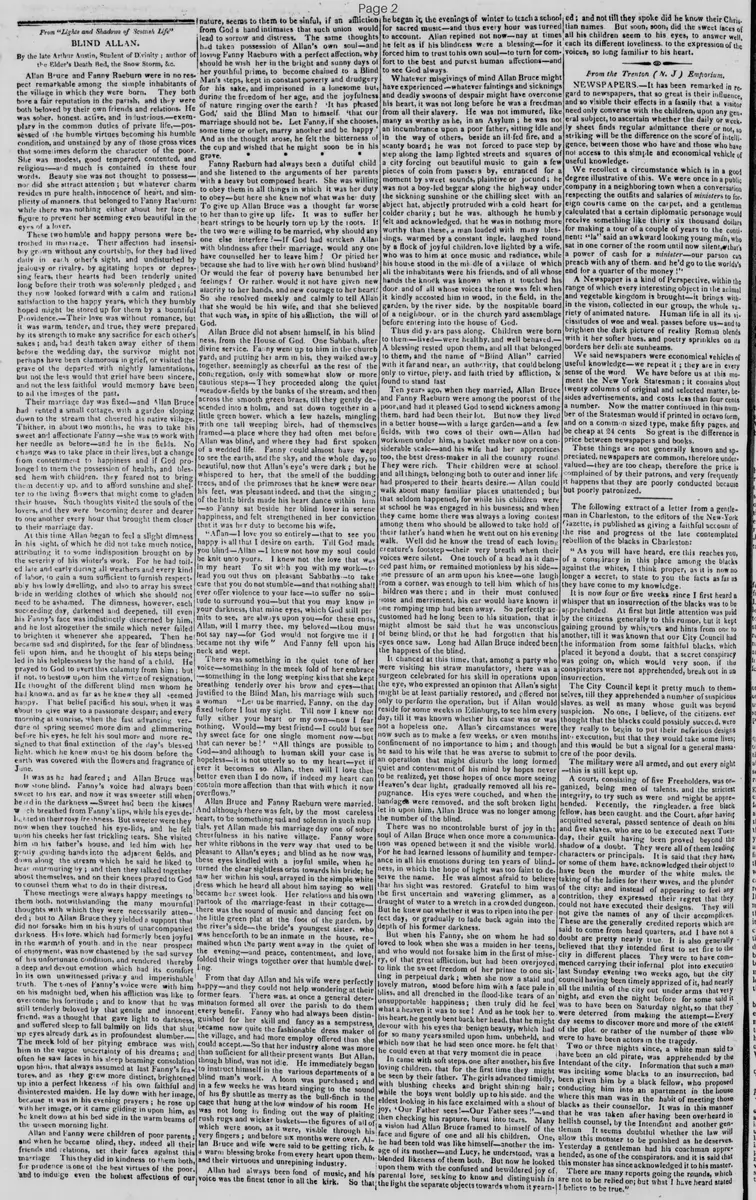
BLIND ALLAN.
By the late Arthur Austin, Student of Divinity; author of the Elder's Death Bed, the Snow Storm, &c.
Allan Bruce and Fanny Raeburn were in no respect remarkable among the simple inhabitants of the village in which they were born. They both bore a fair reputation in the parish, and they were both beloved by their own friends and relations. He was sober, honest, active, and industrious,—exemplary in the common duties of private life,—possessed of the humble virtues becoming his humble condition, and unstained by any of those gross vices that sometimes deform the character of the poor. She was modest, good tempered, contented, and religious—and much is contained in these four words. Beauty she was not thought to possess—nor did she attract attention; but whatever charm resides in pure health, innocence of heart, and simplicity of manners, that belonged to Fanny Raeburn: while there was nothing either about her face or figure to prevent her seeming even beautiful in the eyes of a lover.
These two humble and happy persons were betrothed in marriage. Their affection had insensibly grown without any courtship, for they had lived daily in each other's sight, and undisturbed by jealousy or rivalry, by agitating hopes or depressing fears, their hearts had been tenderly united long before their troth was solemnly pledged; and they now looked forward with a calm and rational satisfaction to the happy years, which they humbly hoped might be stored up for them by a bountiful Providence.—Their love was without romance, but it was warm, tender, and true, they were prepared by its strength to make any sacrifice for each other's sakes; and, had death taken away either of them before the wedding day, the survivor might not perhaps have been clamorous in grief, or visited the grave of the departed with nightly lamentations, but not the less would that grief have been sincere, and not the less faithful would memory have been to all the images of the past.
Their marriage day was fixed—and Allan Bruce had rented a small cottage, with a garden sloping down to the stream that cheered his native village. Thither, in about two months, he was to take his sweet and affectionate Fanny—she was to work with her needle as before—and he in the fields. No change was to take place in their lives, but a change from contentment to happiness and if God prolonged to them the possession of health, and blessed them with children, they feared not to bring them decently up, and to afford sunshine and shelter to the living flowers that might come to gladden their house. Such thoughts visited the souls of the lovers, and they were becoming dearer and dearer to one another every hour that brought them closer to their marriage day.
At this time Allan began to feel a slight dimness in his sight, of which he did not take much notice, attributing it to some indisposition brought on by the severity of his winter's work. For he had toiled late and early during all weathers and every kind of labor, to gain a sum sufficient to furnish respectably his lowly dwelling, and also to array his sweet bride in wedding clothes of which she should not need to be ashamed. The dimness, however, each succeeding day, darkened and deepened, till even his Fanny's face was indistinctly discerned by him, and he lost altogether the smile which never failed to brighten it whenever she appeared. Then he became sad and dispirited, for the fear of blindness fell upon him, and he thought of his steps being led in his helplessness by the hand of a child. He prayed to God to avert this calamity from him; but if not, to bestow upon him the virtue of resignation. He thought of the different blind men whom he had known, and as far as he knew they all seemed happy. That belief pacified his soul, when it was about to give way to a passionate despair; and every morning at sunrise, when the fast advancing verdure of spring seemed more dim and glimmering before his eyes, he felt his soul more and more resigned to that final extinction of the day's blessed light, which he knew must be his doom before the earth was covered with the flowers and fragrance of June.
It was as he had feared; and Allan Bruce was now stone blind. Fanny's voice had always been sweet to his ear, and now it was sweeter still when heard in the darkness—Sweet had been the kisses which breathed from Fanny's lips, while his eyes delighted in their rosy freshness. But sweeter were they now when they touched his eye-lids, and he felt upon his cheeks her fast trickling tears. She visited him in his father's house, and led him with her gently guiding hands into the adjacent fields, and down along the stream which he said he liked to hear murmuring by; and then they talked together about themselves, and on their knees prayed to God to counsel them what to do in their distress.
These meetings were always happy meetings to them both, notwithstanding the many mournful thoughts with which they were necessarily attended; but to Allan Bruce they yielded a support that did not forsake him in his hours of unaccompanied darkness. His love, which had formerly been joyful in the warmth of youth, and in the near prospect of enjoyment, was now chastened by the sad survey of his unfortunate condition, and rendered thereby a deep and devout emotion which had its comfort in its own unwitnessed privacy and imperishable truth. The tones of Fanny's voice were with him on his midnight bed, when his affliction was like to overcome his fortitude; and to know that he was still tenderly beloved by that gentle and innocent friend, was a thought that gave light to darkness, and suffered sleep to fall balmily on lids that shut up eyes already dark as in profoundest slumber.—The meek fold of her pitying embrace was with him in the vague uncertainty of his dreams; and often he saw faces in his sleep beaming consolation upon him, that always assumed at last Fanny's features, and as they grew more distinct, brightened up into a perfect likeness of his own faithful and disinterested maiden. He lay down with her image because it was in his evening prayers; he rose up with her image, or it came gliding in upon him, as he knelt down at his bed side in the warm beams of the unseen morning light.
Allan and Fanny were children of poor parents; and when he became blind, they, indeed all their friends and relations, set their faces against this marriage This they did in kindness to them both, for prudence is one of the best virtues of the poor. and to indulge even the holiest affections of our nature, seems to them to be sinful, if an affliction from God's hand intimates that such union would lead to sorrow and distress. The same thoughts had taken possession of Allan's own soul—and loving Fanny Raeburn with a perfect affection, why should he wish her in the bright and sunny days of her youthful prime, to become chained to a Blind Man's steps, kept in constant poverty and drudgery for his sake, and imprisoned in a lonesome hut, during the freedom of her age, and the joyfulness of nature ringing over the earth? 'It has pleased God,' said the Blind Man to himself, 'that our marriage should not be. Let Fanny, if she chooses, some time or other, marry another and be happy.' And as the thought arose, he felt the bitterness of the cup and wished that he might soon be in his grave.
Fanny Raeburn had always been a dutiful child and she listened to the arguments of her parents with a heavy but composed heart. She was willing to obey them in all things in which it was her duty to obey—but here she knew not what was her duty To give up Allan Bruce was a thought far worse to her than to give up life. It was to suffer her heart strings to be hourly torn up by the roots. If the two were willing to be married, why should any one else interfere?—If God had stricken Allan with blindness after their marriage, would any one have counselled her to leave him? Or pitied her because she had to live with her own blind husband Or would the fear of poverty have benumbed her feelings? Or rather, would it not have given new alacrity to her hands, and new courage to her heart? So she resolved meekly and calmly to tell Allan that she would be his wife, and that she believed that such was, in spite of his affliction, the will of God.
Allan Bruce did not absent himself, in his blindness, from the House of God. One Sabbath, after divine service, Fanny went up to him in the church yard, and putting her arm in his, they walked away together, seemingly as cheerful as the rest of the congregation, only with somewhat slow or more cautious steps—They proceeded along the quiet meadow-fields by the banks of the stream, and then across the smooth green braes, till they gently descended into a holm, and sat down together in a little green bower, which a few hazels, mingling with one tall weeping birch, had of themselves framed—a place where they had often met before Allan was blind, and where they had first spoken of a wedded life. Fanny could almost have wept to see the earth, and the sky, and the whole day, so beautiful, now that Allan's eyes were dark; but he whispered to her, that the smell of the budding trees, and of the primroses that he knew were near his feet, was pleasant indeed, and that the singing of the little birds made his heart dance within him—so Fanny sat beside her blind lover in serene happiness, and felt strengthened in her conviction that it was her duty to become his wife.
"Allan—I love you so entirely—that to see you happy is all that I desire on earth. Till God made you blind—Allan—I knew not how my soul could be knit unto yours. I knew not the love that was in my heart To sit with you with my work—to lead you out thus on pleasant Sabbaths—to take care that you do not stumble—and that nothing shall ever offer violence to your face—to suffer no solitude to surround you—but that you may know in your darkness, that mine eyes, which God still permits to see, are always upon you—for these ends, Allan, will I marry thee, my beloved—thou must not say nay—for God would not forgive me if I became not thy wife" And Fanny fell upon his neck and wept.
There was something in the quiet tone of her voice—something in the meek fold of her embrace—something in the long weeping kiss that she kept breathing tenderly over his brow and eyes—that justified to the Blind Man, his marriage with such a woman "Let us be married, Fanny, on the day fixed before I lost my sight. Till now I knew not fully either your heart or my own—now I fear nothing. Would—my best friend—I could but see thy sweet face for one single moment now—but that can never be!" "All things are possible to God—and although to human skill your case is hopeless—it is not utterly so to my heart—yet if ever it becomes so, Allan, then will I love thee better even than I do now, if indeed my heart can contain more affection than that with which it now overflows."
Allan Bruce and Fanny Raeburn were married. And although there was felt, by the most careless heart, to be something sad and solemn in such nuptials, yet Allan made his marriage day one of sober cheerfulness in his native village. Fanny wore her white ribbons in the very way that used to be pleasant to Allan's eyes; and blind as he now was, these eyes kindled with a joyful smile, when he turned the clear sightless orbs towards his bride; he saw her within his soul, arrayed in the simple white dress which he heard all about him saying so well became her sweet look. Her relations and his own partook of the marriage-feast in their cottage—there was the sound of music and dancing feet on the little green plat at the foot of the garden, by the river's side—the bride's youngest sister, who was henceforth to be an inmate in the house, remained when the party went away in the quiet of the evening—and peace, contentment, and love, folded their wings together over that humble dwelling.
From that day Allan and his wife were perfectly happy—and they could not help wondering at their former fears. There was, at once a general determination formed all over the parish to do them every benefit. Fanny who had always been distinguished for her skill and fancy as a sempstress became now quite the fashionable dress maker of the village, and had more employ offered than she could accept.—So that her industry alone was more than sufficient for all their present wants But Allan, though blind, was not idle. He immediately began to instruct himself in the various departments of a blind man's work. A loom was purchased; and in a few weeks he was heard singing to the sound of his busy shuttle as merry as the bull-finch in the cage that hung at the low window of his room He was not long in finding out the way of plaiting rush rugs and wicker baskets—the figures of all of which were soon, as it were, visible through his very fingers; and before six months were over, Allan Bruce and wife were said to be getting rich, & a warm blessing broke from every heart upon them, and their virtuous and unrepining industry.
Allan had always been fond of music, and his voice was the finest tenor in all the kirk. So that he began in the evenings of winter to teach a school for sacred music—and thus every hour was turned to account. Allan repined not now—nay at times he felt as if his blindness were a blessing—for it forced him to trust to his own soul—to turn for comfort to the best and purest human affections—and to see God always.
Whatever misgivings of mind Allan Bruce might have experienced—whatever faintings and sicknings and deadly swoons of despair might have overcome his heart, it was not long before he was a freedman from all their slavery. He was not immured, like many as worthy as he, in an Asylum; he was not an incumbrance upon a poor father, sitting idle and in the way of others, beside an ill-fed fire, and a scanty board: he was not forced to pace step by step along the lamp lighted streets and squares of a city forcing out beautiful music to gain a few pieces of coin from passers by, entranced for a moment by sweet sounds, plaintive or jocund; he was not a boy-led beggar along the highway under the sickening sunshine or the chilling sleet with an abject hat, abjectly protruded with a cold heart for colder charity; but he was, although he humbly felt and acknowledged, that he was in nothing more worthy than these, a man loaded with many blessings, warmed by a constant ingle, laughed round by a flock of joyful children, love lighted by a wife, who was to him at once music and radiance, while his house stood in the middle of a village of which all the inhabitants were his friends, and of all whose hands the knock was known when it touched his door. and of all whose voices the tone was felt when it kindly accosted him in wood, in the field, in the garden, by the river side, by the hospitable board of a neighbour, or in the church yard assemblage before entering into the house of God.
Thus did years pass along. Children were born to them—lived—were healthy, and well behaved.—A blessing rested upon them, and all that belonged to them, and the name of "Blind Allan" carried with it far and near, an authority, that could belong only to virtue, piety, and faith tried by affliction, & found to stand fast
Ten years ago, when they married, Allan Bruce and Fanny Raeburn were among the poorest of the poor, and had it pleased God to send sickness among them, hard had been their lot. But now they lived in a better house—with a large garden—and a few fields, with two cows of their own—Allan had workmen under him, a basket maker now on a considerable scale—and his wife had her apprentices too, the best dress-maker in all the country round. They were rich. Their children were at school and all things, belonging both to outer and inner life had prospered to their hearts desire.—Allan could walk about many familiar places unattended; but that seldom happened, for while his children were at school he was engaged in his business; and when they came home there was always a loving contest among them who should be allowed to take hold of their father's hand when he went out on his evening walk, Well did he know the tread of each loving creature's footstep—their very breath when their voices were silent. One touch of a head as it danced past him, or remained motionless by his side—one pressure of an arm upon his knee—one laugh from a corner, was enough to tell him which of his children was there: and in their most confused noise and merriment, his ear would have known if one romping imp had been away. So perfectly accustomed had he long been to his situation, that it might almost be said that he was unconscious of being blind, or that he had forgotten that his eyes once saw. Long had Allan Bruce indeed been the happiest of the blind.
It chanced at this time, that, among a party who were visiting his straw manufactory, there was a surgeon celebrated for his skill in operations upon the eye, who expressed an opinion that Allan's sight might be at least partially restored, and offered not only to perform the operation, but if Allan would reside for some weeks in Edinburgh, to see him every day, till it was known whether his case was or was not a hopeless one. Allan's circumstances were now such as to make a few weeks, or even months confinement of no importance to him; and though he said to his wife that he was averse to submit to an operation that might disturb the long formed quiet and contentment of his mind by hopes never to be realized, yet those hopes of once more seeing Heaven's dear light, gradually removed all his repugnance. His eyes were couched, and when the bandages were removed, and the soft broken light let in upon him, Allan Bruce was no longer among the number of the blind.
There was no uncontrollable burst of joy in the soul of Allan Bruce when once more a communication was opened between it and the visible world. For he had learned lessons of humility and temperance in all his emotions during ten years of blindness, in which the hope of light was too faint to deserve the name. He was almost afraid to believe that his sight was restored. Grateful to him was the first uncertain and wavering glimmer, as a draught of water to a wretch in a crowded dungeon. But he knew not whether it was to ripen into the perfect day, or gradually to fade back again into the depth of his former darkness.
But when his Fanny, she on whom he had so loved to look when she was a maiden in her teens, and who would not forsake him in the first misery of that great affliction, but had been overjoyed to link the sweet freedom of her prime to one sitting in perpetual dark; when she now a staid and lovely matron, stood before him with a face pale in bliss, and all drenched in the flood-like tears of an unsupportable happiness; then truly did he feel what a heaven it was to see! And as he took her to his heart, he gently bent back her head, that he might devour with his eyes that benign beauty, which had for so many years smiled upon him, unbeheld, and which now that he had seen once more, he felt that he could even at that very moment die in peace
In came with soft steps, one after another, his five loving children, that for the first time they might be seen by their father. The girls advanced timidly, with blushing cheeks and bright shining hair; while the boys went boldly up to his side. and the eldest looking in his face exclaimed with a shout of joy, 'Our Father sees!—Our Father sees!'—and then checking his rapture, burst into tears. Many a vision had Allan Bruce framed to himself of the face and figure of one and all his children. One, he had been told was like himself another the image of its mother—and Lucy, he understood, was a blended likeness of them both. But now he looked upon them with the confused and bewildered joy of parental love, seeking to know and distinguish in each its different loveliness. to the expression of the voices, so long familiar to his heart. But soon, soon, did the sweet faces of all his children seem to his eyes, to answer well.
BLIND ALLAN.
By the late Arthur Austin, Student of Divinity; author of the Elder's Death Bed, the Snow Storm, &c.
Allan Bruce and Fanny Raeburn were in no respect remarkable among the simple inhabitants of the village in which they were born. They both bore a fair reputation in the parish, and they were both beloved by their own friends and relations. He was sober, honest, active, and industrious,—exemplary in the common duties of private life,—possessed of the humble virtues becoming his humble condition, and unstained by any of those gross vices that sometimes deform the character of the poor. She was modest, good tempered, contented, and religious—and much is contained in these four words. Beauty she was not thought to possess—nor did she attract attention; but whatever charm resides in pure health, innocence of heart, and simplicity of manners, that belonged to Fanny Raeburn: while there was nothing either about her face or figure to prevent her seeming even beautiful in the eyes of a lover.
These two humble and happy persons were betrothed in marriage. Their affection had insensibly grown without any courtship, for they had lived daily in each other's sight, and undisturbed by jealousy or rivalry, by agitating hopes or depressing fears, their hearts had been tenderly united long before their troth was solemnly pledged; and they now looked forward with a calm and rational satisfaction to the happy years, which they humbly hoped might be stored up for them by a bountiful Providence.—Their love was without romance, but it was warm, tender, and true, they were prepared by its strength to make any sacrifice for each other's sakes; and, had death taken away either of them before the wedding day, the survivor might not perhaps have been clamorous in grief, or visited the grave of the departed with nightly lamentations, but not the less would that grief have been sincere, and not the less faithful would memory have been to all the images of the past.
Their marriage day was fixed—and Allan Bruce had rented a small cottage, with a garden sloping down to the stream that cheered his native village. Thither, in about two months, he was to take his sweet and affectionate Fanny—she was to work with her needle as before—and he in the fields. No change was to take place in their lives, but a change from contentment to happiness and if God prolonged to them the possession of health, and blessed them with children, they feared not to bring them decently up, and to afford sunshine and shelter to the living flowers that might come to gladden their house. Such thoughts visited the souls of the lovers, and they were becoming dearer and dearer to one another every hour that brought them closer to their marriage day.
At this time Allan began to feel a slight dimness in his sight, of which he did not take much notice, attributing it to some indisposition brought on by the severity of his winter's work. For he had toiled late and early during all weathers and every kind of labor, to gain a sum sufficient to furnish respectably his lowly dwelling, and also to array his sweet bride in wedding clothes of which she should not need to be ashamed. The dimness, however, each succeeding day, darkened and deepened, till even his Fanny's face was indistinctly discerned by him, and he lost altogether the smile which never failed to brighten it whenever she appeared. Then he became sad and dispirited, for the fear of blindness fell upon him, and he thought of his steps being led in his helplessness by the hand of a child. He prayed to God to avert this calamity from him; but if not, to bestow upon him the virtue of resignation. He thought of the different blind men whom he had known, and as far as he knew they all seemed happy. That belief pacified his soul, when it was about to give way to a passionate despair; and every morning at sunrise, when the fast advancing verdure of spring seemed more dim and glimmering before his eyes, he felt his soul more and more resigned to that final extinction of the day's blessed light, which he knew must be his doom before the earth was covered with the flowers and fragrance of June.
It was as he had feared; and Allan Bruce was now stone blind. Fanny's voice had always been sweet to his ear, and now it was sweeter still when heard in the darkness—Sweet had been the kisses which breathed from Fanny's lips, while his eyes delighted in their rosy freshness. But sweeter were they now when they touched his eye-lids, and he felt upon his cheeks her fast trickling tears. She visited him in his father's house, and led him with her gently guiding hands into the adjacent fields, and down along the stream which he said he liked to hear murmuring by; and then they talked together about themselves, and on their knees prayed to God to counsel them what to do in their distress.
These meetings were always happy meetings to them both, notwithstanding the many mournful thoughts with which they were necessarily attended; but to Allan Bruce they yielded a support that did not forsake him in his hours of unaccompanied darkness. His love, which had formerly been joyful in the warmth of youth, and in the near prospect of enjoyment, was now chastened by the sad survey of his unfortunate condition, and rendered thereby a deep and devout emotion which had its comfort in its own unwitnessed privacy and imperishable truth. The tones of Fanny's voice were with him on his midnight bed, when his affliction was like to overcome his fortitude; and to know that he was still tenderly beloved by that gentle and innocent friend, was a thought that gave light to darkness, and suffered sleep to fall balmily on lids that shut up eyes already dark as in profoundest slumber.—The meek fold of her pitying embrace was with him in the vague uncertainty of his dreams; and often he saw faces in his sleep beaming consolation upon him, that always assumed at last Fanny's features, and as they grew more distinct, brightened up into a perfect likeness of his own faithful and disinterested maiden. He lay down with her image because it was in his evening prayers; he rose up with her image, or it came gliding in upon him, as he knelt down at his bed side in the warm beams of the unseen morning light.
Allan and Fanny were children of poor parents; and when he became blind, they, indeed all their friends and relations, set their faces against this marriage This they did in kindness to them both, for prudence is one of the best virtues of the poor. and to indulge even the holiest affections of our nature, seems to them to be sinful, if an affliction from God's hand intimates that such union would lead to sorrow and distress. The same thoughts had taken possession of Allan's own soul—and loving Fanny Raeburn with a perfect affection, why should he wish her in the bright and sunny days of her youthful prime, to become chained to a Blind Man's steps, kept in constant poverty and drudgery for his sake, and imprisoned in a lonesome hut, during the freedom of her age, and the joyfulness of nature ringing over the earth? 'It has pleased God,' said the Blind Man to himself, 'that our marriage should not be. Let Fanny, if she chooses, some time or other, marry another and be happy.' And as the thought arose, he felt the bitterness of the cup and wished that he might soon be in his grave.
Fanny Raeburn had always been a dutiful child and she listened to the arguments of her parents with a heavy but composed heart. She was willing to obey them in all things in which it was her duty to obey—but here she knew not what was her duty To give up Allan Bruce was a thought far worse to her than to give up life. It was to suffer her heart strings to be hourly torn up by the roots. If the two were willing to be married, why should any one else interfere?—If God had stricken Allan with blindness after their marriage, would any one have counselled her to leave him? Or pitied her because she had to live with her own blind husband Or would the fear of poverty have benumbed her feelings? Or rather, would it not have given new alacrity to her hands, and new courage to her heart? So she resolved meekly and calmly to tell Allan that she would be his wife, and that she believed that such was, in spite of his affliction, the will of God.
Allan Bruce did not absent himself, in his blindness, from the House of God. One Sabbath, after divine service, Fanny went up to him in the church yard, and putting her arm in his, they walked away together, seemingly as cheerful as the rest of the congregation, only with somewhat slow or more cautious steps—They proceeded along the quiet meadow-fields by the banks of the stream, and then across the smooth green braes, till they gently descended into a holm, and sat down together in a little green bower, which a few hazels, mingling with one tall weeping birch, had of themselves framed—a place where they had often met before Allan was blind, and where they had first spoken of a wedded life. Fanny could almost have wept to see the earth, and the sky, and the whole day, so beautiful, now that Allan's eyes were dark; but he whispered to her, that the smell of the budding trees, and of the primroses that he knew were near his feet, was pleasant indeed, and that the singing of the little birds made his heart dance within him—so Fanny sat beside her blind lover in serene happiness, and felt strengthened in her conviction that it was her duty to become his wife.
"Allan—I love you so entirely—that to see you happy is all that I desire on earth. Till God made you blind—Allan—I knew not how my soul could be knit unto yours. I knew not the love that was in my heart To sit with you with my work—to lead you out thus on pleasant Sabbaths—to take care that you do not stumble—and that nothing shall ever offer violence to your face—to suffer no solitude to surround you—but that you may know in your darkness, that mine eyes, which God still permits to see, are always upon you—for these ends, Allan, will I marry thee, my beloved—thou must not say nay—for God would not forgive me if I became not thy wife" And Fanny fell upon his neck and wept.
There was something in the quiet tone of her voice—something in the meek fold of her embrace—something in the long weeping kiss that she kept breathing tenderly over his brow and eyes—that justified to the Blind Man, his marriage with such a woman "Let us be married, Fanny, on the day fixed before I lost my sight. Till now I knew not fully either your heart or my own—now I fear nothing. Would—my best friend—I could but see thy sweet face for one single moment now—but that can never be!" "All things are possible to God—and although to human skill your case is hopeless—it is not utterly so to my heart—yet if ever it becomes so, Allan, then will I love thee better even than I do now, if indeed my heart can contain more affection than that with which it now overflows."
Allan Bruce and Fanny Raeburn were married. And although there was felt, by the most careless heart, to be something sad and solemn in such nuptials, yet Allan made his marriage day one of sober cheerfulness in his native village. Fanny wore her white ribbons in the very way that used to be pleasant to Allan's eyes; and blind as he now was, these eyes kindled with a joyful smile, when he turned the clear sightless orbs towards his bride; he saw her within his soul, arrayed in the simple white dress which he heard all about him saying so well became her sweet look. Her relations and his own partook of the marriage-feast in their cottage—there was the sound of music and dancing feet on the little green plat at the foot of the garden, by the river's side—the bride's youngest sister, who was henceforth to be an inmate in the house, remained when the party went away in the quiet of the evening—and peace, contentment, and love, folded their wings together over that humble dwelling.
From that day Allan and his wife were perfectly happy—and they could not help wondering at their former fears. There was, at once a general determination formed all over the parish to do them every benefit. Fanny who had always been distinguished for her skill and fancy as a sempstress became now quite the fashionable dress maker of the village, and had more employ offered than she could accept.—So that her industry alone was more than sufficient for all their present wants But Allan, though blind, was not idle. He immediately began to instruct himself in the various departments of a blind man's work. A loom was purchased; and in a few weeks he was heard singing to the sound of his busy shuttle as merry as the bull-finch in the cage that hung at the low window of his room He was not long in finding out the way of plaiting rush rugs and wicker baskets—the figures of all of which were soon, as it were, visible through his very fingers; and before six months were over, Allan Bruce and wife were said to be getting rich, & a warm blessing broke from every heart upon them, and their virtuous and unrepining industry.
Allan had always been fond of music, and his voice was the finest tenor in all the kirk. So that he began in the evenings of winter to teach a school for sacred music—and thus every hour was turned to account. Allan repined not now—nay at times he felt as if his blindness were a blessing—for it forced him to trust to his own soul—to turn for comfort to the best and purest human affections—and to see God always.
Whatever misgivings of mind Allan Bruce might have experienced—whatever faintings and sicknings and deadly swoons of despair might have overcome his heart, it was not long before he was a freedman from all their slavery. He was not immured, like many as worthy as he, in an Asylum; he was not an incumbrance upon a poor father, sitting idle and in the way of others, beside an ill-fed fire, and a scanty board: he was not forced to pace step by step along the lamp lighted streets and squares of a city forcing out beautiful music to gain a few pieces of coin from passers by, entranced for a moment by sweet sounds, plaintive or jocund; he was not a boy-led beggar along the highway under the sickening sunshine or the chilling sleet with an abject hat, abjectly protruded with a cold heart for colder charity; but he was, although he humbly felt and acknowledged, that he was in nothing more worthy than these, a man loaded with many blessings, warmed by a constant ingle, laughed round by a flock of joyful children, love lighted by a wife, who was to him at once music and radiance, while his house stood in the middle of a village of which all the inhabitants were his friends, and of all whose hands the knock was known when it touched his door. and of all whose voices the tone was felt when it kindly accosted him in wood, in the field, in the garden, by the river side, by the hospitable board of a neighbour, or in the church yard assemblage before entering into the house of God.
Thus did years pass along. Children were born to them—lived—were healthy, and well behaved.—A blessing rested upon them, and all that belonged to them, and the name of "Blind Allan" carried with it far and near, an authority, that could belong only to virtue, piety, and faith tried by affliction, & found to stand fast
Ten years ago, when they married, Allan Bruce and Fanny Raeburn were among the poorest of the poor, and had it pleased God to send sickness among them, hard had been their lot. But now they lived in a better house—with a large garden—and a few fields, with two cows of their own—Allan had workmen under him, a basket maker now on a considerable scale—and his wife had her apprentices too, the best dress-maker in all the country round. They were rich. Their children were at school and all things, belonging both to outer and inner life had prospered to their hearts desire.—Allan could walk about many familiar places unattended; but that seldom happened, for while his children were at school he was engaged in his business; and when they came home there was always a loving contest among them who should be allowed to take hold of their father's hand when he went out on his evening walk, Well did he know the tread of each loving creature's footstep—their very breath when their voices were silent. One touch of a head as it danced past him, or remained motionless by his side—one pressure of an arm upon his knee—one laugh from a corner, was enough to tell him which of his children was there: and in their most confused noise and merriment, his ear would have known if one romping imp had been away. So perfectly accustomed had he long been to his situation, that it might almost be said that he was unconscious of being blind, or that he had forgotten that his eyes once saw. Long had Allan Bruce indeed been the happiest of the blind.
It chanced at this time, that, among a party who were visiting his straw manufactory, there was a surgeon celebrated for his skill in operations upon the eye, who expressed an opinion that Allan's sight might be at least partially restored, and offered not only to perform the operation, but if Allan would reside for some weeks in Edinburgh, to see him every day, till it was known whether his case was or was not a hopeless one. Allan's circumstances were now such as to make a few weeks, or even months confinement of no importance to him; and though he said to his wife that he was averse to submit to an operation that might disturb the long formed quiet and contentment of his mind by hopes never to be realized, yet those hopes of once more seeing Heaven's dear light, gradually removed all his repugnance. His eyes were couched, and when the bandages were removed, and the soft broken light let in upon him, Allan Bruce was no longer among the number of the blind.
There was no uncontrollable burst of joy in the soul of Allan Bruce when once more a communication was opened between it and the visible world. For he had learned lessons of humility and temperance in all his emotions during ten years of blindness, in which the hope of light was too faint to deserve the name. He was almost afraid to believe that his sight was restored. Grateful to him was the first uncertain and wavering glimmer, as a draught of water to a wretch in a crowded dungeon. But he knew not whether it was to ripen into the perfect day, or gradually to fade back again into the depth of his former darkness.
But when his Fanny, she on whom he had so loved to look when she was a maiden in her teens, and who would not forsake him in the first misery of that great affliction, but had been overjoyed to link the sweet freedom of her prime to one sitting in perpetual dark; when she now a staid and lovely matron, stood before him with a face pale in bliss, and all drenched in the flood-like tears of an unsupportable happiness; then truly did he feel what a heaven it was to see! And as he took her to his heart, he gently bent back her head, that he might devour with his eyes that benign beauty, which had for so many years smiled upon him, unbeheld, and which now that he had seen once more, he felt that he could even at that very moment die in peace
In came with soft steps, one after another, his five loving children, that for the first time they might be seen by their father. The girls advanced timidly, with blushing cheeks and bright shining hair; while the boys went boldly up to his side. and the eldest looking in his face exclaimed with a shout of joy, 'Our Father sees!—Our Father sees!'—and then checking his rapture, burst into tears. Many a vision had Allan Bruce framed to himself of the face and figure of one and all his children. One, he had been told was like himself another the image of its mother—and Lucy, he understood, was a blended likeness of them both. But now he looked upon them with the confused and bewildered joy of parental love, seeking to know and distinguish in each its different loveliness. to the expression of the voices, so long familiar to his heart. But soon, soon, did the sweet faces of all his children seem to his eyes, to answer well.
What sub-type of article is it?
Prose Fiction
What themes does it cover?
Love Romance
Moral Virtue
Religious
What keywords are associated?
Blindness
Marriage
Scottish Village
Resilience
Family Love
Restored Sight
Moral Tale
What entities or persons were involved?
By The Late Arthur Austin, Student Of Divinity; Author Of The Elder's Death Bed, The Snow Storm, &C.
Literary Details
Title
Blind Allan.
Author
By The Late Arthur Austin, Student Of Divinity; Author Of The Elder's Death Bed, The Snow Storm, &C.
Key Lines
"Allan—I Love You So Entirely—That To See You Happy Is All That I Desire On Earth. Till God Made You Blind—Allan—I Knew Not How My Soul Could Be Knit Unto Yours."
"Let Us Be Married, Fanny, On The Day Fixed Before I Lost My Sight. Till Now I Knew Not Fully Either Your Heart Or My Own—Now I Fear Nothing."
And As He Took Her To His Heart, He Gently Bent Back Her Head, That He Might Devour With His Eyes That Benign Beauty, Which Had For So Many Years Smiled Upon Him, Unbeheld, And Which Now That He Had Seen Once More, He Felt That He Could Even At That Very Moment Die In Peace.
The Eldest Looking In His Face Exclaimed With A Shout Of Joy, 'Our Father Sees!—Our Father Sees!'—And Then Checking His Rapture, Burst Into Tears.