Thank you for visiting SNEWPapers!
Sign up free
Atlanta Daily World
Atlanta, Fulton County, Georgia
What is this article about?
New York State Commission Against Discrimination's 1951 annual report to Gov. Dewey and legislature highlights progress in combating employment bias, educational efforts, and public support, while stressing need for ongoing vigilance.
Clipping
OCR Quality
Full Text
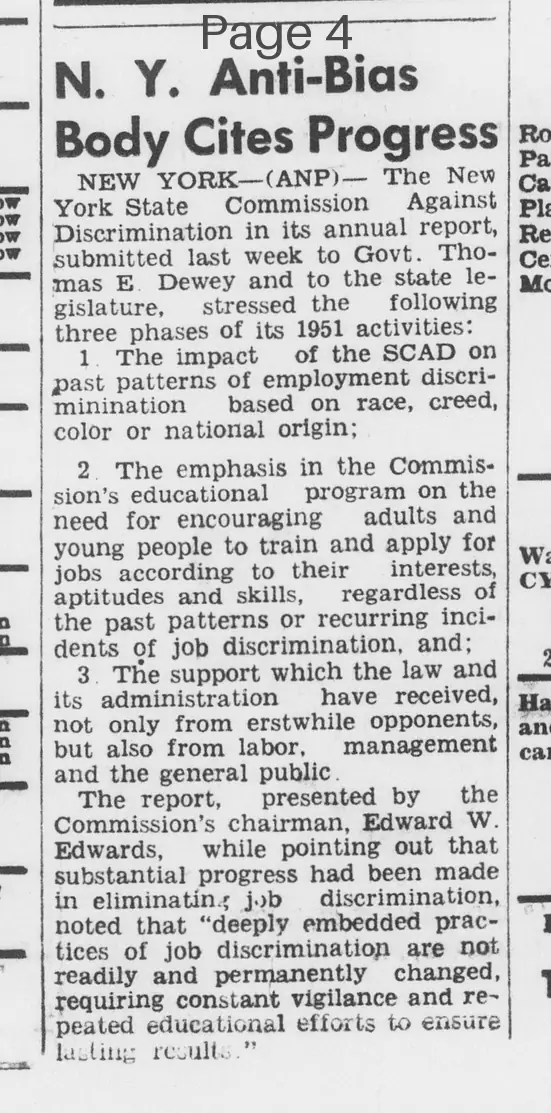
NEW YORK-(ANP)- The New York State Commission Against Discrimination in its annual report, submitted last week to Gov. Thomas E. Dewey and to the state legislature, stressed the following three phases of its 1951 activities:
1 The impact of the SCAD on past patterns of employment discrimination based on race, creed, color or national origin;
2 The emphasis in the Commission's educational program on the need for encouraging adults and young people to train and apply for jobs according to their interests, aptitudes and skills, regardless of the past patterns or recurring incidents of job discrimination. and:
3 The support which the law and its administration have received, not only from erstwhile opponents, but also from labor, management and the general public.
The report, presented by the Commission's chairman, Edward W. Edwards, while pointing out that substantial progress had been made in eliminating job discrimination, noted that "deeply embedded practices of job discrimination are not readily and permanently changed, requiring constant vigilance and repeated educational efforts to ensure lasting results".
What sub-type of article is it?
What keywords are associated?
What entities or persons were involved?
Where did it happen?
Domestic News Details
Primary Location
New York
Event Date
1951
Key Persons
Outcome
substantial progress had been made in eliminating job discrimination
Event Details
The New York State Commission Against Discrimination submitted its annual report for 1951 to Gov. Thomas E. Dewey and the state legislature, stressing three phases of activities: impact on employment discrimination patterns; emphasis in educational program on job training regardless of discrimination; support from law, labor, management, and public. The report noted that deeply embedded practices require constant vigilance and educational efforts.