Thank you for visiting SNEWPapers!
Sign up free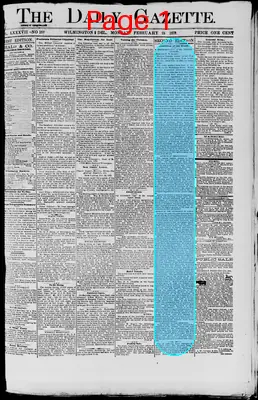
The Daily Gazette
Wilmington, New Castle County, Delaware
What is this article about?
Blanton Duncan's 1879 letter from Louisville, KY, describes dire economic conditions in the post-Civil War South, including impoverished laborers, negative impacts of emancipation on freedmen, shifts in land ownership to merchants, and the creation of a tenant system akin to Ireland's.
Clipping

OCR Quality
Full Text
Condition of the South.
A Southerner's View of the Industrial Situation.
From the N. Y. Herald.
Blanton Duncan writes to the New York Herald a long letter, from Louisville, Ky., dated Feb. 13, 1879, in which he says:
For some weeks I have been in the South, on the Mississippi River. While the cry in political circles and among the wealthy in cities has been that prosperity is coming with accelerated pace from financial legislation I wish that some of the magnates could have been with me to have seen the condition of affairs in the great Mississippi Valley. There I have found among the laboring classes almost a set of paupers. They were in rags; and when the bitter cold weather came on they stayed housed for days, shivering over their fires, which luckily they could procure from the plenteous supplies of fuel near at hand in the woods. From my observation three-fourths of these laborers did not have a month's supply of provisions nor means to procure them with. There was not one in ten who had the stock, wagons, ploughs, &c., with which to cultivate any land that they could rent. And how this class of people were to get through the coming year seemed to me a problem difficult of solution. They were disheartened, demoralized and destitute. Year after year they had labored steadily making often fair crops, and yet at the end of each successive year they found themselves poorer and poorer, until now the final culmination comes in positive impoverishment. They are not educated; they do not bear discussion of political questions, which could enlighten them and teach that all this is the natural sequence of financial blunders, and that the shrinkage of values year after year has placed the cost of production at higher than the market value of products especially in view of the system of supply to laborers which has prevailed for the past ten years throughout many sections of the South.
EFFECTS OF EMANCIPATION.
The radical leaders profess to have given the negro slave the great boon of liberty. On the contrary they have placed him in a bondage more deplorable than he was in prior to the war. "Candid and impartial observation will demonstrate this to any fair minded man. And in addition to this terrible bondage which degrades and will destroy the negro race it is fast producing results which must entail evil consequences in the near future. There is being created a land ownership and a tenantry like that of Ireland, where absenteeism of the owner, the power of the agent and the poverty of the people have produced such disaster to the material interests of that country, and has paralyzed the cause of education, religion and morals by the inevitable degradation of the poorer classes. And in the South it must be remembered that the laboring classes have been slaves, without education and without the means of elevating their mental or moral faculties, and thus even far behind the poor Irishmen, whose sufferings have been increased because they had the intellect for higher grades in life than circumstances have permitted.
CHANGE IN THE OWNERSHIP OF LANDS
During the past six years there has been great change in ownership of lands South. Those who directly after the war attempted to cultivate cotton had been deprived of their slaves and other resources, and in many instances had mortgages standing against them for prior debts. Many of the land owners were the children of planters, reared in luxury and leisure, not understanding how to manage and not inured to labor. What has been the consequence? There was often no forethought, no calculation, not even energy. As the fathers used to rely upon the commission merchant, borrow money at ruinous rates of fifteen or twenty per cent, and still succeed by the richness of their lands, the abundance of crops and good prices, when the labor cost them only food, clothing and care, so the sons believed that the same system would prevail when free labor had come in. They did not examine the subject to see what the laws of supply and demand inexorably demand, nor the statistics of agriculture, which show that the best cultivation only produces four to five per cent. interest per annum. Thus year after year the land owners of the South increased their mortgage debt, their own personal expenses and the deficit for interest above the proceeds of crops; and the result came-as must have been from the start only a question of time-when ten to fifteen per cent. of capital is exhausted each year. The merchants have foreclosed and taken the property at the amount of the debt, because there was nobody else to bid for land; nobody with money to buy it. And to such an extent has this gone on that one commission merchant in New Orleans has absorbed and is cultivating through agents 60,000 acres of the best land in Mississippi. While the practical question in the North has been openly avowed by influential journals to be the purchase of lands by the rich and the formation of a system, which must make a class distinction of aristocrats and serfs, it is fast being carried into effect in the South under the irresistible law of usurious interest and the sacrifice of the debtor land owner. And what becomes of the ruined land owners? There is no field open for them to regain independence or earn a livelihood in the South, and yearly there must be thousands added to the ranks of those who will attempt to drown sorrow and misfortune in drunkenness, and who eke out a miserable existence until death relieves them from further worldly trouble.
CONDITION OF THE FREEDMAN.
Now, on the other hand, what is the condition of the former slave-the serf ready made for the domination of the aristocratic and money possessing land owners. He had good clothes, was well fed and housed, and well cared for as a slave, with good medical attendance when sick, and treated properly when old age and infirmity rendered him valueless.
Out of suffering have emerged the strongest souls, and the most massive characters are seamed with scars. This reads nicely, but any one suffering with rheumatism or neuralgia would do much better by using Keller's Roman Liniment. Price 50 cents.
What sub-type of article is it?
What themes does it cover?
What keywords are associated?
What entities or persons were involved?
Where did it happen?
Story Details
Key Persons
Location
South, Mississippi Valley, Louisville, Ky., New Orleans, Mississippi
Event Date
Feb. 13, 1879
Story Details
Blanton Duncan observes widespread poverty among Southern laborers, critiques emancipation as worsening conditions for freedmen compared to slavery, describes land ownership shifting to merchants via foreclosures, creating a tenant system like Ireland's, and notes ruined planters turning to despair.