Thank you for visiting SNEWPapers!
Sign up free
Story
November 7, 1950
Madison County Democrat
London, Madison County, Ohio
What is this article about?
Ohio fertilizer use reached record 891,609 tons in 1949, 2.5 times 1939 levels, boosting yields; US total hit 16.5 million tons, attributed to profitability and reasonable prices.
Clipping
OCR Quality
95%
Excellent
Full Text
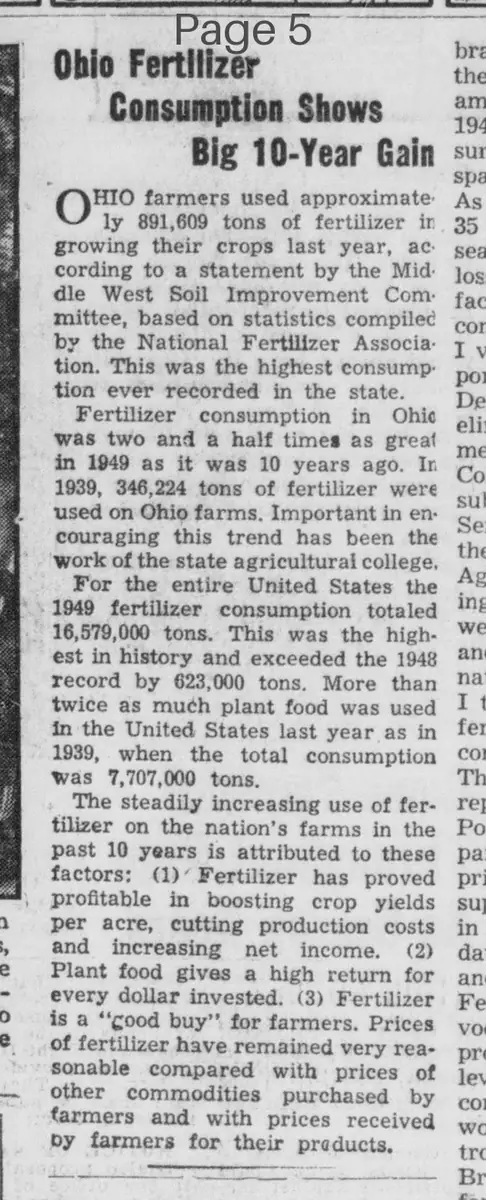
Ohio Fertilizer Consumption Shows Big 10-Year Gain
OHIO farmers used approximately 891,609 tons of fertilizer in growing their crops last year, according to a statement by the Middle West Soil Improvement Committee, based on statistics compiled by the National Fertilizer Association. This was the highest consumption ever recorded in the state.
Fertilizer consumption in Ohio was two and a half times as great in 1949 as it was 10 years ago. In 1939, 346,224 tons of fertilizer were used on Ohio farms. Important in encouraging this trend has been the work of the state agricultural college.
For the entire United States the 1949 fertilizer consumption totaled 16,579,000 tons. This was the highest in history and exceeded the 1948 record by 623,000 tons. More than twice as much plant food was used in the United States last year as in 1939, when the total consumption was 7,707,000 tons.
The steadily increasing use of fertilizer on the nation's farms in the past 10 years is attributed to these factors: (1) Fertilizer has proved profitable in boosting crop yields per acre, cutting production costs and increasing net income. (2) Plant food gives a high return for every dollar invested. (3) Fertilizer is a "good buy" for farmers. Prices of fertilizer have remained very reasonable compared with prices of other commodities purchased by farmers and with prices received by farmers for their products.
OHIO farmers used approximately 891,609 tons of fertilizer in growing their crops last year, according to a statement by the Middle West Soil Improvement Committee, based on statistics compiled by the National Fertilizer Association. This was the highest consumption ever recorded in the state.
Fertilizer consumption in Ohio was two and a half times as great in 1949 as it was 10 years ago. In 1939, 346,224 tons of fertilizer were used on Ohio farms. Important in encouraging this trend has been the work of the state agricultural college.
For the entire United States the 1949 fertilizer consumption totaled 16,579,000 tons. This was the highest in history and exceeded the 1948 record by 623,000 tons. More than twice as much plant food was used in the United States last year as in 1939, when the total consumption was 7,707,000 tons.
The steadily increasing use of fertilizer on the nation's farms in the past 10 years is attributed to these factors: (1) Fertilizer has proved profitable in boosting crop yields per acre, cutting production costs and increasing net income. (2) Plant food gives a high return for every dollar invested. (3) Fertilizer is a "good buy" for farmers. Prices of fertilizer have remained very reasonable compared with prices of other commodities purchased by farmers and with prices received by farmers for their products.
What sub-type of article is it?
Historical Event
What themes does it cover?
Triumph
What keywords are associated?
Fertilizer Consumption
Ohio Farms
Crop Yields
Agricultural Increase
Where did it happen?
Ohio, United States
Story Details
Location
Ohio, United States
Event Date
1949
Story Details
Ohio farmers used 891,609 tons of fertilizer in 1949, highest ever and 2.5 times more than 346,224 tons in 1939, encouraged by state agricultural college. US total 16,579,000 tons in 1949, up from 7,707,000 in 1939. Increase due to profitability, high returns, and reasonable prices.