Thank you for visiting SNEWPapers!
Sign up free
Gazette Of The United States
New York, New York County, New York
What is this article about?
In the U.S. House of Representatives in Philadelphia on March 8, debate ensued on a resolution directing the Secretary of the Treasury to report on raising additional public supplies. Mr. Steele and Mr. Murray supported it, citing precedent and benefits of expert input, while Mr. Findley opposed, arguing it undermines legislative independence and the House's constitutional role in originating revenue bills.
Clipping
OCR Quality
Full Text
PHILADELPHIA.
HOUSE OF REPRESENTATIVES,
THURSDAY, MARCH 8.
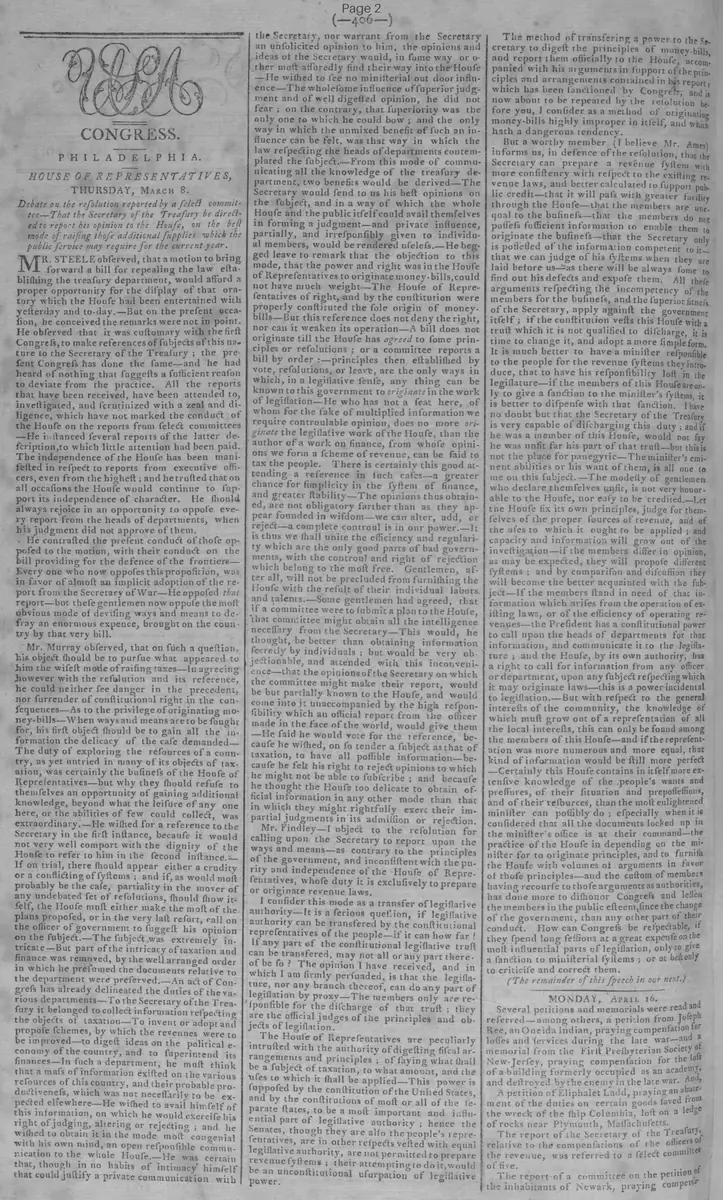
Debate on the resolution reported by a select committee—That the Secretary of the Treasury be directed to report his opinion to the House, on the best mode of raising those additional supplies which the public service may require for the current year.
MR. STEELE observed, that a motion to bring in a bill establishing the treasury department, would afford a proper opportunity for the display of that oratory which the House had been entertained with yesterday and to-day.—But on the present occasion, he conceived the remarks were not in point. He observed that it was customary with the first Congress, to make references of subjects of this nature to the Secretary of the Treasury; the present Congress has done the same—and he had heard of nothing that suggests a sufficient reason to deviate from the practice. All the reports that have been received, have been attended to, investigated, and scrutinized with a zeal and diligence, which have not marked the conduct of the House on the reports from select committees—He instanced several reports of the latter description, to which little attention had been paid. The independence of the House has been manifested in respect to reports from executive officers, even from the highest; and he trusted that on all occasions the House would continue to support its independence of character. He should always rejoice in an opportunity to oppose every report from the heads of departments, when his judgment did not approve of them. He contrasted the present conduct of those opposed to the motion, with their conduct on the bill providing for the defence of the frontiers—Every one who now opposes this proposition, was in favor of almost an implicit adoption of the report from the Secretary of War. He opposed that report—but these gentlemen now oppose the most obvious mode of devising ways and means to defray an enormous expense, brought on the country by that very bill.
Mr. Murray observed, that on such a question, his object should be to pursue what appeared to him the wisest mode of raising taxes—In agreeing however with the resolution and its reference, he could neither see danger in the precedent, nor surrender of constitutional right in the consequences—As to the privilege of originating money-bills—When ways and means are to be sought for, his first object should be to gain all the information the delicacy of the case demanded—The duty of exploring the resources of a country, as yet untried in many of its objects of taxation, was certainly the business of the House of Representatives—but why they should refuse to themselves an opportunity of gaining additional knowledge, beyond what the leisure of any one here, or the abilities of few could collect, was extraordinary.—He wished for a reference to the Secretary in the first instance, because it would not very well comport with the dignity of the House to refer to him in the second instance.—If on trial, there should appear either a crudity or a conflicting of systems; and if, as would most probably be the case, partiality in the mover of any undebated set of resolutions, should show itself, the House must either make the most of the plans proposed, or in the very last resort, call on the officer of government to suggest his opinion on the subject.—The subject was extremely intricate—But part of the intricacy of taxation and finance was removed, by the well arranged order in which he supposed the documents relative to the department were preserved.—An act of Congress has already delineated the duties of the various departments—To the Secretary of the Treasury it belonged to collect information respecting the objects of taxation—To invent or adopt and propose schemes, by which the revenues were to be improved—to digest ideas on the political economy of the country, and to superintend its finances—In such a department, he must think that a mass of information existed on the various resources of this country, and their probable productiveness, which was not necessarily to be expected elsewhere—He wished to avail himself of this information, on which he would exercise his right of judging, altering or rejecting; and he wished to obtain it in the mode most congenial with his own mind, an open responsible communication to the whole House. He was certain that, though in no habits of intimacy himself that could justify a private communication with the Secretary, nor warrant from the Secretary an unsolicited opinion to him, the opinions and ideas of the Secretary would, in some way or other most assuredly find their way into the House—He wished to see no ministerial out door influence—The wholesome influence of superior judgment and of well digested opinion, he did not fear; on the contrary, that superiority was the only one to which he could bow; and the only way in which the unmixed benefit of such an influence can be felt, was that way in which the law respecting the heads of departments contemplated the subject.—From this mode of communicating all the knowledge of the treasury department, two benefits would be derived The Secretary would send to us his best opinions on the subject, and in a way of which the whole House and the public itself could avail themselves in forming a judgment—and private influence, partially, and irresponsibly given to individual members, would be rendered useless. He begged leave to remark that the objection to this mode, that the power and right was in the House of Representatives to originate money-bills, could not have such weight. The House of Representatives of right, and by the constitution were properly constituted the sole origin of money bills—But this reference does not deny the right, nor can it weaken its operation—A bill does not originate till the House has agreed to some principles or resolutions; or a committee reports a bill by order: principles then established by vote, resolutions, or leave, are the only ways in which, in a legislative sense, any thing can be known to this government to originate in the work of legislation—He who has not a seat here, of whom for the sake of multiplied information we require controllable opinion, does no more originate the legislative work of the House, than the author of a work on finance, from whose opinions we form a scheme of revenue, can be said to tax the people, There is certainly this good attending a reference in such cases—a greater chance for simplicity in the system of finance, and greater stability—The opinions thus obtained, are not obligatory farther than as they appear founded in wisdom—we can alter, add, or reject—a complete controul is in our power.—It is thus we shall unite the efficiency and regularity which are the only good parts of bad governments, with the controul and right of rejection which belong to the most free. Gentlemen, after all, will not be precluded from furnishing the House with the result of their individual labors and talents.—Some gentlemen had agreed, that if a committee were to submit a plan to the House, that committee might obtain all the intelligence necessary from the Secretary—This would, he thought, be better than obtaining information secretly by individuals; but would be very objectionable, and attended with this inconvenience—that the opinions of the Secretary on which the committee might make their report, would be but partially known to the House, and would come into it unaccompanied by the high responsibility which an official report from the officer made in the face of the world, would give them—He said he would vote for the reference, because he wished, on so tender a subject as that of taxation, to have all possible information—because he felt his right to reject opinions to which he might not be able to subscribe; and because he thought the House too delicate to obtain official information in any other mode than that in which they might rightfully exert their impartial judgments in its admission or rejection.
Mr. Findley—I object to the resolution for calling upon the Secretary to report upon the ways and means—as contrary to the principles of the government, and inconsistent with the purity and independence of the House of Representatives, whose duty it is exclusively to prepare or originate revenue laws. I consider this mode as a transfer of legislative authority—It is a serious question, if legislative authority can be transferred by the constitutional representatives of the people—if it can how far? If any part of the constitutional legislative trust can be transferred, may not all or any part thereof be so? The opinion I have received, and in which I am firmly persuaded, is that the legislature, nor any branch thereof, can do any part of legislation by proxy—The members only are responsible for the discharge of that trust; they are the official judges of the principles and objects of legislation. The House of Representatives are peculiarly intrusted with the authority of digesting fiscal arrangements and principles; of saying what shall be a subject of taxation, to what amount, and the uses to which it shall be applied. This power is supposed by the constitution of the United States, and by the constitutions of most or all of the separate states, to be a most important and influential part of legislative authority; hence the Senates, though they are also the people's representatives, are in other respects vested with equal legislative authority, are not permitted to prepare revenue systems; their attempting to do it, would be an unconstitutional usurpation of legislative power.
The method of transferring a power to the Secretary to digest the principles of money-bills, and report them officially to the House, accompanied with his arguments in support of the principles and arrangements contained in his report; which has been sanctioned by Congress, and is now about to be repeated by the resolution before you, I consider as a method of originating money-bills highly improper in itself, and which hath a dangerous tendency. But a worthy member (I believe Mr. Ames) informs us, in defence of the resolution, that the Secretary can prepare a revenue system with more consistency with respect to the existing revenue laws, and better calculated to support public credit—that it will pass with greater facility through the House—that the members are unequal to the business—that the members do not possess sufficient information to enable them to originate the business—that the Secretary only is possessed of the information competent to it—that we can judge of his systems when they are laid before us=as there will be always Some to find out his defects and expose them. All these arguments respecting the incompetency of the members for the business, and the superior fitness of the Secretary, apply against the government itself; if the constitution vests this House with a trust which it is not qualified to discharge, it is time to change it, and adopt a more simple form. It is much better to have a minister responsible to the people for the revenue systems they introduce, that to have his responsibility lost in the legislature—if the members of this House are only to give a sanction to the minister's systems, it is better to dispense with that sanction. I have no doubt but that the Secretary of the Treasury is very capable of discharging this duty; and if he was a member of this House, would not say he was unfit for his part of that trust—but this is not the place for panegyric—The minister's eminent abilities or his want of them, is all one to me on this subject.—The modesty of gentlemen who declare themselves unfit, is not very honorable to the House, nor easy to be credited.—Let the House fix its own principles, judge for themselves of the proper sources of revenue, and of the uses to which it ought to be applied; and capacity and information will grow out of the investigation—if the members differ in opinion, as may be expected, they will propose different systems; and by comparison and discussion they will become the better acquainted with the subject—If the members stand in need of that information which arises from the operation of existing laws, or of the efficiency of operating revenues—the President has a constitutional power to call upon the heads of departments for that information, and communicate it to the legislature; and the House, by its own authority, has a right to call for information from any officer or department, upon any subject respecting which it may originate laws—this is a power incidental to legislation.—But with respect to the general interests of the community, the knowledge of which must grow out of a representation of all the local interests, this can only be found among the members of this House—and if the representation was more numerous and more equal, that kind of information would be still more perfect—Certainly this House contains in itself more extensive knowledge of the people's wants and pressures, of their situation and dispositions, and of their resources, than the most enlightened minister can possibly do; especially when it is considered that all the documents locked up in the minister's office is at their command—the practice of the House in depending on the minister for to originate principles, and to furnish the House with volumes of arguments in favor of those principles—and the custom of members having recourse to those arguments as authorities, has done more to dishonor Congress and lessen the members in the public esteem, since the change of the government, than any other part of their conduct. How can Congress be respectable, if they spend long sessions at a great expense on the most influential parts of legislation, only to give a sanction to ministerial systems; or at best only to criticize and correct them.
(The remainder of this speech in our next.)
What sub-type of article is it?
What themes does it cover?
What keywords are associated?
What entities or persons were involved?
Where did it happen?
Story Details
Key Persons
Location
Philadelphia
Event Date
Thursday, March 8
Story Details
Debate in the House on a resolution to direct the Secretary of the Treasury to report on the best mode of raising additional supplies. Mr. Steele defends the practice of referencing the Secretary, contrasting it with prior actions. Mr. Murray supports the reference for gaining expert information without surrendering legislative rights. Mr. Findley opposes it as a transfer of legislative authority, emphasizing the House's exclusive role in originating revenue laws.