Thank you for visiting SNEWPapers!
Sign up free
Norfolk Gazette And Publick Ledger
Norfolk, Virginia
What is this article about?
In the House of Lords on May 8, debate on a bill allowing colonial governors discretionary trade with North America for West Indies supplies. Lord Sheffield sought postponement for petitioners; opponents stressed navigation laws' importance, while supporters argued necessity due to shortages. Bill passed second reading without division.
Merged-components note: Continuation of the same parliamentary debate article across pages, based on text flow and sequential reading order.
Clippings
1 of 2
OCR Quality
Full Text
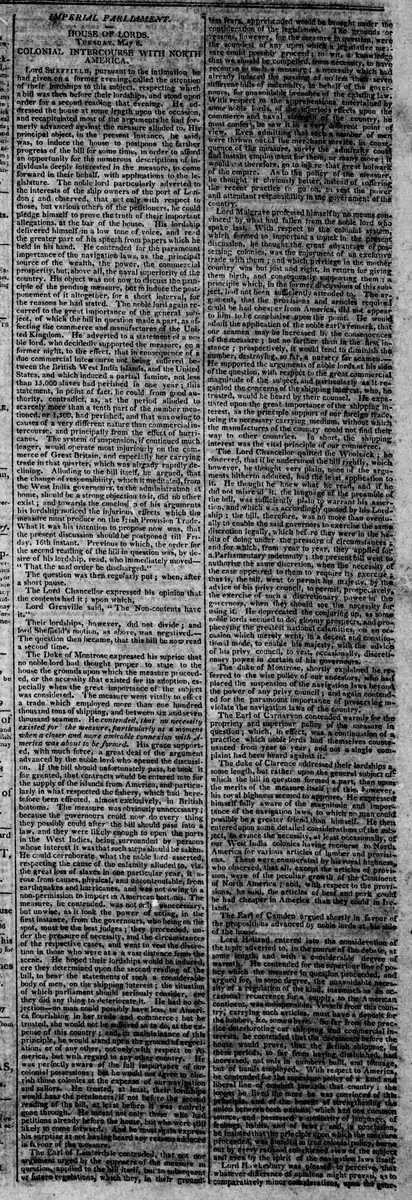
HOUSE OF LORDS.
Tuesday, May 8.
COLONIAL INTERCOURSE WITH NORTH AMERICA.
Lord Sheffield, pursuant to the intimation he had given on a former evening called the attention of their lordships to this subject, respecting which a bill was then before their lordships, and stood upon order for a second reading that evening. He addressed the house at some length upon the occasion, and recapitulated most of the arguments he had formerly advanced against the measure alluded to. His principal object, in the present instance, he said, was, to induce the house to postpone the farther progress of the bill for some time, in order to afford an opportunity for the numerous descriptions of individuals deeply interested in the measure, to come forward in their behalf, with applications to the legislature. The noble lord particularly adverted to the interests of the ship owners of the port of London; and observed, that not only with respect to those, but various others of the petitioners, he could pledge himself to prove the truth of their important allegations, at the bar of the house. His lordship delivered himself in a low tone of voice, and read the greater part of his speech from papers which he held in his hand: He contended for the paramount importance of the navigation laws, as the principal source of the wealth, the power, the commercial prosperity, but, above all, the naval superiority of the country. His object was not now to discuss the principle of the pending measure, but to induce the postponement of it altogether, or a short interval, for the reasons he had stated. The noble lord again recurred to the great importance of the general subject, of which the bill in question made a part, as affecting the commerce and manufactures of the United Kingdom. He adverted to a statement of a noble lord, who decidedly supported the measure, on a former night, to the effect, that in consequence of a due commercial intercourse not being suffered between the British West India islands, and the United States, and which induced a partial famine, not less than 15,000 slaves had perished in one year; this statement, in point of fact, he could from good authority, contradict, as, at the period alluded to scarcely more than a tenth part of the number mentioned, or 1500, had perished, and that was owing to causes of a very different nature than commercial intercourse, and principally from the effect of hurricanes. The system of suspension, if continued much longer, would operate most injuriously on the commerce of Great Britain, and especially her carrying trade in that quarter, which was already rapidly declining. Alluding to the bill itself, he argued, that the change of responsibility, which it meditated, from the West India governors, to the administration at home, should be a strong objection to it, did no other exist; and towards the conclusion of his arguments his lordship noticed the injurious effects which the measure must produce on the Irish Provision Trade. What it was his intention to propose now was, that the present discussion should be postponed till Friday, 13th instant. Previous to which, the order for the second reading of the bill in question was, by desire of his lordship, read, who immediately moved--"That the said order be discharged."
The question was then regularly put; when, after a short pause.
The Lord Chancellor expressed his opinion that the contents had it; upon which,
Lord Grenville said, "The Non-contents have it."
Their lordships, however, did not divide: and Lord Sheffield's motion, as above, was negatived.--The question then became, that this bill be now read a second time.
The Duke of Montrose expressed his surprise that no noble lord had thought proper to state to the house the grounds upon which the measure proceeded, or the necessity that existed for its adoption, especially when the great importance of the subject was considered. The measure went vitally to effect a trade which employed more than one hundred thousand tons of shipping, and between six and seven thousand seamen. He contended, that no necessity existed for the measure, particularly at a moment when a closer and more amicable connexion with America was about to be formed. His grace supported, with much force, a great deal of the argument advanced by the noble lord who opened the discussion. If the bill should unfortunately pass, he took it for granted, that contracts would be entered into for the supply of the islands from America, and particularly in what respected the fishery, which had heretofore been effected, almost exclusively, in British bottoms. The measure was obviously unnecessary; because the governors could now do every thing they possibly could after the bill should pass into a law, and they were likely enough to open the ports in the West Indies, being surrounded by persons whose interest it was that such steps should be taken. He could corroborate what the noble lord asserted, respecting the cause of the calamity alluded to, viz. the great loss of slaves in one particular year, it arose from causes, physical, and uncontroulable, from earthquakes and hurricanes, and was not owing to a non-permission to import in American bottoms. The measure, he contended, was not only unnecessary, but unwise, as it took the power of acting, in the first instance, from the governors, who being on the spot, must be the best judges; they proceeded, under the pressure of necessity, and the circumstances of the respective cases, and went to vest the discretion in those who were at a vast distance from the scene. He hoped their lordships would be induced, before they determined upon the second reading of the bill, to hear the statements of such a considerable body of men, on the shipping interest; the situation of which parliament should seriously consider, before they did any thing to deteriorate it. He had no objection no man could possibly have less, to America flourishing in her trade and commerce; but he trusted, she would not be suffered so to do, at the expense of this country; and in maintenance of this principle, he would stand upon the ground of navigation, or of any other, not only with respect to America, but with regard to any other country. He was perfectly aware of the full importance of our colonial possessions; but he would not agree to cherish those colonies at the expense of our navigation and sailors. He trusted, at least, their lordships would hear the petitioners, if not before the second reading of the bill, at least before it was entirely gone through. He meant not only those who had petitions already before the house but who were still likely to come forward. And he must again express his surprise at not having heard any reasons adduced in favour of the measure itself.
The Earl of Lauderdale contended, that not one argument urged by the opposers of the measure in question, applied to the bill itself, but to subsequent or future regulations; which they, in their groundless fears apprehended would be brought under the consideration of the legislature. The grounds or reasons, however, for the measure in question, were the soundest of any upon which a legislative measure could possibly proceed; to wit, an acknowledged that we should be compelled, from necessity to have recourse to such a measure; a necessity which had already induced the passing of no less than seven different bills of indemnity, in behalf of the governors, for unavoidable breaches of the existing law. With respect to the apprehensions entertained by some noble lords, of its injurious effects upon the commerce and naval strength of the country, he must confess he saw it in a very different point of view. Even admitting that such a number of men were thrown out of the merchant service in consequence of the measure, surely the admiralty could find instant employment for them, or many more it would not therefore, go to injure that great bulwark of the empire. As to the policy of the measure he thought it obviously better instead of suffering the recent practice to go on, to vest the power and attendant responsibility in the government of the
Lord Mulgrave professed himself by no means convinced by what had fallen from the noble lord who spoke last. With respect to the colonial system, which formed so important a topic in the present discussion, he thought the great advantage of possessing colonies, was the enjoyment of an exclusive trade with them; and which privilege in the mother country was but just and right, in return for giving them birth, and consequently supporting them; a principle which, in the former discussions of this subject, had not been sufficiently attended to. The argument, that the provisions and articles required could be had cheaper from America, did not appear to him to be conclusive upon the point. He would admit the application of the noble earl's remark, that our seamen may be increased by the consequences of the measure; but no farther than in the first instance; prospectively, it would tend to diminish the number, destroying, so far, a nursery for seamen. He supported the arguments of noble lords at his side of the question, with respect to the great commercial magnitude of the subject, and particularly as it regarded the concerns of the shipping interest, who, he trusted, would be heard by their counsel. He expatiated upon the great importance of the shipping interest, as the principal support of our foreign trade being its necessary carrying medium, without which the manufactures of the country could not find their way to other countries. In short, the shipping interest was the vital principle of our commerce.
The Lord Chancellor quitted the Woolsack: he observed, that if he understood the bill rightly, which however, he thought very plain, none of the arguments hitherto adduced, had the least application to it. He thought he knew what he read, and if he did not misread it, the language of the preamble of the bill, was sufficiently plain to warrant his assertion, and which was accordingly quoted by his Lordship; the bill, therefore, was no more than eventually to enable the said governors to exercise the same discretion legally, which before they were in the habits of doing under the pressure of circumstances and for which, from year to year, they applied for a Parliamentary indemnity; the present bill went to authorise the same discretion, when the necessity of the case appeared to them to require its exercise. that is, the bill, went to permit his majesty, by the advice of his privy council, to permit, prospectively. the exercise of such a discretionary power in the governors, when they should see the necessity for using it. He deprecated the conjuring up, as some noble lords seemed to do, gloomy prospects, and prophesying the greatest national calamities, on an occasion which merely went in a decent and constitutional mode, to enable his majesty, with the advice of his privy council, to vest, occasionally, discretionary power in certain of his governors.
The duke of Montrose, shortly explained he referred to the wise policy of our ancestors, who had placed the suspension of the navigation laws beyond the power of any privy council; and again contended for the paramount importance of preserving inviolate the navigation laws of the country.
The Earl of Carnarvon contended warmly for the propriety and superior policy of the measure in question; which, in effect, was a continuation of a practice which noble lords had themselves countenanced from year to year, and not a single complaint had been heard against it.
The duke of Clarence addressed their lordships some length, but rather upon the general subject of which the bill in question formed a part, than upon the merits of the measure itself of this, however, his royal highness seemed to approve. He expressed himself fully aware of the magnitude and importance of the navigation laws, to which no man could possibly be a greater friend than himself. He then entered upon some detailed considerations of the subject, to evince the necessity, at least occasionally, of our West India colonies having recourse to North America for various articles of lumber and provisions. These were enumerated by his royal highness who observed, that all, except the articles of provisions, were of the peculiar growth of the Continent of North America; and, with respect to the provisions, he said, the articles of beef and pork could be had cheaper in America than they could in Ireland.
The Earl of Camden argued shortly in favour of the propositions advanced by noble lords at his side of the house.
Lord Holland entered into the consideration of the topic adverted to, in the course of the debate, at some length, and with a considerable degree of warmth. He contended for the superior line of policy which the measure in question proceeded, and argued for in some degree the unavoidable necessity of a regulation of the kind, inasmuch as an occasional recurrence for a supply to the American continent, was indispensable. Vessels from this country, carrying such articles, must have a deposit for the lumber &c, somewhere. So far from the practice deteriorating our shipping and commercial interests, he contended that the documents before the house would prove, that the British shipping, in these periods, so far from having diminished had increased, not only in numbers built, and tonnage but of hands employed. With respect to America he contended for the superior policy of a kind and liberal line of conduct toward that country; the longer he lived the more he was convinced of that principle and of the importance of strengthening the union between both nations, which had one common source, and possessed a similarity of language of feelings, habits, and of laws and, in conclusion, he insisted that the principle upon which the measure proceeded, was founded in true colonial policy born out by every rational enlightened view of the subject and even by the Spirit of the navigation laws itself.
Lord Hawkesbury was pleased to perceive that whatever difference of opinions might prevail, as to comparatively minor considerations upon the subject of the navigation laws, the same spirit manifested itself as well in the house as in the country. His lordship contended for the paramount importance of these, and argued, that as far as it was practicable, it was incumbent on the government to act and carry into effect the spirit and principle of these laws. To these, the great naval and commercial superiority we enjoyed, was chiefly to be attributed and one of the greatest objects in supporting a colonial system, was the interests of our navigation support. Having stated what he conceived to be the real question upon the measure, his lordship observed, there was no case made out to warrant such a bill as that under consideration ; and he seemed to disapprove of it as much in point of policy, as he was disposed to deny its necessity. He was fully aware of the importance of the political and commercial intercourse with America ; but to this, however, he would not consent to sacrifice the rights and the commerce of the subjects of this country. After arguing for some time to this effect, on these various topics, with his usual ability, his lordship expressed his disapprobation of the bill in question.
Lord Grenville, in consequence of points which had transpired in the course of the debate, wished to trouble their lordships with a few observations. A great deal of what was said, seemed of a prospective complexion ; in that view, he owned, he did not possess foresight enough to say, what at a future period may be the best commercial system for the country to embrace, or what circumstances may occur, to render any one particular system preferable to another. Some of their lordships had gone into the consideration of abstract theories and upon topics which had not the least reference to that regularly before the house. A noble lord (Hawkesbury) had conceived the idea of commerce and navigation clashing ; for his part, he believed that such a case never existed. The loss of the thirteen provinces of America had been adverted to, as inducing a convulsion in our commerce, yet it produced no such effect ; after that event, the operations of commerce remained the same. Nay, the commerce and navigation of the country had equally increased since. He deprecated, as erroneous, the principle of adhering too rigidly to old institutions, after the causes which led to those had ceased to exist ; and said, that true policy accommodated itself to the changes wrought by time, and to the varying situations of countries. They should not consider themselves so circumstanced as those ancestors who made, for instance, the very laws in question ; and who, at the time, did not consider themselves as bound by that practice.
Lord Eldon, in rising, declared he did not mean to trouble the house at that late hour, at any great length, particularly after the arduous duty of the forenoon ; but having, in some measure, been instrumental in inducing the noble lord (Sheffield) to bring forward the discussion of this question on this day, he found it necessary to intrude a few observations on their lordships. He was inimical to this measure, from the principles of it, as they went to legalise an act, which, by the law, as it at present stood, was unlawful; and, therefore, he considered it dangerous to leave that in the power and discretion of persons entrusted with official situations in those islands, which, at any time, might be exercised in too great a degree. It would, he continued, be a very hazardous experiment to resort to, and should only be thought of when our navy was not sufficient to supply those islands, without having recourse to the assistance of other nations. After taking an enlarged and general view of the subject, the noble lord concluded, in declaring, that, from every argument which had been made use of, and every consideration he could give the measure, he could not see the necessity of it ; and, therefore, should give it his decided disapprobation.
Lord Sheffield, in reply to the several arguments on the other side of the House, shortly observed, that notwithstanding all that had been said in support of this measure, not one argument or reason had been adduced, which could lead him into an opinion of the necessity or propriety of such a proceeding. And he therefore declared it his intention to support the petitioners against this bill, in every stage of it.
After a few further observations from Lord Grenville and Lord Eldon, the question was put for the second reading of the bill, and carried without a division.
The bill was then read a second time, and ordered to be committed on Thursday next.
The other orders of the day, mostly of a private nature, were then disposed of, and the house adjourned till to-morrow ; when their lordships stand summoned upon the second reading of the Slave trade limitation bill.
What sub-type of article is it?
What keywords are associated?
What entities or persons were involved?
Where did it happen?
Foreign News Details
Primary Location
North America
Event Date
Tuesday, May 8
Key Persons
Outcome
the bill was read a second time and ordered to be committed on thursday next. lord sheffield's motion to discharge the order for the second reading was negatived without a division.
Event Details
Lord Sheffield moved to postpone the second reading of the bill on colonial intercourse with North America to allow petitioners, including ship owners of London, to present their cases. He argued against the measure, emphasizing the importance of navigation laws for Britain's wealth, power, and naval superiority, and contradicted claims of 15,000 slave deaths due to trade restrictions, stating only 1500 perished from hurricanes. The Duke of Montrose supported postponement, highlighting impacts on shipping and seamen. Other lords debated the necessity, policy, and effects on commerce, navigation, and colonial trade with the West Indies. Supporters like the Earl of Lauderdale and Lord Grenville argued it legalized necessary discretionary powers for governors amid shortages. Opponents like Lord Hawkesbury and Lord Eldon opposed it as unnecessary and harmful to British interests. The debate covered trade provisions, lumber, and the spirit of navigation laws.