Thank you for visiting SNEWPapers!
Sign up free
Alexandria Gazette & Daily Advertiser
Alexandria, Virginia
What is this article about?
Funeral of General Tadeusz Kosciuszko held in Paris on October 31, attended by international figures including Lafayette; biographical sketch distributed, recounting his roles in American and Polish fights for independence. (198 characters)
Clipping
OCR Quality
Full Text
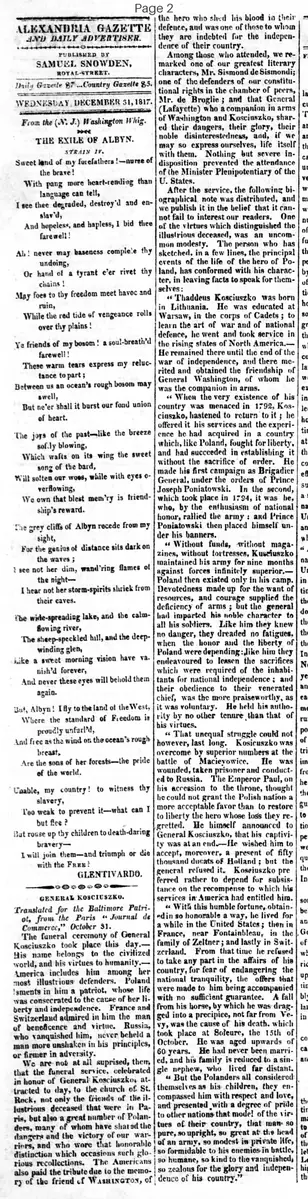
Translated for the Baltimore Patriot, from the Paris "Journal de Commerce," October 31.
The funeral ceremony of General Kosciuszko took place this day.—His name belongs to the civilized world, and his virtues to humanity.—America includes him among her most illustrious defenders. Poland laments in him a patriot, whose life was consecrated to the cause of her liberty and independence. France and Switzerland admired in him the man of benevolence and virtue. Russia, who vanquished him, never beheld a man more unshaken in his principles, or firmer in adversity.
We are not at all surprised, therefore, that the funeral service, celebrated in honor of General Kosciuszko attracted this day, to the church of St. Rock, not only the friends of the illustrious deceased that were in Paris, but also a great number of Poles, many of whom have shared the dangers and the victory of our warriors, and who wore that honorable distinction which occasions such glorious recollections. The Americans also paid the tribute due to the memory of the friend of Washington, of the hero who shed his blood in their defence, and was one of those to whom they are indebted for the independence of their country.
Among those who attended, we remarked one of our greatest literary characters, Mr. Sismondi de Sismondi; one of the defenders of our constitutional rights in the chamber of peers, Mr. de Broglie: and that General (Lafayette) who a companion in arms of Washington and Kosciuszko, shared their dangers, their glory, their noble disinterestedness, and, if we may so express ourselves, life itself with them. Nothing but severe indisposition prevented the attendance of the Minister Plenipotentiary of the U. States.
After the service, the following biographical note was distributed, and we publish it in the belief that it cannot fail to interest our readers. One of the virtues which distinguished the illustrious deceased, was an uncommon modesty. The person who has sketched, in a few lines, the principal events of the life of the hero of Poland, has conformed with his character, in leaving facts to speak for themselves:
"Thaddeus Kosciuszko was born in Lithuania. He was educated at Warsaw, in the corps of Cadets; to learn the art of war and of national defence, he went and took service in the rising states of North America.—He remained there until the end of the war of independence, and there merited and obtained the friendship of General Washington, of whom he was the companion in arms.
"When the very existence of his country was menaced in 1792, Kosciuszko hastened to return to it: he offered it his services and the experience he had acquired in a country which, like Poland, fought for liberty, and had succeeded in establishing it without the sacrifice of order. He made his first campaign as Brigadier General, under the orders of Prince Joseph Poniatowski. In the second, which took place in 1794, it was he, who, by the enthusiasm of national honor, rallied the army: and Prince Poniatowski then placed himself under his banners.
"Without funds, without magazines, without fortresses, Kosciuszko maintained his army for nine months against forces infinitely superior.—Poland then existed only in his camp. Devotedness made up for the want of resources, and courage supplied the deficiency of arms; but the general had imparted his noble character to all his soldiers. Like him they knew no danger, they dreaded no fatigues. When the honor and the liberty of Poland were depending: like him they endeavoured to lessen the sacrifices which were required of the inhabitants for national independence; and their obedience to their venerated chief, was the more praiseworthy, as it was voluntary. He held his authority by no other tenure than that of his virtues.
"That unequal struggle could not however, last long. Kosciuszko was overcome by superior numbers at the battle of Macievowice. He was wounded, taken prisoner and conducted to Russia. The Emperor Paul, on his accession to the throne, thought he could not grant the Polish nation a more acceptable favor than to restore to liberty the hero whose loss they regretted. He himself announced to General Kosciuszko, that his captivity was at an end—He wished him to accept, moreover, a present of fifty thousand ducats of Holland; but the general refused it. Kosciuszko preferred rather to depend for subsistence on the recompense to which his services in America had entitled him.
"With this humble fortune, obtained in so honorable a way, he lived for a while in the United States; then in France, near Fontainbleau, in the family of Zeltner; and lastly in Switzerland. From that time he refused to take any part in the affairs of his country, for fear of endangering the national tranquility, the offers that were made to him being accompanied with no sufficient guarantee. A fall from his horse, by which he was dragged into a precipice, not far from Vevey, was the cause of his death, which took place at Soleure, the 15th of October. He was aged upwards of 60 years. He had never been married, and his family is reduced to a single nephew, who lived far distant.
"But the Polanders all considered themselves as his children, they encompassed him with respect and love, and presented with a degree of pride to other nations that model of the virtues of their country, that man so pure, so upright, so great at the head of an army, so modest in private life, so formidable to his enemies in battle, so humane, so kind to the vanquished, so zealous for the glory and independence of his country."
What sub-type of article is it?
What keywords are associated?
What entities or persons were involved?
Where did it happen?
Foreign News Details
Primary Location
Paris
Event Date
Funeral On October 31; Death On The 15th Of October
Key Persons
Outcome
funeral ceremony attended by poles, americans, and french; biographical note distributed
Event Details
The funeral ceremony of General Kosciuszko took place at the church of St. Rock in Paris, attracting friends, Poles who fought in wars, Americans honoring his role in their independence, and notables like Sismondi de Sismondi, de Broglie, and Lafayette. A biographical note was distributed detailing his birth in Lithuania, education in Warsaw, service in American War of Independence, friendship with Washington, campaigns in Poland in 1792 and 1794 under Poniatowski, leadership against superior Russian forces, capture at Macievowice, release by Emperor Paul, refusal of gift, life in US, France, Switzerland, and death from a horse fall near Vevey at age over 60.