Thank you for visiting SNEWPapers!
Sign up free
Story
November 17, 1891
The Anaconda Standard
Anaconda, Deer Lodge County, Montana
What is this article about?
Discussion from the Washington Post on the New York Court of Appeals decision in the Tilden will case, emphasizing the challenges and risks of creating trusts in wills that may be invalidated due to legal technicalities or rules of construction.
Clipping
OCR Quality
95%
Excellent
Full Text
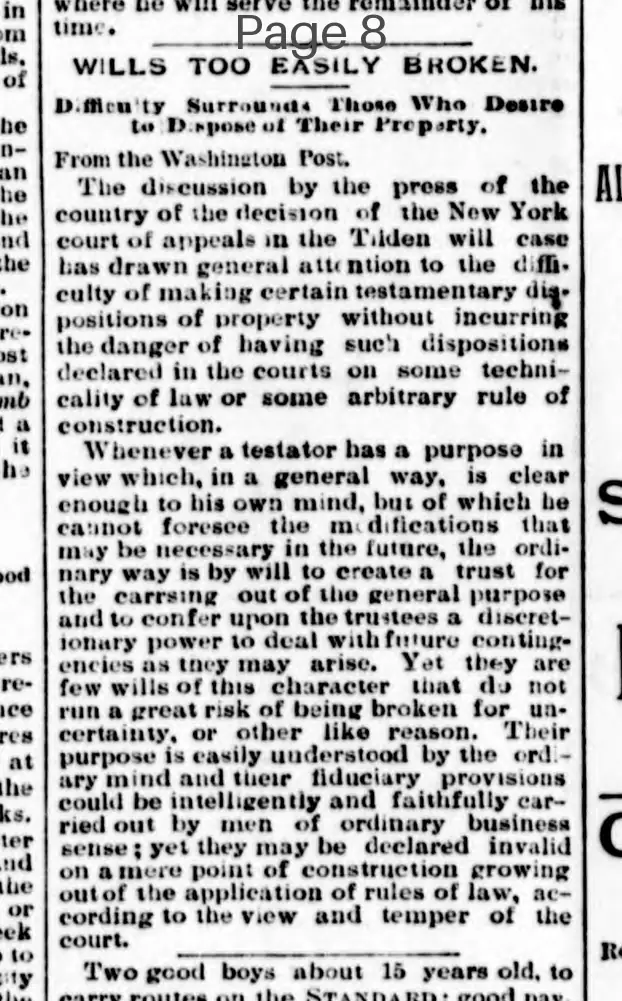
WILLS TOO EASILY BROKEN.
Difficulty Surrounds Those Who Desire to Dispose of Their Property.
From the Washington Post.
The discussion by the press of the country of the decision of the New York court of appeals on the Tilden will case has drawn general attention to the difficulty of making certain testamentary dispositions of property without incurring the danger of having such dispositions declared in the courts on some technicality of law or some arbitrary rule of construction.
Whenever a testator has a purpose in view which, in a general way, is clear enough to his own mind, but of which he cannot foresee the modifications that may be necessary in the future, the ordinary way is by will to create a trust for the carrying out of the general purpose and to confer upon the trustees a discretionary power to deal with future contingencies as they may arise. Yet they are few wills of this character that do not run a great risk of being broken for uncertainty, or other like reason. Their purpose is easily understood by the ordinary mind and their fiduciary provisions could be intelligently and faithfully carried out by men of ordinary business sense; yet they may be declared invalid on a mere point of construction growing out of the application of rules of law, according to the view and temper of the court.
Difficulty Surrounds Those Who Desire to Dispose of Their Property.
From the Washington Post.
The discussion by the press of the country of the decision of the New York court of appeals on the Tilden will case has drawn general attention to the difficulty of making certain testamentary dispositions of property without incurring the danger of having such dispositions declared in the courts on some technicality of law or some arbitrary rule of construction.
Whenever a testator has a purpose in view which, in a general way, is clear enough to his own mind, but of which he cannot foresee the modifications that may be necessary in the future, the ordinary way is by will to create a trust for the carrying out of the general purpose and to confer upon the trustees a discretionary power to deal with future contingencies as they may arise. Yet they are few wills of this character that do not run a great risk of being broken for uncertainty, or other like reason. Their purpose is easily understood by the ordinary mind and their fiduciary provisions could be intelligently and faithfully carried out by men of ordinary business sense; yet they may be declared invalid on a mere point of construction growing out of the application of rules of law, according to the view and temper of the court.
What sub-type of article is it?
Historical Event
Curiosity
What themes does it cover?
Justice
Misfortune
Family
What keywords are associated?
Wills
Testamentary Dispositions
Tilden Will Case
Court Decision
Legal Technicalities
Trusts
Inheritance
What entities or persons were involved?
Tilden
Where did it happen?
New York
Story Details
Key Persons
Tilden
Location
New York
Story Details
The press discusses the New York court of appeals decision on the Tilden will case, highlighting risks of testamentary dispositions being invalidated due to legal technicalities; testators create trusts with discretionary powers for trustees, but such wills often face invalidation for uncertainty despite clear intent.