Thank you for visiting SNEWPapers!
Sign up free
Literary
December 27, 1939
The Key West Citizen
Key West, Monroe County, Florida
What is this article about?
In Chapter 32 of 'The Creeping Man,' Duncan Murchison confesses to Michael Forrester about his brother Edgar's disappearance, claiming Edgar hid a valuable diamond necklace for him, fearing his wife Marie's claim. Duncan seeks permission to search the study, but Michael reveals a tin box containing pebbles and letters instead of diamonds, exposing Duncan's likely deception. The group learns of Alix Lissey's murder.
Clipping
OCR Quality
95%
Excellent
Full Text
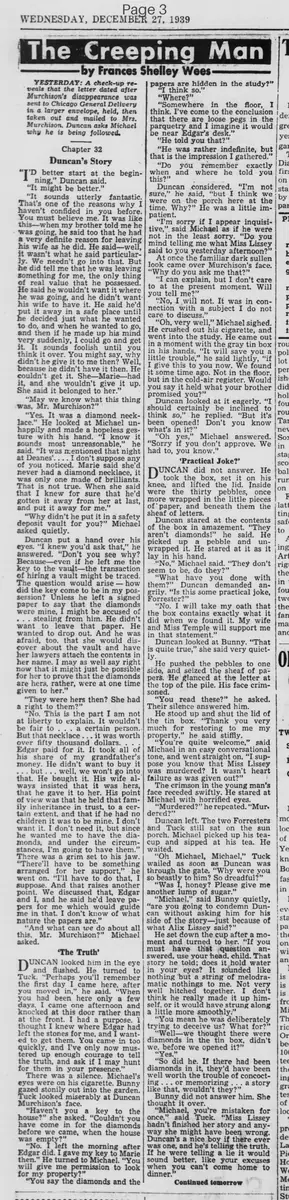
WEDNESDAY. DECEMBER 27. 1939
The Creeping Man
by Frances Shelley Wees
YESTERDAY: A check-up reveals that the letter dated after Murchison's disappearance was sent to Chicago General Delivery in a larger envelope, held, then taken out and mailed to Mrs. Murchison. Duncan asks Michael why he is being followed.
Chapter 32
Duncan's Story
"I'd better not—I think it might be better."
It sounds utterly fantastic. That's one of the reasons why I haven't confided in you before. You must believe me. It was like this—when my brother told me he was going, he said too that he had a very definite reason for leaving his wife as he did. He said—well it wasn't what he said particularly. We needn't go into that. But he did tell me that he was leaving something for me, the only thing of real value that he possessed. He said he wouldn't want it where he was going, and he didn't want his wife to have it. He said he'd put it away in a safe place until he decided just what he wanted to do, and when he wanted to go and then if he made up his mind very suddenly, I could go and get it. It sounds foolish until you think it over. You might say, why didn't he give it to me then? Well, because he didn't have it then. He couldn't get it. She—Marie—had it, and she wouldn't give it up. She said it belonged to her."
"May we know what this thing was, Mr. Murchison?"
"Yes. It was a diamond necklace." He looked at Michael unhappily and made a hopeless gesture with his hand. "I know it sounds most unreasonable," he said. "It was mentioned that night at Deanes'.... I don't suppose any of you noticed. Marie said she'd never had a diamond necklace, it was only one made of brilliants. That is not true. When she said that I knew for sure that he'd gotten it away from her at last, and put it away for me."
"Why didn't he put it in a safety deposit vault for you?" Michael asked quietly.
Duncan put a hand over his eyes. "I knew you'd ask that." he answered. "Don't you see why? Because—even if he left me the key to the vault—the transaction of hiring a vault might be traced. The question would arise—how did the key come to be in my possession? Unless he left a signed paper to say that the diamonds were mine, I might be accused of stealing from him. He didn't want to leave that paper. He wanted to drop out. And he was afraid, too, that she would discover about the vault and have her lawyers attach the contents in her name. I may as well say right now that it might just be possible for her to prove that the diamonds are hers. rather, were at one time given to her."
"They were hers then? She had a right to them?"
"No. This is the part I am not at liberty to explain. It wouldn't be fair to . . . a certain person. But that necklace . . . it was worth over fifty thousand dollars. Edgar paid for it. It took all of his share of my grandfather's money. He didn't want to buy it ... but . . . well, we won't go into that. He bought it. His wife always insisted that it was hers, that he gave it to her. His point of view was that he held that family inheritance in trust, to a certain extent, and that if he had no children it was to be mine. I don't want it. I don't need it, but since he wanted me to have the diamonds, and under the circumstances, I'm going to have them."
There was a grim set to his jaw. "There'll have to be something arranged for her support," he went on. "I'll have to do that, I suppose. And that raises another point. We discussed that, Edgar and I, and he said he'd leave papers for me which would guide me in that. I don't know of what nature the papers are."
"And what can we do about all this, Mr. Murchison?" Michael asked.
'The Truth'
DUNCAN looked him in the eye and flushed. He turned to Tuck. "Perhaps you'll remember the first day I came here, after you moved in," he said. "When you had been here only a few days. I came one afternoon and knocked at this door rather than at the front. I had a purpose. I thought I knew where Edgar had left the stones for me, and I wanted to get them. You came in too quickly, and I've only now mustered up enough courage to tell the truth, and ask if I may hunt for them in your presence."
There was a silence. Michael's eyes were on his cigarette. Bunny gazed stonily out into the garden. Tuck looked miserably at Duncan Murchison's face.
"Haven't you a key to the house?" she asked. "Couldn't you have come in for the diamonds before we came, when the house was empty?"
"No. I left the morning after Edgar did. I gave my key to Marie then." He turned to Michael. "You will give me permission to look for my property?"
"You say the diamonds and the papers are hidden in the study?"
"I think so."
"Where?"
"Somewhere in the floor, I think. I've come to the conclusion that there are loose pegs in the parquetry and I imagine it would be near Edgar's desk."
"He told you that?"
"He was rather indefinite, but that is the impression I gathered."
"Do you remember exactly when and where he told you this?"
Duncan considered. "I'm not sure," he said. "but I think we were on the porch here at the time. Why?" He was a little impatient.
"I'm sorry if I appear inquisitive," said Michael as if he were not in the least sorry. "Do you mind telling me what Miss Lissey said to you yesterday afternoon?"
At once the familiar dark sullen look came over Murchison's face.
"Why do you ask me that?"
"I can explain, but I don't care to at the present moment. Will you tell me?"
"No, I will not. It was in connection with a subject I do not care to discuss."
"Oh, very well," Michael sighed. He crushed out his cigarette, and went into the study. He came out in a moment with the gray tin box in his hands. "It will save you a little trouble," he said lightly, "if I give this to you now. We found it some time ago. Not in the floor, but in the cold-air register. Would you say it held what your brother promised you?"
Duncan looked at it eagerly. "I should certainly be inclined to think so." he replied. "But it's been opened! Don't you know what's in it?"
"Oh yes," Michael answered. "Sorry if you don't approve. We had to, you know."
'Practical Joke?'
DUNCAN did not answer. He took the box, set it on his knee, and lifted the lid. Inside were the thirty pebbles, once more wrapped in the little pieces of paper, and beneath them the sheaf of letters.
Duncan stared at the contents of the box in amazement. "They aren't diamonds!" he said. He picked up a pebble and unwrapped it. He stared at it as it lay in his hand.
"No." Michael said. "They don't seem to be, do they?"
"What have you done with them?" Duncan demanded angrily. "Is this some practical joke, Forrester?"
"No. I will take my oath that the box contains exactly what it did when we found it. My wife and Miss Temple will support me in that statement."
Duncan looked at Bunny. "That is quite true," she said very quietly.
He pushed the pebbles to one side, and seized the sheaf of papers. He glanced at the letter at the top of the pile. His face crimsoned.
"You read these?" he asked.
Their silence answered him.
He stood up and shut the lid of the tin box. "Thank you very much for restoring to me my property." he said stiffly.
"You're quite welcome," said Michael in an easy conversational tone, and went straight on. "I suppose you know that Miss Lissey was murdered? It wasn't heart failure as was given out?"
The crimson in the young man's face receded swiftly. He stared at Michael with horrified eyes.
"Murdered?" he repeated. "Murdered?"
Duncan left. The two Forresters and Tuck still sat on the sun porch. Michael picked up his tea-cup and sipped at his tea. He waited.
"Oh Michael. Michael," Tuck wailed as soon as Duncan was through the gate. "Why were you so beastly to him? So dreadful?"
"Was I, honey? Please give me another lump of sugar."
"Michael," said Bunny quietly, "are you going to condemn Duncan without asking him for his side of the story—just because of what Alix Lissey said?"
He set down the cup after a moment and turned to her. "If you must have that question answered, use your head, child. That story he told; does it hold water in your eyes? It sounded like nothing but a string of melodramatic nothings to me. Not very well hitched together. I don't think he really made it up himself, or it would have strung along a little more smoothly."
"You mean he was deliberately trying to deceive us? What for?"
"Well—we thought there were diamonds in the tin box, didn't we, before we opened it?"
"Yes."
"So did he. If there had been diamonds in it, they'd have been well worth the trouble of concocting ... or memorizing ... a story like that, wouldn't they?"
Bunny did not answer him. She thought it over.
"Michael, you're mistaken for once." said Tuck. "Miss Lissey hadn't finished her story and anyway she might have been wrong. Duncan's a nice boy if there ever was one, and he's telling the truth. If he were telling a lie it would sound better, like your excuses when you can't come home to dinner."
Continued tomorrow
The Creeping Man
by Frances Shelley Wees
YESTERDAY: A check-up reveals that the letter dated after Murchison's disappearance was sent to Chicago General Delivery in a larger envelope, held, then taken out and mailed to Mrs. Murchison. Duncan asks Michael why he is being followed.
Chapter 32
Duncan's Story
"I'd better not—I think it might be better."
It sounds utterly fantastic. That's one of the reasons why I haven't confided in you before. You must believe me. It was like this—when my brother told me he was going, he said too that he had a very definite reason for leaving his wife as he did. He said—well it wasn't what he said particularly. We needn't go into that. But he did tell me that he was leaving something for me, the only thing of real value that he possessed. He said he wouldn't want it where he was going, and he didn't want his wife to have it. He said he'd put it away in a safe place until he decided just what he wanted to do, and when he wanted to go and then if he made up his mind very suddenly, I could go and get it. It sounds foolish until you think it over. You might say, why didn't he give it to me then? Well, because he didn't have it then. He couldn't get it. She—Marie—had it, and she wouldn't give it up. She said it belonged to her."
"May we know what this thing was, Mr. Murchison?"
"Yes. It was a diamond necklace." He looked at Michael unhappily and made a hopeless gesture with his hand. "I know it sounds most unreasonable," he said. "It was mentioned that night at Deanes'.... I don't suppose any of you noticed. Marie said she'd never had a diamond necklace, it was only one made of brilliants. That is not true. When she said that I knew for sure that he'd gotten it away from her at last, and put it away for me."
"Why didn't he put it in a safety deposit vault for you?" Michael asked quietly.
Duncan put a hand over his eyes. "I knew you'd ask that." he answered. "Don't you see why? Because—even if he left me the key to the vault—the transaction of hiring a vault might be traced. The question would arise—how did the key come to be in my possession? Unless he left a signed paper to say that the diamonds were mine, I might be accused of stealing from him. He didn't want to leave that paper. He wanted to drop out. And he was afraid, too, that she would discover about the vault and have her lawyers attach the contents in her name. I may as well say right now that it might just be possible for her to prove that the diamonds are hers. rather, were at one time given to her."
"They were hers then? She had a right to them?"
"No. This is the part I am not at liberty to explain. It wouldn't be fair to . . . a certain person. But that necklace . . . it was worth over fifty thousand dollars. Edgar paid for it. It took all of his share of my grandfather's money. He didn't want to buy it ... but . . . well, we won't go into that. He bought it. His wife always insisted that it was hers, that he gave it to her. His point of view was that he held that family inheritance in trust, to a certain extent, and that if he had no children it was to be mine. I don't want it. I don't need it, but since he wanted me to have the diamonds, and under the circumstances, I'm going to have them."
There was a grim set to his jaw. "There'll have to be something arranged for her support," he went on. "I'll have to do that, I suppose. And that raises another point. We discussed that, Edgar and I, and he said he'd leave papers for me which would guide me in that. I don't know of what nature the papers are."
"And what can we do about all this, Mr. Murchison?" Michael asked.
'The Truth'
DUNCAN looked him in the eye and flushed. He turned to Tuck. "Perhaps you'll remember the first day I came here, after you moved in," he said. "When you had been here only a few days. I came one afternoon and knocked at this door rather than at the front. I had a purpose. I thought I knew where Edgar had left the stones for me, and I wanted to get them. You came in too quickly, and I've only now mustered up enough courage to tell the truth, and ask if I may hunt for them in your presence."
There was a silence. Michael's eyes were on his cigarette. Bunny gazed stonily out into the garden. Tuck looked miserably at Duncan Murchison's face.
"Haven't you a key to the house?" she asked. "Couldn't you have come in for the diamonds before we came, when the house was empty?"
"No. I left the morning after Edgar did. I gave my key to Marie then." He turned to Michael. "You will give me permission to look for my property?"
"You say the diamonds and the papers are hidden in the study?"
"I think so."
"Where?"
"Somewhere in the floor, I think. I've come to the conclusion that there are loose pegs in the parquetry and I imagine it would be near Edgar's desk."
"He told you that?"
"He was rather indefinite, but that is the impression I gathered."
"Do you remember exactly when and where he told you this?"
Duncan considered. "I'm not sure," he said. "but I think we were on the porch here at the time. Why?" He was a little impatient.
"I'm sorry if I appear inquisitive," said Michael as if he were not in the least sorry. "Do you mind telling me what Miss Lissey said to you yesterday afternoon?"
At once the familiar dark sullen look came over Murchison's face.
"Why do you ask me that?"
"I can explain, but I don't care to at the present moment. Will you tell me?"
"No, I will not. It was in connection with a subject I do not care to discuss."
"Oh, very well," Michael sighed. He crushed out his cigarette, and went into the study. He came out in a moment with the gray tin box in his hands. "It will save you a little trouble," he said lightly, "if I give this to you now. We found it some time ago. Not in the floor, but in the cold-air register. Would you say it held what your brother promised you?"
Duncan looked at it eagerly. "I should certainly be inclined to think so." he replied. "But it's been opened! Don't you know what's in it?"
"Oh yes," Michael answered. "Sorry if you don't approve. We had to, you know."
'Practical Joke?'
DUNCAN did not answer. He took the box, set it on his knee, and lifted the lid. Inside were the thirty pebbles, once more wrapped in the little pieces of paper, and beneath them the sheaf of letters.
Duncan stared at the contents of the box in amazement. "They aren't diamonds!" he said. He picked up a pebble and unwrapped it. He stared at it as it lay in his hand.
"No." Michael said. "They don't seem to be, do they?"
"What have you done with them?" Duncan demanded angrily. "Is this some practical joke, Forrester?"
"No. I will take my oath that the box contains exactly what it did when we found it. My wife and Miss Temple will support me in that statement."
Duncan looked at Bunny. "That is quite true," she said very quietly.
He pushed the pebbles to one side, and seized the sheaf of papers. He glanced at the letter at the top of the pile. His face crimsoned.
"You read these?" he asked.
Their silence answered him.
He stood up and shut the lid of the tin box. "Thank you very much for restoring to me my property." he said stiffly.
"You're quite welcome," said Michael in an easy conversational tone, and went straight on. "I suppose you know that Miss Lissey was murdered? It wasn't heart failure as was given out?"
The crimson in the young man's face receded swiftly. He stared at Michael with horrified eyes.
"Murdered?" he repeated. "Murdered?"
Duncan left. The two Forresters and Tuck still sat on the sun porch. Michael picked up his tea-cup and sipped at his tea. He waited.
"Oh Michael. Michael," Tuck wailed as soon as Duncan was through the gate. "Why were you so beastly to him? So dreadful?"
"Was I, honey? Please give me another lump of sugar."
"Michael," said Bunny quietly, "are you going to condemn Duncan without asking him for his side of the story—just because of what Alix Lissey said?"
He set down the cup after a moment and turned to her. "If you must have that question answered, use your head, child. That story he told; does it hold water in your eyes? It sounded like nothing but a string of melodramatic nothings to me. Not very well hitched together. I don't think he really made it up himself, or it would have strung along a little more smoothly."
"You mean he was deliberately trying to deceive us? What for?"
"Well—we thought there were diamonds in the tin box, didn't we, before we opened it?"
"Yes."
"So did he. If there had been diamonds in it, they'd have been well worth the trouble of concocting ... or memorizing ... a story like that, wouldn't they?"
Bunny did not answer him. She thought it over.
"Michael, you're mistaken for once." said Tuck. "Miss Lissey hadn't finished her story and anyway she might have been wrong. Duncan's a nice boy if there ever was one, and he's telling the truth. If he were telling a lie it would sound better, like your excuses when you can't come home to dinner."
Continued tomorrow
What sub-type of article is it?
Prose Fiction
Dialogue
What themes does it cover?
Commerce Trade
Moral Virtue
Death Mortality
What keywords are associated?
Diamond Necklace
Inheritance Dispute
Hidden Box
Deception
Murder Revelation
Family Secrets
What entities or persons were involved?
By Frances Shelley Wees
Literary Details
Title
Chapter 32 Duncan's Story
Author
By Frances Shelley Wees
Key Lines
"Yes. It Was A Diamond Necklace."
"They Aren't Diamonds!"
"I Suppose You Know That Miss Lissey Was Murdered? It Wasn't Heart Failure As Was Given Out?"
"Murdered?" He Repeated. "Murdered?"
"That Story He Told; Does It Hold Water In Your Eyes? It Sounded Like Nothing But A String Of Melodramatic Nothings To Me."