Thank you for visiting SNEWPapers!
Sign up free
Virginia Argus
Richmond, Virginia
What is this article about?
A Philadelphia magistrate delivers an opinion refusing to issue process to arrest and return a British seaman who deserted a merchant vessel in a US port, citing the absence of relevant treaty provisions and principles of the law of nations.
Clipping
OCR Quality
Full Text
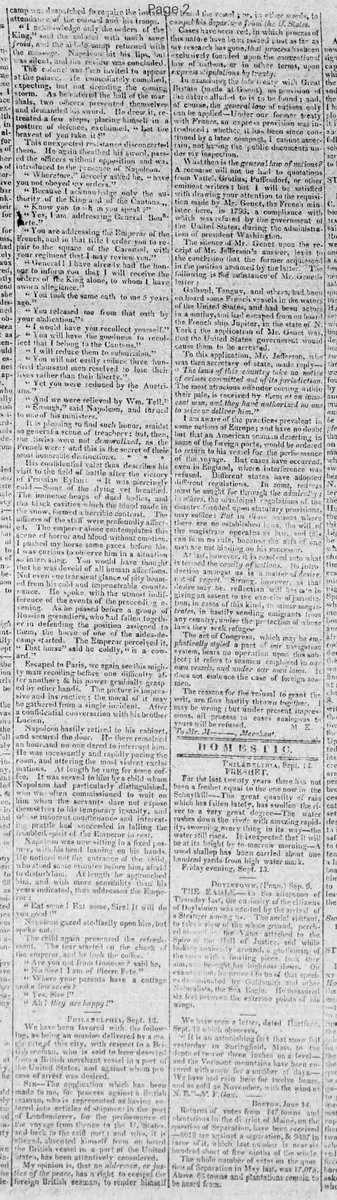
We have been favored with the following, as being an opinion delivered by a magistrate of this city, with respect to a British seaman, who is said to have deserted from a British merchant vessel in a port of the United States, and against whom process of arrest was desired.
SIR--The application which has been made to me, for process against a British seaman, who is represented as having entered into articles of shipment in the port of Londonderry, for the performance of the voyage from thence to the U. States. and back to the said port : and who, it is alleged, absented himself from on board the British vessel in a port of the United States, has been attentively considered.
My opinion is, that no alderman, or justice of the peace, has a right to compel the foreign British seaman, to return to his vessel ; or, in other words, to compel his departure from the U. States. Cases have occurred, in which process of this nature have been issued ; but as far as my research has gone,that process has been exclusively founded upon the conventional law of nations, or in other terms, upon express stipulations by treaty.
In examining the late treaty with Great Britain (made at Ghent) no provision of the nature alluded to is to be found: and, of course, the general law of nations only can be applied-Under our former treaty with France, an express provision was introduced; whether it has been since continued by a later compact, I cannot ascertain, not having the public documents under my inspection.
What then is the general law of nations? A recourse will not be had to quotations from Vattel., Grotius, Puffendorf, or other eminent writers: but I will be satisfied with drawing your attention to the requisition made by Mr. Genet, the French minister here, in 1793, a compliance with which was refused by the government of the United States. during the administration of president Washington.
The silence of Mr. Genet upon the receipt of Mr. Jefferson's answer, leads to the conclusion that the former acquiesced in the position assumed by the latter. The following is the substance of Mr. Genet's letter:
Galbaud. Tanguy, and others. had been on board same French vessels in the waters of the United States, and had been actors in a mutiny,and had escaped from on board the French ship Jupiter, in the state of N. York ; the application of Mr. Genet was. that the United States government would cause them to be arrested.
To this application, Mr. Jefferson, who was then secretary of state, made reply- The laws of this country take no notice of crimes committed out of its jurisdiction. The most atrocious offender coming within their pale, is received by them as an innocent man, and they have authorized no one to seize or deliver him."
I am aware of the practices prevalent in some nations of Europe; and have no doubt but that an American seaman deserting in some of the foreign ports, would be ordered to return to his vessel for the performance of the voyage. But cases have occurred, even in England, where interference was refused. Different states have adopted different regulations. In some, redress must be sought for through the admiralty ; in others, the municipal regulations of the country.founded upon statutory provisions, may suffice: But in those nations where there,are no established laws, the will of the magistrate operates as law, and this can form no rule, because the acts of one man are not binding on his successor.
At last, however., it is resolved into what is termed the comity of nations. Its introduction amongst us is a matter of desire. not-of regret. Strong, however, as that desire may be. reflection will hesitate in giving an assent to the exercise of jurisdiction, in cases of this kind, to inferior magistrates, in hastily sending emigrants from any country, under the protection of whose laws they seek refuge.
The act of Congress, which may be emphatically styled a part of our navigation system, bears no operation upon this subject; it refers to seamen employed in our own vessels, and under our own laws. It does not embrace the case of foreign seamen.
The reasons for the refusal to grant the writ. are thus hastily thrown together. may be wrong : but under present impressions, all process in cases analogous to yours will be refused.
M X.
To Mr. M----, Merchant.
What sub-type of article is it?
What keywords are associated?
What entities or persons were involved?
Where did it happen?
Domestic News Details
Primary Location
Philadelphia
Event Date
Sept. 12.
Key Persons
Outcome
refusal to grant process of arrest; all similar cases will be refused.
Event Details
A magistrate opines that no US alderman or justice can compel a British seaman, who deserted in a US port after shipping from Londonderry, to return to his vessel, as no such provision exists in the Ghent treaty or general law of nations, referencing 1793 Genet-Jefferson exchange and European practices.