Thank you for visiting SNEWPapers!
Sign up free
Gazette Of The United States
New York, New York County, New York
What is this article about?
In the U.S. House of Representatives on May 13, debate on increasing tonnage duties on foreign ships, with Mr. Madison advocating discrimination favoring allied nations like France over Britain to boost American navigation, opposed by Mr. Fitzsimons and Mr. Ames who warned of risks to trade advantages.
Merged-components note: Continuation of congressional debate on tonnage duty across pages.
Clippings
1 of 2
OCR Quality
Full Text
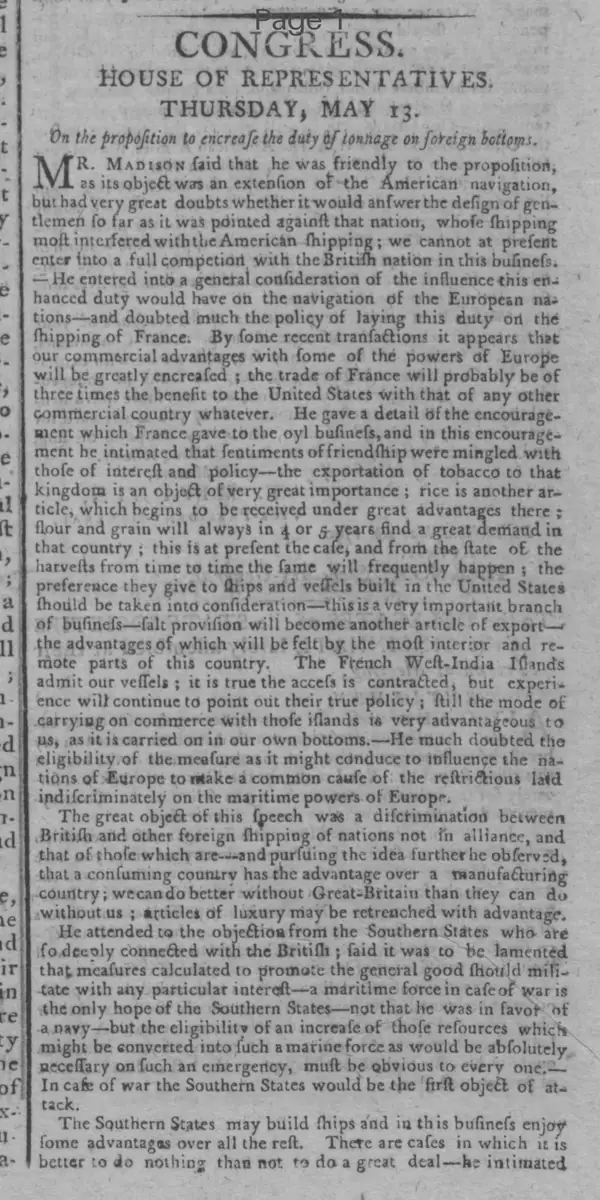
HOUSE OF REPRESENTATIVES.
THURSDAY, MAY 13.
On the proposition to increase the duty of tonnage on foreign bottoms.
MR. Madison said that he was friendly to the proposition, as its object was an extension of the American navigation, but had very great doubts whether it would answer the design of gentlemen so far as it was pointed against that nation, whose shipping most interfered with the American shipping; we cannot at present enter into a full competition with the British nation in this business. He entered into a general consideration of the influence this enhanced duty would have on the navigation of the European nations and doubted much the policy of laying this duty on the Shipping of France. By some recent transactions it appears that our commercial advantages with some of the powers of Europe will be greatly increased; the trade of France will probably be of three times the benefit to the United States with that of any other commercial country whatever. He gave a detail of the encouragement which France gave to the oil business, and in this encouragement he intimated that sentiments of friendship were mingled with those of interest and policy—the exportation of tobacco to that kingdom is an object of very great importance; rice is another article, which begins to be received under great advantages there; flour and grain will always in 4 or 5 years find a great demand in that country; this is at present the case, and from the state of the harvests from time to time the same will frequently happen; the preference they give to ships and vessels built in the United States should be taken into consideration—this is a very important branch of business all provision will become another article of export the advantages of which will be felt by the most interior and remote parts of this country. The French West-India Islands admit our vessels; it is true the access is contracted, but experience will continue to point out their true policy; till the mode of carrying on commerce with those islands is very advantageous to us, as it is carried on in our own bottoms. He much doubted the eligibility of the measure as it might conduce to influence the nations of Europe to mistake a common cause of the restrictions laid indiscriminately on the maritime powers of Europe.
The great object of this speech was a discrimination between British and other foreign shipping of nations not in alliance, and that of those which are—and pursuing the idea further he observed, that a consuming country has the advantage over a manufacturing country; we can do better without Great-Britain than they can do without us; articles of luxury may be retrenched with advantage. He attended to the objection from the Southern States who are so deeply connected with the British; said it was to be lamented that measures calculated to promote the general good should militate with any particular interest—a maritime force in case of war is the only hope of the Southern States—not that he was in favor of a navy—but the eligibility of an increase of those resources which might be converted into such a marine force as would be absolutely necessary on such an emergency, must be obvious to every one. In case of war the Southern States would be the first object of attack. The Southern States may build ships and in this business enjoy some advantages over all the rest. There are cases in which it is better to do nothing than not to do a great deal—he intimated
That it might be good policy to interdict the vessels of all nations, from carrying our produce
Mr. Fitzsimons observed that the question was fully agitated the last session—he was one of those who were in favor of the discrimination at that time—but he now greatly doubted the propriety of the measure. France does not furnish ships in such numbers as to make it any great object with them to be exempted—those measures which are calculated to diminish the navigation of her rivals, she would consider as an indemnification for the enhancement of the duty on her own—With the additional heavy tonnage now proposed, Great-Britain has so great a surplus of shipping, that she cannot employ them so advantageously in any other way, as in the trade of America. America is the best foreign market that Great-Britain has: This every man may be convinced of who looks at what covers him. He instanced a number of articles (especially lumber) which Great-Britain is absolutely dependent on America for—and she has no market for upwards of four millions gallons of rum but the United States: The sale of this rum is a source of greater profit than all her other West-India trade. We enjoy great and increasing commercial advantages, from the adoption of the constitution. I should be extremely sorry to risk these advantages by adopting the motion. and if this is to be a condition of enhancing the tonnage. I shall as at present informed, vote against it.
Mr. Ames in opposition to the motion, observed, that from the introductory observations of the gentleman, he anticipated something which would conduce much to the advantage of our allies—but it had terminated in a proposition to testify our gratitude to that nation, which in any event cannot be much benefited by the discrimination proposed, if it should be adopted. Adverting to what had been said upon treaties. He doubted whether any treaties were of any advantage to us, and therefore he was not solicitous to have them increased. Our ships are at present (notwithstanding the treaty) admitted with almost as much facility into the British as into the French Islands. The great design in the increase of the tonnage, is to increase our own navigation—but the gentleman's plan is to testify our gratitude to our allies, by waging a commercial war with nations not in treaty. The question the last session was thoroughly discussed, and he hoped that it would not be renewed the present—especially when it is considered that the other house were so strongly against it. If we make a distinction here; we ought to carry it through, and lessen the duties in other instances.
What sub-type of article is it?
What keywords are associated?
What entities or persons were involved?
Where did it happen?
Domestic News Details
Primary Location
House Of Representatives
Event Date
Thursday, May 13
Key Persons
Event Details
Debate on proposition to increase tonnage duty on foreign ships, with Madison supporting discrimination favoring France over Britain to promote American navigation and trade, opposed by Fitzsimons and Ames citing risks to U.S. commercial advantages and prior discussions.