Thank you for visiting SNEWPapers!
Sign up free
Delaware State Journal
Wilmington, New Castle County, Delaware
What is this article about?
A Kent County citizen defends the Whig party and Hon. John M. Clayton against claims of responsibility for Delaware's equal county representation in the legislature, explaining its historical roots from William Penn's charter through constitutions of 1776, 1792, and 1831, and warns against political partisanship.
Clipping
OCR Quality
Full Text
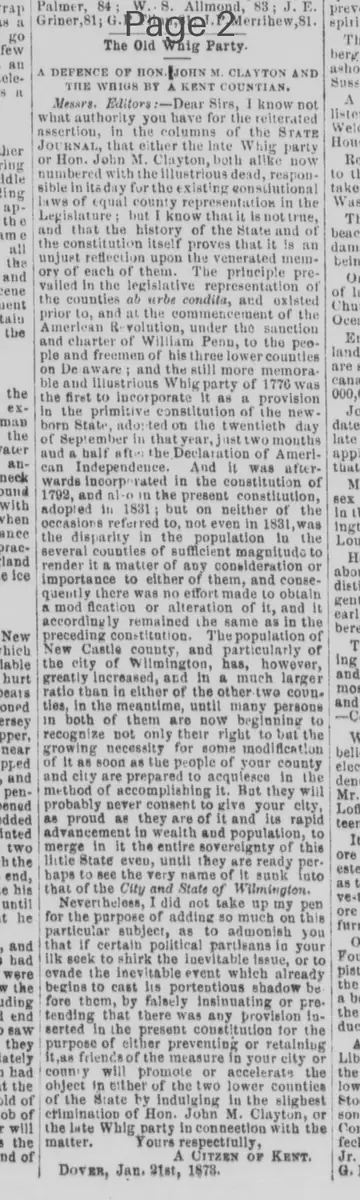
A Defence of Hon. John M. Clayton and the Whigs by a Kent Countian.
Messrs. Editors:—Dear Sirs, I know not what authority you have for the reiterated assertion, in the columns of the State Journal, that either the late Whig party or Hon. John M. Clayton, both alike now numbered with the illustrious dead, responsible in this day for the existing constitutional laws of equal county representation in the Legislature: but I know that it is not true, and that the history of the State and of the constitution itself proves that it is an unjust reflection upon the venerated memory of each of them. The principle prevailed in the legislative representation of the counties ab urbe condita, and existed prior to, and at the commencement of the American Revolution, under the sanction and charter of William Penn, to the people and freemen of his three lower counties on Delaware; and the still more memorable and illustrious Whig party of 1776 was the first to incorporate it as a provision in the primitive constitution of the new-born State, adopted on the twentieth day of September in that year, last two months and a half after the Declaration of American Independence. And it was afterwards incorporated in the constitution of 1792, and also in the present constitution, adopted in 1831; but on neither of the occasions referred to, not even in 1831, was the disparity in the population in the several counties of sufficient magnitude to render it a matter of any consideration or importance to either of them, and consequently there was no effort made to obtain a modification or alteration of it, and it accordingly remained the same as in the preceding constitution. The population of New Castle county, and particularly of the city of Wilmington, has, however, greatly increased, and in a much larger ratio than in either of the other two counties, in the meantime, until many persons in both of them are now beginning to recognize not only their right to but the growing necessity for some modification of it as soon as the people of your county and city are prepared to acquiesce in the method of accomplishing it. But they will probably never consent to give your city, as proud as they are of it and its rapid advancement in wealth and population, to merge in it the entire sovereignty of this little State even, until they are ready perhaps to see the very name of it sunk into that of the City and State of Wilmington.
Nevertheless, I did not take up my pen for the purpose of adding so much on this particular subject, as to admonish you that if certain political partisans in your city seek to shirk the inevitable issue, or to evade the inevitable event which already begins to cast its portentious shadow before them, by falsely insinuating or pretending that there was any provision inserted in the present constitution for the purpose of either preventing or retaining it, as friends of the measure in your city or county will promote or accelerate the object in either of the two lower counties of the State by indulging in the slightest crimination of Hon. John M. Clayton, or the late Whig party in connection with the matter.
Yours respectfully,
A CITIZEN OF KENT.
DOVER, Jan. 21st, 1873.
What sub-type of article is it?
What themes does it cover?
What keywords are associated?
What entities or persons were involved?
Letter to Editor Details
Author
A Citizen Of Kent.
Recipient
Messrs. Editors
Main Argument
the whig party and hon. john m. clayton are not responsible for delaware's equal county representation in the legislature; this principle dates back to william penn's charter and was incorporated in constitutions of 1776, 1792, and 1831 without significant population disparities warranting change at the time.
Notable Details