Thank you for visiting SNEWPapers!
Sign up free
Gazette Of The United States, & Philadelphia Daily Advertiser
Philadelphia, Philadelphia County, Pennsylvania
What is this article about?
An anonymous letter to Mr. Fenno draws a parallel between recent chaotic U.S. congressional debates and a 17th-century disorder in the English House of Commons under Charles II, involving heated arguments over recalling British subjects from French service amid fears of French expansion. It quotes historical debates and describes the tumult, including near-violence, to illustrate that such precedents exist.
Clipping
OCR Quality
Full Text
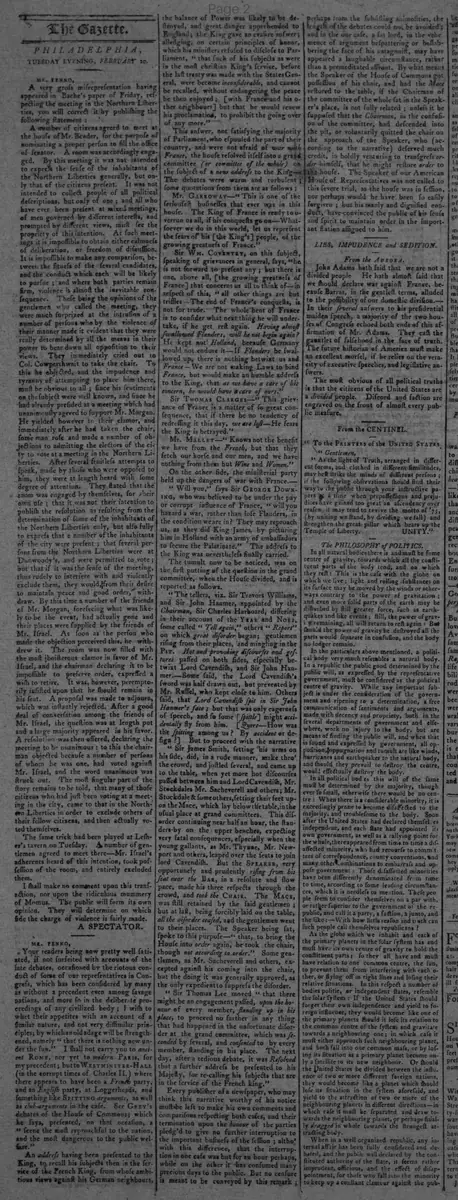
Your readers being now pretty well satiated, if not surfeited with accounts of the late debates, occasioned by the riotous conduct of some of our representatives in Congress, which has been considered by many as without a precedent even among savages, and more so in the deliberate proceedings of any civilized body; I wish to whet their appetites with an account of a similar nature, and not very dissimilar principles; by which an old adage will be strengthened, namely "that there is nothing new under the sun." I shall not carry you to ancient Rome, nor yet to modern Paris, for my precedent; but to Westminster-Hall (in the corrupt times of Charles II.) where there appears to have been a French party, and an English party, at Loggerheads, and something like Spitting arguments, as well as club-arguments in the case. See Grey's debates of the House of Commons; which he says, presented, on that occasion, a "scene the most reproachful to the nation, and the most dangerous to the public welfare."
An address having been presented to the King, to recall his subjects then in the service of the French King, from whose ambitious views against his German neighbours, the balance of Power was likely to be destroyed, and great danger apprehended to England; the King gave an evasive answer; alleging, on certain principles of honor, which his ministers refused to disclose to Parliament, "that such of his subjects as were in the most christian King's service, before the last treaty was made with the States General, were become inconsiderable, and cannot be recalled, without endangering the peace he then enjoyed; [with France and his other neighbours] but that he would renew his proclamation, to prohibit the going over of any more."
This answer, not satisfying the majority of Parliament, who espoused the part of their country, and were not afraid of war with France, the house resolved itself into a grand committee (or committee of the whole) on the subject of a new address to the King. The debates were warm and turbulent; some quotations from them are as follows:
Mr. Garroway- "This is one of the serious business that ever was in this house. The King of France is ready to overrun us all, if his conquests go on. Whatever we do in this world, let us represent the fears of his [the King's] people, of the growing greatness of France."
Sir Wm. Coventry, on this Subject, speaking of grievances in general, says, "he is not forward to present any; but there is one, above all, the growing greatness of France] that concerns us all to think of in respect of this, "all other things are but trifles-The end of France's conquests, is not for trade. The whole bent of France is to consider what next thing he will undertake, if he get rest again. Having almost swallowed Flanders, will he not begin again? He kept not Holland, because Germany would not endure it-If Flanders be swallowed up, there is nothing betwixt us and France -We are not making Laws to bind France, but would make an humble address to the King, that as we have a care of his concern, he would have a care of ours."
Sir Thomas Clarges- "This grievance of France is a matter of so great consequence, that if there be no tendency of redressing it this day, we are lost-He fears the King is betrayed."
Mr. Mallett "Knows not the benefit we have from the French, but that they fetch our horse and our men, and we have nothing from them but Wine and Women."
On the other side, the ministerial party held up the dangers of war with France.— "Will you," says Sir George Downing, who was believed to be under the pay or corrupt influence of France, "will you hazard a war, rather than lose Flanders, in the condition we are in? They may reproach us, as they did King James, by picturing him in Holland with an army of ambassadors to secure the Palatinate." The address to the King was nevertheless finally carried.
The tumult now to be noticed, was on the first putting of the question in the grand committee, when the House divided, and is reported as follows.
"The tellers, viz. Sir Trevor Williams, and Sir John Hanmer, appointed by the Chairman, Sir Charles Harbord, differing in their account of the Yeas and Noes, some called "Tell again." others "Report" on which great disorder began; gentlemen rising from their places, and mingling in the Pit. Hot and provoking discourses and gestures passed on both sides, especially betwixt Lord Cavendish, and Sir John Hanmer. Some said, the Lord Cavendish's sword was half drawn out, but prevented by Mr. Russell, who kept close to him. Others said, that Lord Cavendish spit in Sir John Hanmer's face;: but that was only eagerness of speech, and so some spittle] might accidentally fly from him. Duceret-How was the spitting among us? By accident or design?] But to proceed with the narrative
"Sir James Smith, setting his arms on his side, did, in a rude manner, make thro' the crowd, and jostled several, and came up to the table, when yet more hot discourses passed between him and Lord Cavendish, Mr. Stockdale's Mr. Sacheverell and others; Mr. Stockdale & some others, setting their feet upon the Mace, which lay below the table, in the usual place at grand committees. This disorder continuing near half an hour, the standers-by on the upper benches, expecting very fatal consequences, especially when the young gallants, as Mr. Thynne, Mr. Newport and others, leaped over the seats to join lord Cavendish. But the Speaker, very opportunely. and prudently rising from his seat near the Bar, in a resolute and slow pace, made his three respects through the crowd, and took the Chair. The Mace, was still retained by the said gentlemen; but at last, being forcibly laid on the table, all the disorder ceased, and the gentlemen went to their places. The Speaker being at, spoke to this purpose-"that, to bring the House into order again, he took the chair, though not according to order." Some gentlemen, as Mr. Sacheverell and others, excepted against his coming into the chair, but the doing it was generally approved, as the only expedient to suppress the disorder.
"Sir Thomas Lee moved "that there might be an engagement passed, upon the honour of every member, standing up in his place, to proceed no farther in any thing that had happened in the unfortunate disorder at the grand committee, which was seconded by several, and consented to by every member, standing in his place. The next day, after a tedious debate, it was Resolved that a further address be presented to his Majesty, for re-calling his subjects that are in the service of the French king."
Every publisher of a newspaper, who may think this narrative worthy of his notice must be left to make his own comments and comparisons respecting both cases, and their termination upon the honour of the parties pledged to give no further interruption to the important business of the session; altho with this difference, that the interruption in one case was but for an hour perhaps, while on the other it has consumed many precious days to the public. But no censure is meant to be conveyed by this remark;
Perhaps from the subsiding animosities, the length of the debates could not be avoided': and in the one case, a fat lord, in the vehemence of argument bespattering or belabouring the face of his antagonist, may have appeared a laughable circumstance, rather than a premeditated affront. By what means the Speaker of the House of Commons got possession of his chair, and had the Mace restored to the table, if the Chairman of the committee of the whole sat in the Speaker's place, is not fully related : unless it be supposed that the Chairman, in the confusion of the committee, had descended into the pit, or voluntarily quitted the chair on the approach of the Speaker, who (according to the narrative) deserved much credit, in boldly venturing to transgress order himself, that he might restore order to the house. The Speaker of our American House of Representatives was not called to this severe trial, as the house was in session, nor perhaps. would he have been so easily forgiven ; but his manly and dignified conduct, have convinced the public of his sense and spirit to maintain order in the important station assigned to him.
What sub-type of article is it?
What themes does it cover?
What keywords are associated?
What entities or persons were involved?
Letter to Editor Details
Recipient
Mr. Fenno
Main Argument
recent chaotic congressional debates have historical precedents, as seen in the disorderly 17th-century english parliamentary debates over french influence and the balance of power, illustrating that 'there is nothing new under the sun.'
Notable Details