Thank you for visiting SNEWPapers!
Sign up free
The New Hampshire Gazette
Portsmouth, Rockingham County, New Hampshire
What is this article about?
A response to an 'Old Ecclesiastic's' criticisms of President Adams' proclamation for a national fast, defending its propriety, refuting charges of hypocrisy related to past laws and foreign policy, and urging unity in observance despite political divisions.
Clipping
OCR Quality
Full Text
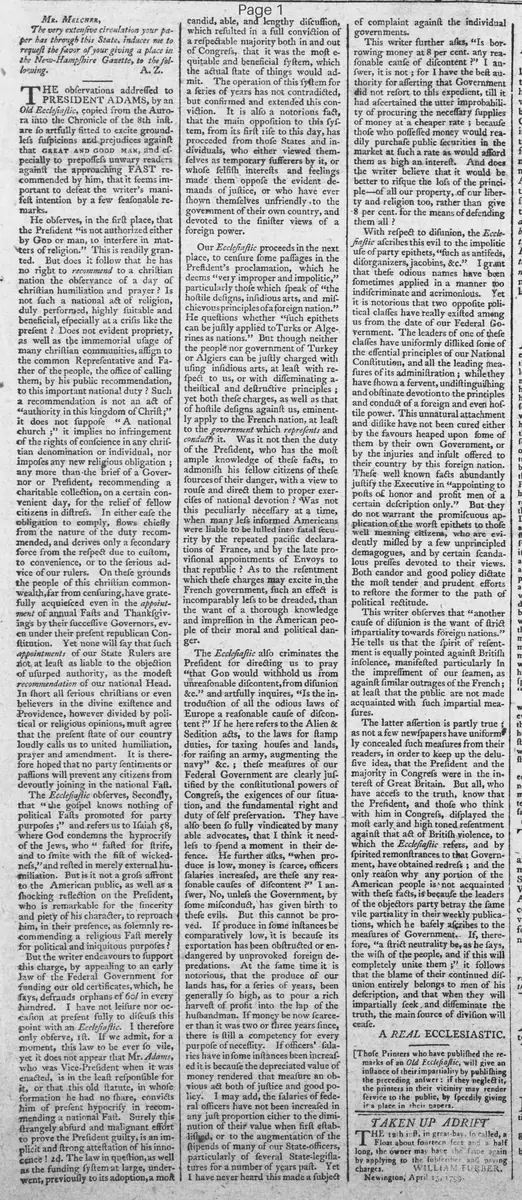
The very extensive circulation your paper has through this State, induces me to request the favor of your giving a place in the New-Hampshire Gazette, to the following.
A.Z.
THE observations addressed to PRESIDENT ADAMS, by an Old Ecclesiastic, copied from the Aurora into the Chronicle of the 8th inst. are so artfully fitted to excite groundless suspicions and prejudices against that GREAT AND GOOD MAN, and especially to predispose unwary readers against the approaching FAST recommended by him, that it seems important to defeat the writer's manifest intention by a few reasonable remarks.
He observes, in the first place, that the President "is not authorized either by God or man, to interfere in matters of religion." This is readily granted. But does it follow that he has no right to recommend to a christian nation the observance of a day of christian humiliation and prayer? Is not such a national act of religion, duly performed, highly suitable and beneficial, especially at a crisis like the present? Does not evident propriety, as well as the immemorial usage of many christian communities, assign to the common Representative and Father of the people, the office of calling them, by his public recommendation, to this important national duty? Such a recommendation is not an act of "authority in this kingdom of Christ;" it does not suppose "a national church;" it implies no infringement of the rights of conscience in any christian denomination or individual, nor imposes any new religious obligation; any more than the brief of a Governor or President, recommending a charitable collection, on a certain convenient day, for the relief of fellow citizens in distress. In either case the obligation to comply, flows chiefly from the nature of the duty recommended, and derives only a secondary force from the respect due to custom, to convenience, or to the serious advice of our rulers. On these grounds the people of this christian commonwealth, far from censuring, have gratefully acquiesced even in the appointment of annual Fasts and Thanksgivings by their successive Governors, even under their present republican Constitution. Yet none will say that such appointments of our State Rulers are not at least as liable to the objection of usurped authority, as the modest recommendation of our national Head.
In short all serious christians or even believers in the divine existence and Providence, however divided by political or religious opinions, must agree that the present state of our country loudly calls us to united humiliation, prayer and amendment. It is therefore hoped that no party sentiments or passions will prevent any citizens from devoutly joining in the national Fast.
The Ecclesiastic observes, Secondly, that "the gospel knows nothing of political Fasts promoted for party purposes;" and refers us to Isaiah 58, where God condemns the hypocrisy of the Jews, who fasted for strife, and to smite with the fist of wickedness, "and rested in merely external humiliation. But is it not a gross affront to the American public, as well as a shocking reflection on the President, who is remarkable for the sincerity and piety of his character, to reproach him, in their presence, as solemnly recommending a religious Fast merely for political and iniquitous purposes?
But the writer endeavours to support this charge, by appealing to an early Law of the Federal Government for funding our old certificates, which, he says, defrauds orphans of 6ol in every hundred. I have not leisure nor occasion at present fully to discuss this point with an Ecclesiastic. I therefore only observe, 1st. If we admit, for a moment, this law to be ever so vile, yet it does not appear that Mr. Adams, who was Vice-President when it was enacted, is in the least responsible for it, or that this old statute, in whose formation he had no share, convicts him of present hypocrisy in recommending a national Fast. Surely this strangely absurd and malignant effort to prove the President guilty, is an implicit and strong attestation of his innocence!
2d. The law in question, as well as the funding system at large, underwent, previously to its adoption, a most candid, able, and lengthy discussion, which resulted in a full conviction of a respectable majority both in and out of Congress, that it was the most equitable and beneficial system, which the actual state of things would admit. The operation of this system for a series of years has not contradicted, but confirmed and extended this conviction. It is also a notorious fact, that the main opposition to this system, from its first rise to this day, has proceeded from those States and individuals, who either viewed themselves as temporary sufferers by it, or whose selfish interests and feelings made them oppose the evident demands of justice, or who have ever shown themselves unfriendly to the government of their own country, and devoted to the sinister views of a foreign power.
Our Ecclesiastic proceeds in the next place, to censure some passages in the President's proclamation, which he deems "very improper and impolitic," particularly those which speak of "the hostile designs, insidious arts, and mischievous principles of a foreign nation." He questions whether "such epithets can be justly applied to Turks or Algerines as nations." But though neither the people nor government of Turkey or Algiers can be justly charged with using insidious arts, at least with respect to us, or with disseminating atheistical and destructive principles; yet both these charges, as well as that of hostile designs against us, eminently apply to the French nation, at least to the government which represents and conducts it. Was it not then the duty of the President, who has the most ample knowledge of these facts, to admonish his fellow citizens of these sources of their danger, with a view to rouse and direct them to proper exercises of national devotion? Was not this peculiarly necessary at a time, when many less informed Americans were liable to be lulled into fatal security by the repeated pacific declarations of France, and by the late provisional appointments of Envoys to that republic? As to the resentment which these charges may excite in the French government, such an effect is incomparably less to be dreaded, than the want of a thorough knowledge and impression in the American people of their moral and political danger.
The Ecclesiastic also criminates the President for directing us to pray "that God would withhold us from unreasonable discontent, from disunion &c." and artfully inquires, "Is the introduction of all the odious laws of Europe a reasonable cause of discontent?" If he here refers to the Alien & Sedition acts, to the laws for stamp duties, for taxing houses and lands, for raising an army, augmenting the navy" &c.: these measures of our Federal Government are clearly justified by the constitutional powers of Congress, the exigences of our situation, and the fundamental right and duty of self preservation. They have also been so fully vindicated by many able advocates, that I think it needless to spend a moment in their defence.
He further asks, "when produce is low, money is scarce, officers salaries increased, are these any reasonable causes of discontent?" I answer, No, unless the Government, by some misconduct, has given birth to these evils. But this cannot be proved. If produce in some instances be comparatively low, it is because its exportation has been obstructed or endangered by unprovoked foreign depredations. At the same time it is notorious, that the produce of our lands has, for a series of years, been generally so high, as to pour a rich harvest of profit into the lap of the husbandman. If money be now scarcer than it was two or three years since, there is still a competency for every purpose of necessity. If officers' salaries have in some instances been increased it is because the depreciated value of money rendered that measure an obvious act both of justice and good policy. I may add, the salaries of federal officers have not been increased in any just proportion either to the diminution of their value when first established, or to the augmentation of the stipends of many of our State-officers, particularly of several State-legislatures for a number of years past. Yet I have never heard this made a subject of complaint against the individual governments.
This writer further asks, "Is borrowing money at 8 per cent. any reasonable cause of discontent?" I answer, it is not; for I have the best authority for asserting that Government did not resort to this expedient, till it had ascertained the utter improbability of procuring the necessary supplies of money at a cheaper rate; because those who possessed money would readily purchase public securities in the market at such a rate as would afford them as high an interest. And does the writer believe that it would be better to risque the loss of the principal--of all our property, of our liberty and religion too, rather than give 8 per cent. for the means of defending them all?
With respect to disunion, the Ecclesiastic ascribes this evil to the impolitic use of party epithets, "such as antifeds, disorganizers, jacobins, &c." I grant that these odious names have been sometimes applied in a manner too indiscriminate and acrimonious. Yet it is notorious that two opposite political classes have really existed among us from the date of our Federal Government. The leaders of one of these classes have uniformly disliked some of the essential principles of our National Constitution, and all the leading measures of its administration; while they have shown a fervent, undistinguishing and obstinate devotion to the principles and conduct of a foreign and even hostile power. This unnatural attachment and dislike have not been cured either by the favours heaped upon some of them by their own Government, or by the injuries and insult offered to their country by this foreign nation. These well known facts abundantly justify the Executive in "appointing to posts of honor and profit men of a certain description only." But they do not warrant the promiscuous application of the worst epithets to those well meaning citizens, who are evidently misled by a few unprincipled demagogues, and by certain scandalous presses devoted to their views. Both candor and good policy dictate the most tender and prudent efforts to restore the former to the path of political rectitude.
This writer observes that "another cause of disunion is the want of strict impartiality towards foreign nations." He tells us that the spirit of resentment is equally pointed against British insolence, manifested particularly in the impressment of our seamen, as against similar outrages of the French; at least that the public are not made acquainted with such impartial measures.
The latter assertion is partly true; as not a few newspapers have uniformly concealed such measures from their readers, in order to keep up the delusive idea, that the President and the majority in Congress were in the interest of Great Britain. But all, who have access to the truth, know that the President, and those who think with him in Congress, displayed the most early and high toned resentment against that act of British violence, to which the Ecclesiastic refers, and by spirited remonstrances to that Government, have obtained redress; and the only reason why any portion of the American people is not acquainted with these facts, is because the leaders of the opposition party betray the same vile partiality in their weekly publications, which he basely ascribes to the measures of Government. If, therefore, "a strict neutrality be, as he says, the wish of the people, and if this will completely unite them;" it follows that the blame of their continued disunion entirely belongs to men of his description, and that when they will impartially seek, and disseminate the truth, the main source of division will cease.
A REAL ECCLESIASTIC.
[Those Printers who have published the remarks of an Old Ecclesiastic, will give an instance of their impartiality by publishing the preceding answer: if they neglect it, the printers in their vicinity may render service to the public, by speedily giving it a place in their papers.]
What sub-type of article is it?
What themes does it cover?
What keywords are associated?
What entities or persons were involved?
Letter to Editor Details
Author
A Real Ecclesiastic
Recipient
Mr. Melcher
Main Argument
president adams' recommendation for a national fast is appropriate and not an overreach into religion or hypocritical political maneuvering; it addresses national crises without infringing on conscience, and criticisms from the 'old ecclesiastic' are unfounded, especially regarding past laws, foreign policy, and economic measures.
Notable Details