Thank you for visiting SNEWPapers!
Sign up free
Editorial
December 28, 1892
The True Northerner
Paw Paw, Van Buren County, Michigan
What is this article about?
The editorial praises the Indiana Supreme Court's decision to invalidate a legislative gerrymander, following similar rulings in Wisconsin and Michigan, as a step toward fair political apportionment. It lauds the judiciary's impartiality and constitutional role in checking partisan excesses.
Clipping
OCR Quality
98%
Excellent
Full Text
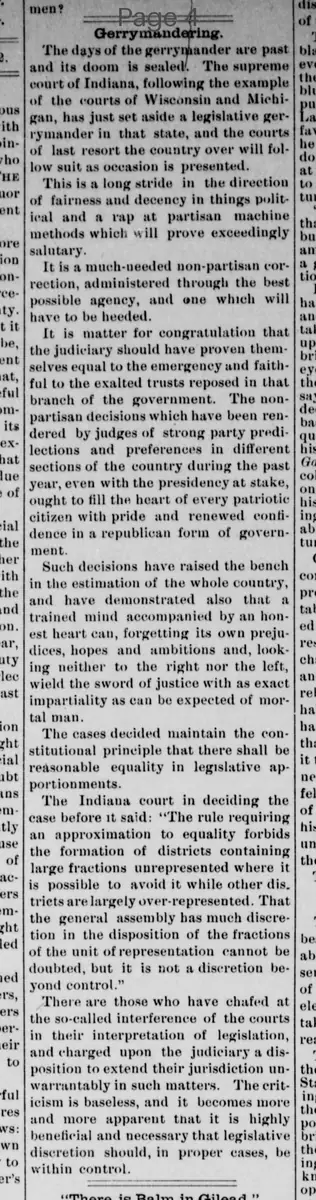
Gerrymandering
The days of the gerrymander are past and its doom is sealed. The supreme court of Indiana, following the example of the courts of Wisconsin and Michigan, has just set aside a legislative gerrymander in that state, and the courts of last resort the country over will follow suit as occasion is presented.
This is a long stride in the direction of fairness and decency in things political and a rap at partisan machine methods which will prove exceedingly salutary.
It is a much-needed non-partisan correction, administered through the best possible agency, and one which will have to be heeded.
It is matter for congratulation that the judiciary should have proven themselves equal to the emergency and faithful to the exalted trusts reposed in that branch of the government. The non-partisan decisions which have been rendered by judges of strong party predilections and preferences in different sections of the country during the past year, even with the presidency at stake, ought to fill the heart of every patriotic citizen with pride and renewed confidence in a republican form of government.
Such decisions have raised the bench in the estimation of the whole country, and have demonstrated also that a trained mind accompanied by an honest heart can, forgetting its own prejudices, hopes and ambitions and, looking neither to the right nor the left, wield the sword of justice with as exact impartiality as can be expected of mortal man.
The cases decided maintain the constitutional principle that there shall be reasonable equality in legislative apportionments.
The Indiana court in deciding the case before it said: "The rule requiring an approximation to equality forbids the formation of districts containing large fractions unrepresented where it is possible to avoid it while other districts are largely over-represented. That the general assembly has much discretion in the disposition of the fractions of the unit of representation cannot be doubted, but it is not a discretion beyond control."
There are those who have chafed at the so-called interference of the courts in their interpretation of legislation and charged upon the judiciary a disposition to extend their jurisdiction unwarrantedly in such matters. The criticism is baseless, and it becomes more and more apparent that it is highly beneficial and necessary that legislative discretion should, in proper cases, be within control.
The days of the gerrymander are past and its doom is sealed. The supreme court of Indiana, following the example of the courts of Wisconsin and Michigan, has just set aside a legislative gerrymander in that state, and the courts of last resort the country over will follow suit as occasion is presented.
This is a long stride in the direction of fairness and decency in things political and a rap at partisan machine methods which will prove exceedingly salutary.
It is a much-needed non-partisan correction, administered through the best possible agency, and one which will have to be heeded.
It is matter for congratulation that the judiciary should have proven themselves equal to the emergency and faithful to the exalted trusts reposed in that branch of the government. The non-partisan decisions which have been rendered by judges of strong party predilections and preferences in different sections of the country during the past year, even with the presidency at stake, ought to fill the heart of every patriotic citizen with pride and renewed confidence in a republican form of government.
Such decisions have raised the bench in the estimation of the whole country, and have demonstrated also that a trained mind accompanied by an honest heart can, forgetting its own prejudices, hopes and ambitions and, looking neither to the right nor the left, wield the sword of justice with as exact impartiality as can be expected of mortal man.
The cases decided maintain the constitutional principle that there shall be reasonable equality in legislative apportionments.
The Indiana court in deciding the case before it said: "The rule requiring an approximation to equality forbids the formation of districts containing large fractions unrepresented where it is possible to avoid it while other districts are largely over-represented. That the general assembly has much discretion in the disposition of the fractions of the unit of representation cannot be doubted, but it is not a discretion beyond control."
There are those who have chafed at the so-called interference of the courts in their interpretation of legislation and charged upon the judiciary a disposition to extend their jurisdiction unwarrantedly in such matters. The criticism is baseless, and it becomes more and more apparent that it is highly beneficial and necessary that legislative discretion should, in proper cases, be within control.
What sub-type of article is it?
Partisan Politics
Constitutional
Legal Reform
What keywords are associated?
Gerrymandering
Judicial Review
Legislative Apportionment
Partisan Politics
Constitutional Equality
Judiciary Impartiality
What entities or persons were involved?
Supreme Court Of Indiana
Courts Of Wisconsin
Courts Of Michigan
Judiciary
General Assembly
Editorial Details
Primary Topic
Judicial Invalidation Of Gerrymandering
Stance / Tone
Supportive Of Anti Gerrymandering Court Decisions And Judicial Impartiality
Key Figures
Supreme Court Of Indiana
Courts Of Wisconsin
Courts Of Michigan
Judiciary
General Assembly
Key Arguments
Gerrymandering's Days Are Past Due To Court Interventions.
Indiana Supreme Court Set Aside Legislative Gerrymander, Following Wisconsin And Michigan.
This Promotes Fairness In Politics And Checks Partisan Methods.
Judiciary Has Proven Impartial, Even In Politically Charged Times.
Decisions Uphold Constitutional Equality In Legislative Apportionments.
Courts Control Legislative Discretion To Prevent Unequal Districts.
Criticism Of Judicial Interference Is Baseless; It Is Beneficial.