Thank you for visiting SNEWPapers!
Sign up free
Alexandria Daily Advertiser
Alexandria, Virginia
What is this article about?
Testimony in Aaron Burr's trial for treason, including General Wilkinson's cipher explanations and George Poindexter's account of Burr's surrender to civil authority in the Mississippi Territory in January 1807, amid suspicions of conspiracy with Wilkinson.
Merged-components note: These two components are sequential in reading order and contain continuation of the detailed testimony from the Burr trial, forming a single coherent story.
Clippings
1 of 2
OCR Quality
Full Text
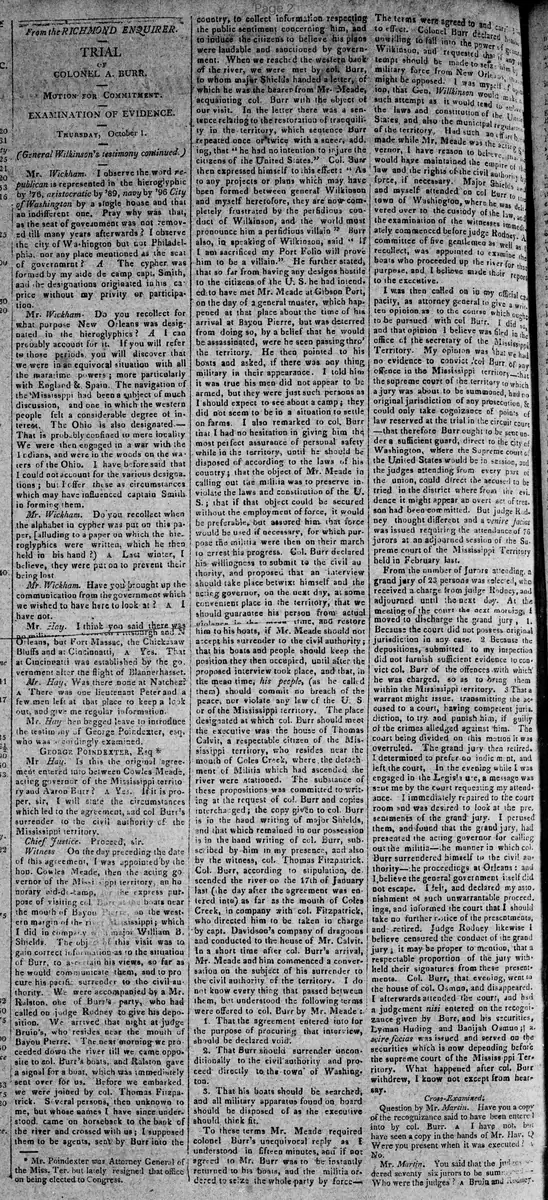
TRIAL
COLONEL A. BURR
MOTION FOR COMMITMENT.
EXAMINATION OF EVIDENCE.
Thursday, October 1.
(General Wilkinson's testimony continued.)
Mr. Wickham. I observe the word republican is represented in the hieroglyphic by 76, aristocratic by '89, navy by '96. City of Washington by a single house and that an indifferent one. Pray, why was that; as the seat of government was not removed till many years afterwards? I observe the city of Washington but not Philadelphia, nor any place mentioned as the seat of government? A. The cypher was formed by my aide de camp, Capt. Smith, and his designations originated in his caprice without my privity or participation.
Mr. Wickham. Do you recollect for what purpose New Orleans was designated in the hieroglyphics? A. I can probably account for it. If you will refer to those periods, you will discover that we were in an equivocal situation with all the maritime powers; more particularly with England & Spain. The navigation of the Mississippi had been a subject of much discussion, and one in which the western people felt a considerable degree of interest. The Ohio is also designated.-- That is probably confined to mere locality. We were then engaged in a war with the Indians, and were in the woods on the waters of the Ohio. I have before said that I could not account for the various designations; but I offer these as circumstances which may have influenced Captain Smith in forming them.
Mr. Wickham: Do you recollect when the alphabet in cypher was put on this paper, [alluding to a paper on which the hieroglyphics were written, which he then held in his hand?] A. Last winter, I believe, they were put on to prevent their being lost.
Mr. Wickham. Have you brought up the communication from the government which we wished to have here to look at? A. I have not.
Mr. Hay.
I think you said there was [something missing, perhaps "no post"] through to New Orleans, but Fort Massac, the Chickasaw Bluffs and at Cincinnati. A. Yes. That at Cincinnati was established by the government after the flight of Blennerhassett.
Mr. Hay. Was there none at Natchez? A. There was one Lieutenant Peter and a few men left at that place to keep a look out, and give me regular information.
Mr. Hay then begged leave to introduce the testimony of George Poindexter, Esq. who was accordingly examined.
George Poindexter, Esq.*
Mr. Hay. Is this the original agreement entered into between Cowles Meade acting governor of the Mississippi territory and Aaron Burr? A. Yes. If it is proper, sir, I will state the circumstances which led to the agreement, and Col. Burr's surrender to the civil authority of the Mississippi territory.
Chief Justice. Proceed, sir.
Witness. On the day preceding the date of this agreement, I was appointed by the Hon. Cowles Meade, then the acting governor of the Mississippi territory, an honorary aide-de-camp, for the express purpose of visiting Col. Burr at his boats near the mouth of Bayou Pierre, on the western margin of the river Mississippi; which I did in company with Major William B. Shields. The object of this visit was to gain correct information as to the situation of Burr, to ascertain his views, so far as he would communicate them, and to procure his pacific surrender to the civil authority. We were accompanied by a Mr. Ralston, one of Burr's party, who had called on Judge Rodney to give his deposition. We arrived that night at Judge Bruin's, who resides near the mouth of Bayou Pierre. The next morning we proceeded down the river till we came opposite to Col. Burr's boats, and Ralston gave a signal for a boat, which was immediately sent over for us. Before we embarked, we were joined by Col. Thomas Fitzpatrick. Several persons, then unknown to me, but whose names I have since understood, came on horseback to the bank of the river and crossed with us; I supposed them to be agents, sent by Burr into the country, to collect information respecting the public sentiment concerning him, and to induce the citizens to believe his plans were laudable and sanctioned by government. When we reached the western bank of the river, we were met by Col. Burr, to whom Major Shields handed a letter of which he was the bearer from Mr. Meade acquainting Col. Burr with the object of our visit. In the letter there was a sentence relating to the restoration of tranquillity in the territory, which sentence Burr repeated once or twice with a sneer, adding, that "he had no intention to injure the citizens of the United States."-- Col. Burr then expressed himself to this effect: "As to any projects or plans which may have been formed between General Wilkinson and myself heretofore, they are now completely frustrated by the perfidious conduct of Wilkinson, and the world must pronounce him a perfidious villain." Burr also, in speaking of Wilkinson, said "If I am sacrificed my Port Folio will prove him to be a villain." He further stated that so far from having any designs hostile to the citizens of the U. S. he had intended to have met Mr. Meade at Gibson Port, on the day of a general muster, which happened at that place about the time of his arrival at Bayou Pierre, but was deterred from doing so, by a belief that he would be assassinated, were he seen passing through the territory. He then pointed to his boats and asked, if there was any thing military in their appearance. I told him it was true his men did not appear to be armed, but they were just such persons as I should expect to see about a camp; they did not seem to be in a situation to settle on farms. I also remarked to Col. Burr that I had no hesitation in giving him the most perfect assurance of personal safety while in the territory, until he should be disposed of according to the laws of his country; that the object of Mr. Meade in calling out the militia was to preserve inviolate the laws and constitution of the U. S.; that if that object could be secured without the employment of force, it would be preferable, but assured him that force would be used if necessary, for which purpose the militia were then on their march to arrest his progress. Col. Burr declared his willingness to submit to the civil authority, and proposed that an interview should take place betwixt himself and the acting governor, on the next day, at some convenient place in the territory, that we should guarantee his person from actual violence in the mean time, and restore him to his boats, if Mr. Meade should not accept his surrender to the civil authority; that his boats and people should keep the position they then occupied, until after the proposed interview took place, and that, in the mean time, his people, (as he called them) should commit no breach of the peace, nor violate any law of the U. S. or of the Mississippi territory. The place designated at which Col. Burr should meet the executive was the house of Thomas Calvit, a respectable citizen of the Mississippi territory, who resides near the mouth of Coles Creek, where the detachment of Militia which had ascended the river were stationed. The substance of these propositions was committed to writing at the request of Col. Burr and copies interchanged; the copy given to Col. Burr is in the hand writing of Major Shields, and that which remained in our possession is in the hand writing of Col. Burr, subscribed by him in my presence, and also by the witness, Col. Thomas Fitzpatrick. Col. Burr, according to stipulation, descended the river on the 17th of January last (the day after the agreement was entered into) as far as the mouth of Coles Creek, in company with Col. Fitzpatrick, who directed him to be taken in charge by Capt. Davidson's company of dragoons and conducted to the house of Mr. Calvit. In a short time after Col. Burr's arrival, Mr. Meade and him commenced a conversation on the subject of his surrender to the civil authority of the territory. I do not know every thing that passed between them, but understood the following terms were offered to Col. Burr by Mr. Meade:
1. That the agreement entered into for the purpose of procuring that interview, should be declared void.
2. That Burr should surrender unconditionally to the civil authority and proceed directly to the town of Washington.
3. That his boats should be searched, and all military apparatus found on board should be disposed of as the executive should think fit.
To these terms Mr. Meade required Colonel Burr's unequivocal reply as I understood in fifteen minutes, and if not agreed to Mr. Burr was to be instantly returned to his boats, and the militia ordered to seize the whole party by force.
The terms were agreed to and carried into effect. Colonel Burr declared himself unwilling to fall into the power of Wilkinson, and requested that if any attempt should be made to seize him by military force from New Orleans, that it might be opposed. I was myself of opinion, that Gen. Wilkinson would make such attempt as it would tend to subvert the laws and constitution of the United States, and also the municipal regulations of the territory. Had such an effort been made while Mr. Meade was the acting governor I have reason to believe that if the law and force and if we have the necessary rights maintained of the the civil authority of the territory and myself attended on Col. Burr to Washington to the custody where he the law and the examination of the witnesses immediately commenced before Judge Rodney. A committee of five gentlemen as well as I recollect, was appointed to examine the boats who proceeded up the river for that purpose, and I believe made their report to the executive.
I was then called on in my official capacity, as attorney general to give a written opinion as to the course which ought to be pursued with Col. Burr. I did so, and that opinion I believe was filed in the office of the secretary of the Mississippi Territory. My opinion was that we had no evidence to convict Col. Burr of any offence in the Mississippi territory--that the supreme court of the territory to which a jury was about to be summoned, had no original jurisdiction of any prosecution, & could only take cognizance of points of law reserved at the trial in the circuit court--that therefore Burr ought to be sent under a sufficient guard, direct to the city of Washington, where the Supreme court of the United States would be in session, and the judges attending from every part of the union, could direct the accused to be tried in the district where from the evidence it might appear an overt act of treason had been committed. But Judge Rodney thought different and a venire facias was issued requiring the attendance of 76 jurors at an adjourned session of the Supreme court of the Mississippi Territory held in February last. From the number of Jurors attending, a grand jury of 23 persons was selected, who received a charge from Judge Rodney, and adjourned until the next day. At the meeting of the court the next morning, I moved to discharge the grand jury, 1. Because the court did not possess original jurisdiction in any case. 2. Because the depositions, submitted to my inspection did not furnish sufficient evidence to convict Col. Burr of the offences with which he was charged, so as to bring them within the Mississippi territory. 3. That a warrant might issue, transmitting the accused to a court, having competent jurisdiction, to try and punish him, if guilty of the crimes alledged against him. The court being divided on this motion it was overruled. The grand jury then retired. I determined to prefer no indictment, and left the court. In the evening while I was engaged in the Legislature, a message was sent me by the court requesting my attendance. I immediately repaired to the court room and was desired to look at the presentments of the grand jury. I perused them, and found that the grand jury, had presented the acting governor for calling out the militia--the manner in which Col. Burr surrendered himself to the civil authority--the proceedings at Orleans: and I believe the general government itself did not escape. I felt, and declared my astonishment at such unwarrantable proceedings, and informed the court that I should take no further notice of the presentments, and retired. Judge Rodney likewise I believe censured the conduct of the grand jury: it may be proper to mention, that a respectable proportion of the jury withheld their signatures from these presentments. Col. Burr, that evening, went to the house of Col. Osborn, and disappeared. I afterwards attended the court, and had a judgement nisi entered on the recognizance given by Burr; and his securities, Lyman Harding and Banijah Osborn; a scire facias was issued and served on the securities which is now depending before the supreme court of the Mississippi Territory. What happened after Col. Burr withdrew, I know not except from hearsay.
Cross-Examined:
Question by Mr. Martin. Have you a copy of the recognizance said to have been entered into by Col. Burr. A. I have not, but have seen a copy in the hands of Mr. Hay. Q. Were you present when it was executed? No.
Mr. Martin. You said that the judges ordered seventy six jurors to be summoned-- Who were the judges? A. Bruin and Rodney.
Mr. Wickham. Do you know anything of Burr? A. I understood that there were men sent from New Orleans to seize Dr. Carmichael who resides in the country. That of the country that Gen. Wilkinson Mr. Beckwith. Was there an expectation there was one? Burr would be seized? A. It was talked of and men that purpose and that generally disapproved. Q. Where was Col. [Burr?] vention on the west side of the Mississippi? A. Burr at the time of his entering into the con- He was in the territory of Orleans, and in pur- suance of his agreement came over to the M. Ter. Fell into the hands of Gen. Wilkinson. He except that he was particularly unwilling mprehensive of military force? A. He did Mr. Wickham. Did Col. Burr seem to be emeried of Col. Fitzpatrick, Major Shields snr above Natchez through which he could ed myself, whether there was any pass or et to Ouachita, and wished to know whether person could be employed to pilot him. subject My own impression was that he We gave him no satisfactory answer on the rmied to establish himself on the Ouachita, as a place of rendezvous to which his men rignt pally. Mr. Wickham. Have you understood that oscer of the army was sent by Gen. Wil- kinson to take Col. Burr? A. I heard a lieut. like army (but I had rather not mention his name) say that he was one of the persons em- ployed for that purpose. Here Mr. Hay offered to read the reconni- zance entered into by Col. B. in the Mississip- pi territory Mr. Martin objected to its being read, and declared it a forgery. He said he was willing puswer ri: consequences to Judge Rodney, and to give it under his hand that it was a for- M. Hay. Judge Rodney is so near Mr. Martin that you can answer for it with per- fectly. M. Poindextre. Mr. Harding one of the securities in the recognizance, said that the re- cognizance returned by Judge Rodney was not the one entered into by Colonel Burr, M. Osmuir and himself. But I do not think twas believed by one honest person in the territory, Mr. Hay. Did the paper of which this is authentic copy bear any marks of erasure? I not that I recollect. It was in the usual form in which Judge Rodney took other re- cognizances; that the person bound should attend from day to day until discharged by the court. The recognizances of Blennerhas- sett and others taken on the same occasion, were in the same form. Judge Rodney in- formed me that Mr. Harding sat down to draw the recognizance, and after beginning it, said it was useless to go through with it; that they would acknowledge themselves bound be- fore him and he might make out the recog- nizance at his leisure. Mr. Wickham. Then you understood Mr. Lumney to say that the recognizance was not reduced to writing until the departure of Col. Burr from his presence. A. I so under- stood Mr. Wickham. Then it was no recognizance at all. Mr. Poindexter. That is a question Mr. Hay. As something has been said a- bout Judge Rodney, what is his general cha- racter? He is one of the most honest men un- der Heaven, and an old revolutionary pa- M. Hay. And this is the man who has been charged with forgery by Mr. Martin! Mr. Martin. Let him be who he will, I charge him with having returned a different recognizance from that which was entered before him. On Friday, the 2d of October, Mr. Poindexter was again called, and further exami- Question by Col. Burr. Do you recollect whether it was one of the stipulations between Meade and me that military authority should be laid aside? A. You were not re- quired to surrender yourself a prisoner of war, you surrendered unconditionally to the ci- vil authority. Burr. Did not Mr. Meade promise to issue all military authority as to me? A. I do not recollect to have heard Mr. Meade say such thing. (Poindexter testimony to be continued.)
What sub-type of article is it?
What themes does it cover?
What keywords are associated?
What entities or persons were involved?
Where did it happen?
Story Details
Key Persons
Location
Mississippi Territory
Event Date
17th Of January Last
Story Details
Testimony details Burr's surrender to civil authority in Mississippi Territory after negotiations, his accusations against Wilkinson, legal proceedings, and escape while on recognizance.