Thank you for visiting SNEWPapers!
Sign up free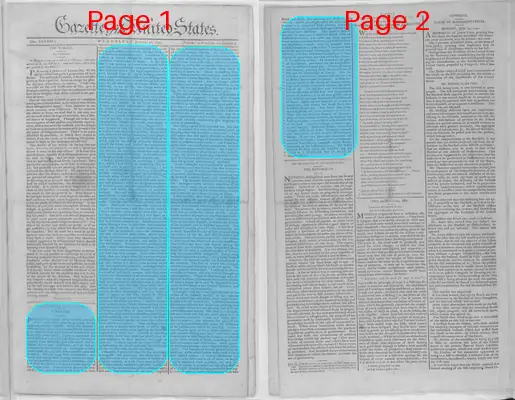
Literary
January 27, 1790
Gazette Of The United States
New York, New York County, New York
What is this article about?
In this allegorical reverie, the narrator observes the Goddess of Love's departure, causing human society to lose vivacity, tenderness, and artistic inspiration, leading to melancholy. Her return revives nature and emotions. She addresses mortals, emphasizing love's power over the soul despite its pains.
Merged-components note: These two components form the complete 'A REVERIE' essay, with text continuing directly across the page boundary.
Clippings
1 of 2
OCR Quality
95%
Excellent
Full Text
FOR THE GAZETTE OF THE UNITED STATES.
A REVERIE.
(Concluded.)
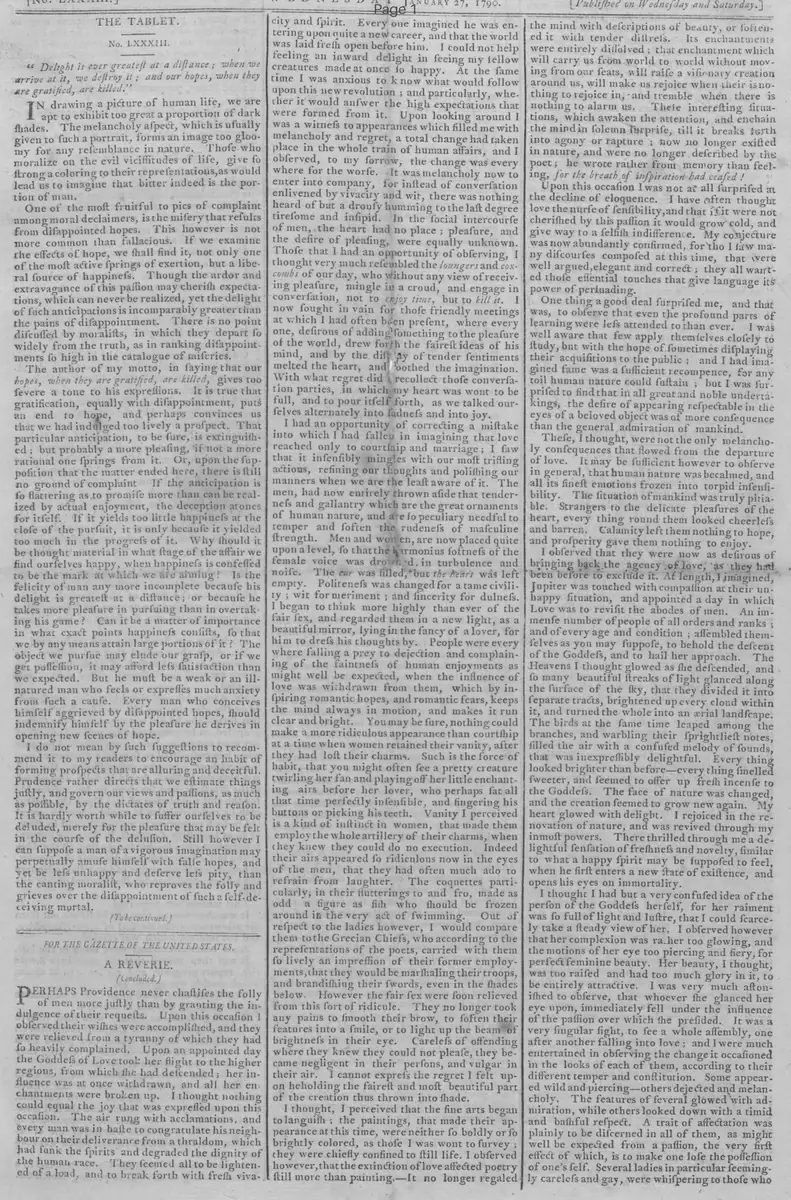
Perhaps Providence never chastises the folly of men more justly than by granting the indulgence of their requests. Upon this occasion I observed their wishes were accomplished, and they were relieved from a tyranny of which they had so heavily complained. Upon an appointed day the Goddess of Love took her flight to the higher regions, from which she had descended; her influence was at once withdrawn, and all her enchantments were broken up. I thought nothing could equal the joy that was expressed upon this occasion. The air rung with acclamations, and every man was in haste to congratulate his neighbour on their deliverance from a thraldom, which had sunk the spirits and degraded the dignity of the human race. They seemed all to be lightened of a load, and to break forth with fresh vivacity and spirit. Every one imagined he was entering upon quite a new career, and that the world was laid fresh open before him. I could not help feeling an inward delight in seeing my fellow creatures made at once so happy. At the same time I was anxious to know what would follow upon this new revolution; and particularly, whether it would answer the high expectations that were formed from it. Upon looking around I was a witness to appearances which filled me with melancholy and regret, a total change had taken place in the whole train of human affairs, and I observed, to my sorrow, the change was everywhere for the worse. It was melancholy now to enter into company, for instead of conversation enlivened by vivacity and wit, there was nothing heard of but a drowsy humming to the last degree tiresome and insipid. In the social intercourse of men, the heart had no place; pleasure, and the desire of pleasing, were equally unknown. Those that I had an opportunity of observing, I thought very much resembled the loungers and coxcombs of our day, who without any view of receiving pleasure, mingle in a crowd, and engage in conversation, not to enjoy time, but to kill it. I now sought in vain for those friendly meetings at which I had often been present, where every one, desirous of adding something to the pleasure of the world, drew forth the fairest ideas of his mind, and by the display of tender sentiments melted the heart, and soothed the imagination. With what regret did I recollect those conversation parties, in which my heart was wont to be full, and to pour itself forth, as we talked ourselves alternately into sadness and into joy.
I had an opportunity of correcting a mistake into which I had fallen in imagining that love reached only to courtship and marriage; I saw that it insensibly mingles with our most trifling actions, refining our thoughts and polishing our manners when we are the least aware of it. The men, had now entirely thrown aside that tenderness and gallantry which are the great ornaments of human nature, and are so peculiarly needful to temper and soften the rudeness of masculine strength. Men and women, are now placed quite upon a level, so that the harmonious softness of the female voice was drowned in turbulence and noise. The ear was filled, but the heart was left empty. Politeness was changed for a tame civility; wit for merriment; and sincerity for dulness. I began to think more highly than ever of the fair sex, and regarded them in a new light, as a beautiful mirror, lying in the fancy of a lover, for him to dress his thoughts by. People were everywhere falling a prey to dejection and complaining of the faintness of human enjoyments as might well be expected, when the influence of love was withdrawn from them, which by inspiring romantic hopes, and romantic fears, keeps the mind always in motion, and makes it run clear and bright. You may be sure, nothing could make a more ridiculous appearance than courtship at a time when women retained their vanity, after they had lost their charms. Such is the force of habit, that you might often see a pretty creature twirling her fan and playing off her little enchanting airs before her lover, who perhaps at all that time perfectly insensible, and fingering his buttons or picking his teeth. Vanity I perceived is a kind of instinct in women, that made them employ the whole artillery of their charms, when they knew they could do no execution. Indeed their airs appeared so ridiculous now in the eyes of the men, that they had often much ado to refrain from laughter. The coquettes particularly, in their flutterings to and fro, made as odd a figure as fish who should be frozen around in the very act of swimming. Out of respect to the ladies however, I would compare them to the Grecian Chiefs, who according to the representations of the poets, carried with them so lively an impression of their former employments, that they would be marshaling their troops, and brandishing their swords, even in the shades below. However the fair sex were soon relieved from this sort of ridicule. They no longer took any pains to smooth their brow, to soften their features into a smile, or to light up the beam of brightness in their eye. Careless of offending where they knew they could not please, they became negligent in their persons, and vulgar in their air. I cannot express the regret I felt upon beholding the fairest and most beautiful part of the creation thus thrown into shade.
I thought, I perceived that the fine arts began to languish; the paintings, that made their appearance at this time, were neither so boldly or so brightly colored, as those I was wont to survey; they were chiefly confined to still life. I observed however, that the extinction of love affected poetry still more than painting. It no longer regaled the mind with descriptions of beauty, or softened it with tender distresses. Its enchantments were entirely dissolved; that enchantment which will carry us from world to world without moving from our seats, will raise a visionary creation around us, will make us rejoice when there is nothing to rejoice in, -and tremble when there is nothing to alarm us. These interesting situations, which awaken the attention, and enchain the mind in solemn surprise, till it breaks forth into agony or rapture; now no longer existed in nature, and were no longer described by the poet; he wrote rather from memory than feeling, for the breath of inspiration had ceased!
Upon this occasion I was not at all surprised at the decline of eloquence. I have often thought love the nurse of sensibility, and that if it were not cherished by this passion it would grow cold, and give way to a selfish indifference. My conjecture was now abundantly confirmed, for though I saw many discourses composed at this time, that were well argued, elegant and correct; they all wanted those essential touches that give language its power of persuading.
One thing a good deal surprised me, and that was, to observe that even the profound parts of learning were less attended to than ever. I was well aware that few apply themselves closely to study, but with the hope of sometimes displaying their acquisitions to the public; and I had imagined fame was a sufficient recompence, for any toil human nature could sustain; but I was surprised to find that in all great and noble undertakings, the desire of appearing respectable in the eyes of a beloved object was of more consequence than the general admiration of mankind.
These, I thought, were not the only melancholy consequences that flowed from the departure of love. It may be sufficient however to observe in general, that human nature was becalmed, and all its finest emotions frozen into torpid insensibility. The situation of mankind was truly pitiable. Strangers to the delicate pleasures of the heart, every thing round them looked cheerless and barren. Calamity left them nothing to hope, and prosperity gave them nothing to enjoy.
I observed that they were now as desirous of bringing back the agency of love, as they had been before to exclude it. At length, I imagined, Jupiter was touched with compassion at their unhappy situation, and appointed a day in which Love was to revisit the abodes of men. An immense number of people of all orders and ranks; and of every age and condition; assembled themselves as you may suppose, to behold the descent of the Goddess, and to hail her approach. The Heavens I thought glowed as she descended, and so many beautiful streaks of light glanced along the surface of the sky, that they divided it into separate tracts, brightened up every cloud within it, and turned the whole into an aerial landscape. The birds at the same time leaped among the branches, and warbling their sprightliest notes, filled the air with a confused melody of sounds, that was inexpressibly delightful. Every thing looked brighter than before every thing smelled sweeter, and seemed to offer up fresh incense to the Goddess. The face of nature was changed, and the creation seemed to grow new again. My heart glowed with delight. I rejoiced in the renovation of nature, and was revived through my inmost powers. There thrilled through me a delightful sensation of freshness and novelty, similar to what a happy spirit may be supposed to feel, when he first enters a new state of existence, and opens his eyes on immortality.
I thought I had but a very confused idea of the person of the Goddess herself, for her raiment was so full of light and lustre, that I could scarcely take a steady view of her. I observed however that her complexion was rather too glowing, and the motions of her eye too piercing and fiery, for perfect feminine beauty. Her beauty, I thought, was too raised and had too much glory in it, to be entirely attractive. I was very much astonished to observe, that whoever she glanced her eye upon, immediately fell under the influence of the passion over which she presided. It was a very singular sight, to see a whole assembly, one after another falling into love; and I was much entertained in observing the change it occasioned in the looks of each of them, according to their different temper and constitution. Some appeared wild and piercing—others dejected and melancholy. The features of several glowed with admiration, while others looked down with a timid and bashful respect. A trait of affectation was plainly to be discerned in all of them, as might well be expected from a passion, the very first effect of which, is to make one lose the possession of one's self. Several ladies in particular seemingly careless and gay, were whispering to those who
Stood next them, and assuming airs of particular vivacity, whilst you might easily see their countenance was chequered with anxiety, lest they should chance not to please those upon whom they had fixed their affections. The greater part of the fair sex however, I observed smiled with an ineffable sweetness, nor could any thing appear more lovely than their features, upon which there was imprinted a tender reserve, mingled with modest complacency and desire. I imagined that after the goddess had thoroughly surveyed the assembly, and they had seated themselves in some degree of composure, she thus addressed them—
"Ye children of men. Ye abound in the gifts of Providence, and many are the favors Heaven has bestowed upon you. The earth teems with bounty, pouring forth the necessaries of life and the refinements of luxury. The sea refreshes you with its breezes and carries you to distant shores upon its bosom; it links nation to nation in the bonds of mutual advantage, and transfers to every climate, the blessings of all. To the sun you are indebted for the splendor of the day, and the grateful return of seasons; it is he who guides you as you wander through the trackless wilderness of space, lights up the beauties of nature around you, and makes her break forth into fruitfulness and joy. But know that these, though delightful, are not the pleasures of the heart. They will not heal the wounds of fortune; they will not enchant solitude, or suspend the feeling of pain. Know that I only am mistress of the soul. To me it belongs to impart agony and rapture. Hope and despair, terror and delight, walk in my train. My power extends over time itself, as well as over all sublunary beings. It can turn ages into moments and moments into ages. Lament not the dispensations of Providence, amongst which the bestowment of my influence is one. HE WHO FEELS IT MAY NOT BE HAPPY, but HE WHO IS A STRANGER TO IT MUST BE MISERABLE."
H.
A REVERIE.
(Concluded.)
Perhaps Providence never chastises the folly of men more justly than by granting the indulgence of their requests. Upon this occasion I observed their wishes were accomplished, and they were relieved from a tyranny of which they had so heavily complained. Upon an appointed day the Goddess of Love took her flight to the higher regions, from which she had descended; her influence was at once withdrawn, and all her enchantments were broken up. I thought nothing could equal the joy that was expressed upon this occasion. The air rung with acclamations, and every man was in haste to congratulate his neighbour on their deliverance from a thraldom, which had sunk the spirits and degraded the dignity of the human race. They seemed all to be lightened of a load, and to break forth with fresh vivacity and spirit. Every one imagined he was entering upon quite a new career, and that the world was laid fresh open before him. I could not help feeling an inward delight in seeing my fellow creatures made at once so happy. At the same time I was anxious to know what would follow upon this new revolution; and particularly, whether it would answer the high expectations that were formed from it. Upon looking around I was a witness to appearances which filled me with melancholy and regret, a total change had taken place in the whole train of human affairs, and I observed, to my sorrow, the change was everywhere for the worse. It was melancholy now to enter into company, for instead of conversation enlivened by vivacity and wit, there was nothing heard of but a drowsy humming to the last degree tiresome and insipid. In the social intercourse of men, the heart had no place; pleasure, and the desire of pleasing, were equally unknown. Those that I had an opportunity of observing, I thought very much resembled the loungers and coxcombs of our day, who without any view of receiving pleasure, mingle in a crowd, and engage in conversation, not to enjoy time, but to kill it. I now sought in vain for those friendly meetings at which I had often been present, where every one, desirous of adding something to the pleasure of the world, drew forth the fairest ideas of his mind, and by the display of tender sentiments melted the heart, and soothed the imagination. With what regret did I recollect those conversation parties, in which my heart was wont to be full, and to pour itself forth, as we talked ourselves alternately into sadness and into joy.
I had an opportunity of correcting a mistake into which I had fallen in imagining that love reached only to courtship and marriage; I saw that it insensibly mingles with our most trifling actions, refining our thoughts and polishing our manners when we are the least aware of it. The men, had now entirely thrown aside that tenderness and gallantry which are the great ornaments of human nature, and are so peculiarly needful to temper and soften the rudeness of masculine strength. Men and women, are now placed quite upon a level, so that the harmonious softness of the female voice was drowned in turbulence and noise. The ear was filled, but the heart was left empty. Politeness was changed for a tame civility; wit for merriment; and sincerity for dulness. I began to think more highly than ever of the fair sex, and regarded them in a new light, as a beautiful mirror, lying in the fancy of a lover, for him to dress his thoughts by. People were everywhere falling a prey to dejection and complaining of the faintness of human enjoyments as might well be expected, when the influence of love was withdrawn from them, which by inspiring romantic hopes, and romantic fears, keeps the mind always in motion, and makes it run clear and bright. You may be sure, nothing could make a more ridiculous appearance than courtship at a time when women retained their vanity, after they had lost their charms. Such is the force of habit, that you might often see a pretty creature twirling her fan and playing off her little enchanting airs before her lover, who perhaps at all that time perfectly insensible, and fingering his buttons or picking his teeth. Vanity I perceived is a kind of instinct in women, that made them employ the whole artillery of their charms, when they knew they could do no execution. Indeed their airs appeared so ridiculous now in the eyes of the men, that they had often much ado to refrain from laughter. The coquettes particularly, in their flutterings to and fro, made as odd a figure as fish who should be frozen around in the very act of swimming. Out of respect to the ladies however, I would compare them to the Grecian Chiefs, who according to the representations of the poets, carried with them so lively an impression of their former employments, that they would be marshaling their troops, and brandishing their swords, even in the shades below. However the fair sex were soon relieved from this sort of ridicule. They no longer took any pains to smooth their brow, to soften their features into a smile, or to light up the beam of brightness in their eye. Careless of offending where they knew they could not please, they became negligent in their persons, and vulgar in their air. I cannot express the regret I felt upon beholding the fairest and most beautiful part of the creation thus thrown into shade.
I thought, I perceived that the fine arts began to languish; the paintings, that made their appearance at this time, were neither so boldly or so brightly colored, as those I was wont to survey; they were chiefly confined to still life. I observed however, that the extinction of love affected poetry still more than painting. It no longer regaled the mind with descriptions of beauty, or softened it with tender distresses. Its enchantments were entirely dissolved; that enchantment which will carry us from world to world without moving from our seats, will raise a visionary creation around us, will make us rejoice when there is nothing to rejoice in, -and tremble when there is nothing to alarm us. These interesting situations, which awaken the attention, and enchain the mind in solemn surprise, till it breaks forth into agony or rapture; now no longer existed in nature, and were no longer described by the poet; he wrote rather from memory than feeling, for the breath of inspiration had ceased!
Upon this occasion I was not at all surprised at the decline of eloquence. I have often thought love the nurse of sensibility, and that if it were not cherished by this passion it would grow cold, and give way to a selfish indifference. My conjecture was now abundantly confirmed, for though I saw many discourses composed at this time, that were well argued, elegant and correct; they all wanted those essential touches that give language its power of persuading.
One thing a good deal surprised me, and that was, to observe that even the profound parts of learning were less attended to than ever. I was well aware that few apply themselves closely to study, but with the hope of sometimes displaying their acquisitions to the public; and I had imagined fame was a sufficient recompence, for any toil human nature could sustain; but I was surprised to find that in all great and noble undertakings, the desire of appearing respectable in the eyes of a beloved object was of more consequence than the general admiration of mankind.
These, I thought, were not the only melancholy consequences that flowed from the departure of love. It may be sufficient however to observe in general, that human nature was becalmed, and all its finest emotions frozen into torpid insensibility. The situation of mankind was truly pitiable. Strangers to the delicate pleasures of the heart, every thing round them looked cheerless and barren. Calamity left them nothing to hope, and prosperity gave them nothing to enjoy.
I observed that they were now as desirous of bringing back the agency of love, as they had been before to exclude it. At length, I imagined, Jupiter was touched with compassion at their unhappy situation, and appointed a day in which Love was to revisit the abodes of men. An immense number of people of all orders and ranks; and of every age and condition; assembled themselves as you may suppose, to behold the descent of the Goddess, and to hail her approach. The Heavens I thought glowed as she descended, and so many beautiful streaks of light glanced along the surface of the sky, that they divided it into separate tracts, brightened up every cloud within it, and turned the whole into an aerial landscape. The birds at the same time leaped among the branches, and warbling their sprightliest notes, filled the air with a confused melody of sounds, that was inexpressibly delightful. Every thing looked brighter than before every thing smelled sweeter, and seemed to offer up fresh incense to the Goddess. The face of nature was changed, and the creation seemed to grow new again. My heart glowed with delight. I rejoiced in the renovation of nature, and was revived through my inmost powers. There thrilled through me a delightful sensation of freshness and novelty, similar to what a happy spirit may be supposed to feel, when he first enters a new state of existence, and opens his eyes on immortality.
I thought I had but a very confused idea of the person of the Goddess herself, for her raiment was so full of light and lustre, that I could scarcely take a steady view of her. I observed however that her complexion was rather too glowing, and the motions of her eye too piercing and fiery, for perfect feminine beauty. Her beauty, I thought, was too raised and had too much glory in it, to be entirely attractive. I was very much astonished to observe, that whoever she glanced her eye upon, immediately fell under the influence of the passion over which she presided. It was a very singular sight, to see a whole assembly, one after another falling into love; and I was much entertained in observing the change it occasioned in the looks of each of them, according to their different temper and constitution. Some appeared wild and piercing—others dejected and melancholy. The features of several glowed with admiration, while others looked down with a timid and bashful respect. A trait of affectation was plainly to be discerned in all of them, as might well be expected from a passion, the very first effect of which, is to make one lose the possession of one's self. Several ladies in particular seemingly careless and gay, were whispering to those who
Stood next them, and assuming airs of particular vivacity, whilst you might easily see their countenance was chequered with anxiety, lest they should chance not to please those upon whom they had fixed their affections. The greater part of the fair sex however, I observed smiled with an ineffable sweetness, nor could any thing appear more lovely than their features, upon which there was imprinted a tender reserve, mingled with modest complacency and desire. I imagined that after the goddess had thoroughly surveyed the assembly, and they had seated themselves in some degree of composure, she thus addressed them—
"Ye children of men. Ye abound in the gifts of Providence, and many are the favors Heaven has bestowed upon you. The earth teems with bounty, pouring forth the necessaries of life and the refinements of luxury. The sea refreshes you with its breezes and carries you to distant shores upon its bosom; it links nation to nation in the bonds of mutual advantage, and transfers to every climate, the blessings of all. To the sun you are indebted for the splendor of the day, and the grateful return of seasons; it is he who guides you as you wander through the trackless wilderness of space, lights up the beauties of nature around you, and makes her break forth into fruitfulness and joy. But know that these, though delightful, are not the pleasures of the heart. They will not heal the wounds of fortune; they will not enchant solitude, or suspend the feeling of pain. Know that I only am mistress of the soul. To me it belongs to impart agony and rapture. Hope and despair, terror and delight, walk in my train. My power extends over time itself, as well as over all sublunary beings. It can turn ages into moments and moments into ages. Lament not the dispensations of Providence, amongst which the bestowment of my influence is one. HE WHO FEELS IT MAY NOT BE HAPPY, but HE WHO IS A STRANGER TO IT MUST BE MISERABLE."
H.
What sub-type of article is it?
Vision Or Dream
Allegory
Essay
What themes does it cover?
Love Romance
Moral Virtue
Social Manners
What keywords are associated?
Reverie
Goddess Of Love
Human Nature
Social Decline
Arts And Eloquence
Providence
Romantic Influence
What entities or persons were involved?
H.
Literary Details
Title
A Reverie.
Author
H.
Form / Style
Allegorical Reverie In Prose
Key Lines
Perhaps Providence Never Chastises The Folly Of Men More Justly Than By Granting The Indulgence Of Their Requests.
He Who Feels It May Not Be Happy, But He Who Is A Stranger To It Must Be Miserable.
I Have Often Thought Love The Nurse Of Sensibility, And That If It Were Not Cherished By This Passion It Would Grow Cold, And Give Way To A Selfish Indifference.