Thank you for visiting SNEWPapers!
Sign up free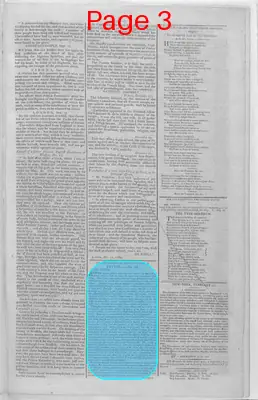
Letter to Editor
February 27, 1790
Gazette Of The United States
New York, New York County, New York
What is this article about?
In Letter No. III to Mr. Fenno, Rusticus contends that woolly-haired negroes are innately inferior and suited for slavery, citing historical revolts and modern English/French failures in freeing them, including a personal 1786 incident.
Clipping
OCR Quality
98%
Excellent
Full Text
FOR THE GAZETTE OF THE UNITED STATES.
LETTER No. III.
MR. FENNO,
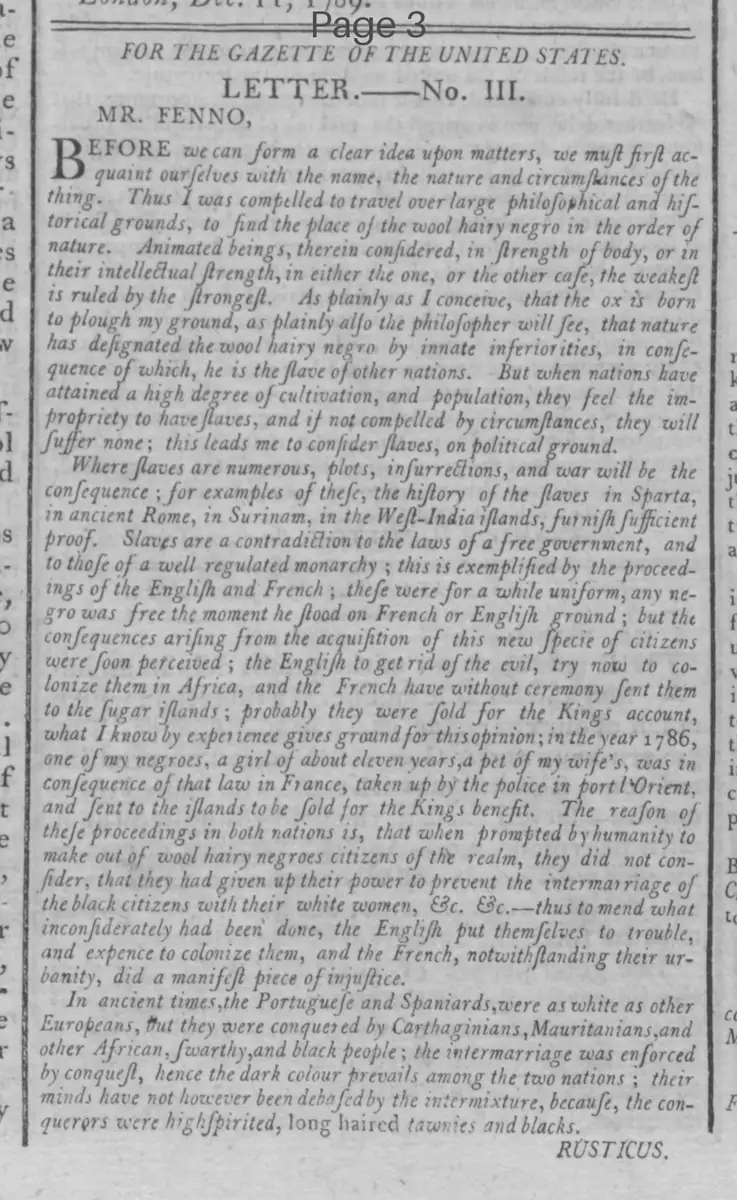
Before we can form a clear idea upon matters, we must first acquaint ourselves with the name, the nature and circumstances of the thing. Thus I was compelled to travel over large philosophical and historical grounds, to find the place of the woolly haired negro in the order of nature. Animated beings, therein considered, in strength of body, or in their intellectual strength, in either the one, or the other case, the weakest is ruled by the strongest. As plainly as I conceive, that the ox is born to plough my ground, as plainly also the philosopher will see, that nature has designated the woolly haired negro by innate inferiorities, in consequence of which, he is the slave of other nations. But when nations have attained a high degree of cultivation, and population, they feel the impropriety to have slaves, and if not compelled by circumstances, they will suffer none; this leads me to consider slaves, on political ground.
Where slaves are numerous, plots, insurrections, and war will be the consequence; for examples of these, the history of the slaves in Sparta, in ancient Rome, in Surinam, in the West-India islands, furnish sufficient proof. Slaves are a contradiction to the laws of a free government, and to those of a well regulated monarchy; this is exemplified by the proceedings of the English and French; these were for a while uniform, any negro was free the moment he stood on French or English ground; but the consequences arising from the acquisition of this new species of citizens were soon perceived; the English to get rid of the evil, try now to colonize them in Africa, and the French have without ceremony sent them to the sugar islands; probably they were sold for the King's account, what I know by experience gives ground for this opinion; in the year 1786, one of my negroes, a girl of about eleven years, a pet of my wife's, was in consequence of that law in France, taken up by the police in Port l'Orient, and sent to the islands to be sold for the King's benefit. The reason of these proceedings in both nations is, that when prompted by humanity to make out of woolly haired negroes citizens of the realm, they did not consider, that they had given up their power to prevent the intermarriage of the black citizens with their white women, &c. &c.—thus to mend what inconsiderately had been done, the English put themselves to trouble, and expense to colonize them, and the French, notwithstanding their urbanity, did a manifest piece of injustice.
In ancient times, the Portuguese and Spaniards, were as white as other Europeans, but they were conquered by Carthaginians, Mauritanians, and other African, swarthy, and black people; the intermarriage was enforced by conquest, hence the dark colour prevails among the two nations; their minds have not however been debased by the intermixture, because, the conquerors were high spirited, long haired tawnies and blacks.
RUSTICUS.
LETTER No. III.
MR. FENNO,
Before we can form a clear idea upon matters, we must first acquaint ourselves with the name, the nature and circumstances of the thing. Thus I was compelled to travel over large philosophical and historical grounds, to find the place of the woolly haired negro in the order of nature. Animated beings, therein considered, in strength of body, or in their intellectual strength, in either the one, or the other case, the weakest is ruled by the strongest. As plainly as I conceive, that the ox is born to plough my ground, as plainly also the philosopher will see, that nature has designated the woolly haired negro by innate inferiorities, in consequence of which, he is the slave of other nations. But when nations have attained a high degree of cultivation, and population, they feel the impropriety to have slaves, and if not compelled by circumstances, they will suffer none; this leads me to consider slaves, on political ground.
Where slaves are numerous, plots, insurrections, and war will be the consequence; for examples of these, the history of the slaves in Sparta, in ancient Rome, in Surinam, in the West-India islands, furnish sufficient proof. Slaves are a contradiction to the laws of a free government, and to those of a well regulated monarchy; this is exemplified by the proceedings of the English and French; these were for a while uniform, any negro was free the moment he stood on French or English ground; but the consequences arising from the acquisition of this new species of citizens were soon perceived; the English to get rid of the evil, try now to colonize them in Africa, and the French have without ceremony sent them to the sugar islands; probably they were sold for the King's account, what I know by experience gives ground for this opinion; in the year 1786, one of my negroes, a girl of about eleven years, a pet of my wife's, was in consequence of that law in France, taken up by the police in Port l'Orient, and sent to the islands to be sold for the King's benefit. The reason of these proceedings in both nations is, that when prompted by humanity to make out of woolly haired negroes citizens of the realm, they did not consider, that they had given up their power to prevent the intermarriage of the black citizens with their white women, &c. &c.—thus to mend what inconsiderately had been done, the English put themselves to trouble, and expense to colonize them, and the French, notwithstanding their urbanity, did a manifest piece of injustice.
In ancient times, the Portuguese and Spaniards, were as white as other Europeans, but they were conquered by Carthaginians, Mauritanians, and other African, swarthy, and black people; the intermarriage was enforced by conquest, hence the dark colour prevails among the two nations; their minds have not however been debased by the intermixture, because, the conquerors were high spirited, long haired tawnies and blacks.
RUSTICUS.
What sub-type of article is it?
Persuasive
Historical
Philosophical
What themes does it cover?
Slavery Abolition
Morality
Politics
What keywords are associated?
Slavery
Racial Inferiority
Natural Order
Slave Insurrections
Emancipation Policies
Intermarriage
African Colonization
What entities or persons were involved?
Rusticus
Mr. Fenno
Letter to Editor Details
Author
Rusticus
Recipient
Mr. Fenno
Main Argument
argues that woolly-haired negroes are naturally inferior in body and intellect, destined by nature to be slaves of other nations; emancipation leads to insurrections and social contradictions in free governments, as shown by historical examples and english/french policies.
Notable Details
References Slave Plots And Insurrections In Sparta, Ancient Rome, Surinam, West India Islands
Cites English Efforts To Colonize Negroes In Africa And French Deportation To Sugar Islands
Personal Anecdote Of Negro Girl Taken By Police In Port L'orient In 1786 And Sent To Islands
Explains Dark Color Of Portuguese And Spaniards Due To Intermarriage Enforced By African Conquerors