Thank you for visiting SNEWPapers!
Sign up free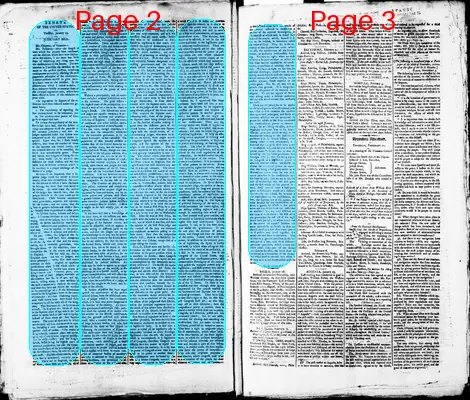
Alexandria Advertiser And Commercial Intelligencer
Alexandria, Virginia
What is this article about?
In a U.S. Senate debate on January 19, Mr. Chipman of Vermont argues against repealing the Judiciary Act of 1801, defending its necessity over the 1789 system, critiquing English judicial comparisons, and asserting Congress lacks constitutional power to abolish courts and judges' salaries without violating ex post facto principles.
Merged-components note: This is the continuation of the Senate Judiciary Bill debate story across pages 2 and 3, ending with '(To be continued.)'.
Clippings
1 of 2
OCR Quality
Full Text
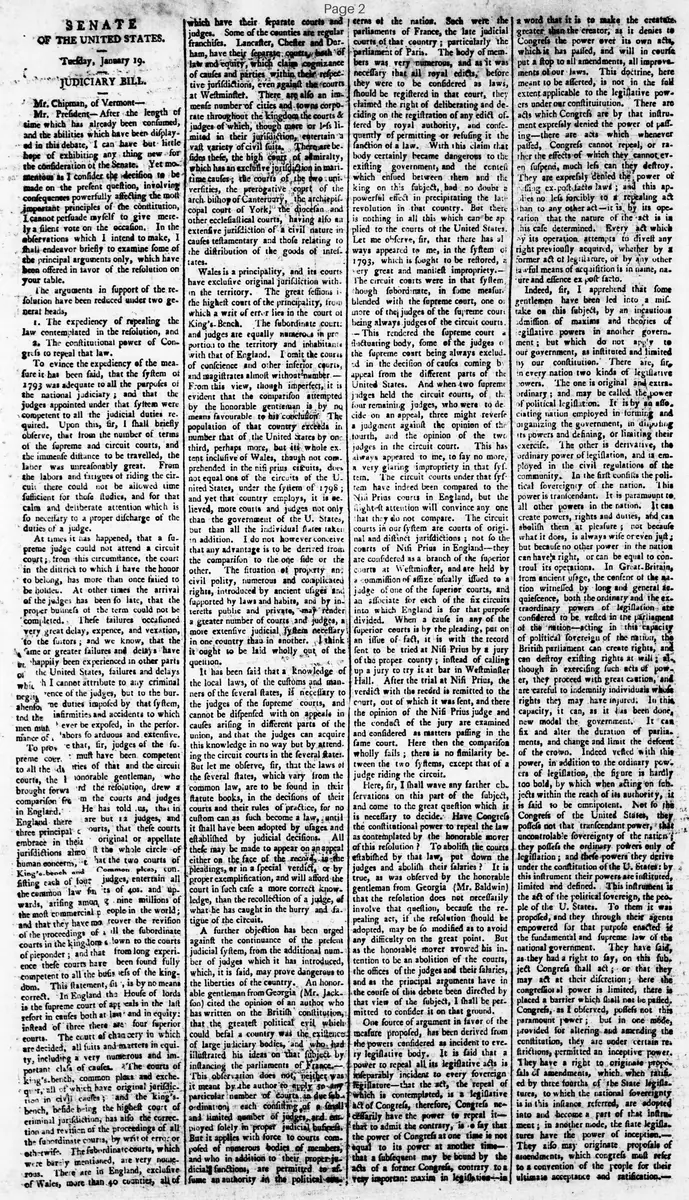
OF THE UNITED STATES.
Tuesday, January 19.
JUDICIARY BILL.
Mr. Chipman, of Vermont--.
Mr. President-- After the length of time which has already been consumed, and the abilities which have been displayed in this debate, I can have but little hope of exhibiting any thing new for the consideration of the Senate. Yet momentous as I consider the decision to be made on the present question, involving consequences powerfully affecting the most important principles of the constitution, I cannot persuade myself to give merely a silent vote on the occasion. In the observations which I intend to make, I shall endeavor briefly to examine some of the principal arguments only, which have been offered in favor of the resolution on your table.
The arguments in support of the resolution have been reduced under two general heads,
1. The expediency of repealing the law contemplated in the resolution, and
2. The constitutional power of Congress to repeal that law.
To evince the expediency of the measure it has been said, that the system of 1793 was adequate to all the purposes of the national judiciary; and that the judges appointed under that system were competent to all the judicial duties required. Upon this, sir, I shall briefly observe, that from the number of terms of the supreme and circuit courts, and the immense distance to be travelled, the labor was unreasonably great. From the labors and fatigues of riding the circuit there could not be allowed time sufficient for those studies, and for that calm and deliberate attention which is so necessary to a proper discharge of the duties of a judge.
At times it has happened, that a supreme judge could not attend a circuit court; from this circumstance, the court in the district to which I have the honor to belong, has more than once failed to be holden. At other times the arrival of the judges has been so late, that the proper business of the term could not be completed. These failures occasioned very great delay, expense, and vexation, to the suitors; and we know, that the same or greater failures and delays have been experienced in other parts of the United States, failures and delays which I cannot attribute to any criminal negligence of the judges, but to the burdensome duties imposed by that system, and the infirmities and accidents to which men are ever exposed, in the performance of labors so arduous and extensive.
To prove that, sir, judges of the supreme court must have been competent to all the duties of that and the circuit courts, the honorable gentleman, who brought forward the resolution, drew a comparison from the courts and judges in England.
He has told us, that in England there are but 12 judges, and three principal courts, that these courts embrace in their original or appellate jurisdictions almost the whole circle of human concerns. That the two courts of King's-Bench and Common Pleas, consisting each of four judges, entertain all the common law suits of £40. and upwards, arising among nine millions of people; and that they have moreover the revision of the most commercial people in the world: of the proceedings of all the subordinate courts in the kingdom shown to the courts hence these courts have been found fully adequate; and that from long experience they have been competent to all the business of the kingdom. This statement, sir, is by no means correct. In England the House of Lords is the supreme court of appeals in the last resort in causes both at law and in equity: instead of three there are four superior courts. The court of chancery in which are decided all suits and matters in equity, including a very numerous and important class of causes. The courts of king's-bench, common pleas and exchequer, all of which have original jurisdiction in civil causes; and the king's-bench, beside being the highest court of criminal jurisdiction, has also the correction and revision of the proceedings of all the subordinate courts, by writ of error: or otherwise. The subordinate courts, which were barely mentioned, are very numerous. There are in England, exclusive of Wales, more than 40 counties, all of which have their separate courts and judges. Some of the counties are regular franchises. Lancaster, Chester and Durham, have their separate courts both of law and equity, which claim cognizance of causes and parties within their respective jurisdictions, even against the courts at Westminster. There are also an immense number of cities and towns corporate throughout the kingdom the courts & judges of which, though more or less limited in their jurisdiction, entertain a vast variety of civil suits. There are besides these, the high court of admiralty, which has an exclusive jurisdiction in maritime causes; the courts of the two universities, the prerogative court of the archbishop of Canterbury, the archiepiscopal court of York the diocesan and other ecclesiastical courts, having also an extensive jurisdiction of a civil nature in causes testamentary and those relating to the distribution of the goods of intestates.
Wales is a principality, and its courts have exclusive original jurisdiction within the territory. The great sessions is the highest court of the principality, from which a writ of error lies in the court of King's-Bench. The subordinate courts and judges are equally numerous in proportion to the territory and inhabitants with that of England. I omit the courts of conscience and other inferior courts, and magistrates almost without number.
From this view, though imperfect, it is evident that the comparison attempted by the honorable gentleman is by no means favourable to his conclusion. The population of that country exceeds in number that of the United States by one third, perhaps more, but its whole extent inclusive of Wales, though not comprehended in the nisi prius circuits, does not equal one of the circuits of the United States, under the system of 1798; and yet that country employs, it is believed, more courts and judges not only than the government of the U. States, but than all the individual states taken in addition. I do not however conceive that any advantage is to be derived from the comparison to the one side or the other. The situation of property and civil polity, numerous and complicated rights, introduced by ancient usages and supported by laws and habits, and by interests public and private, may render a greater number of courts and judges, a more extensive judicial system necessary in one country than in another. I think it ought to be laid wholly out of the question.
And it has been said that a knowledge of the local laws, of the customs and manners of the several states, is necessary to the judges of the supreme courts, and cannot be dispensed with on appeal in causes arising in different parts of the union, and that the judges can acquire this knowledge in no way but by attending the circuit courts in the several states. But let me observe, sir, that the laws of the several states, which vary from the common law, are to be found in their statute books, in the decisions of their courts and their rules of practice, for no custom can such become a law, until it shall have been adopted by usages and established by judicial decisions. All these may be made to appear on an appeal either on the face of the record, in the pleadings, or in a special verdict, or by proper exemplification, and will afford the court in such case a more correct knowledge, than the recollection of a judge, of what he has caught in the hurry and fatigue of the circuit.
A further objection has been urged against the continuance of the present judicial system, from the additional number of judges which it has introduced, which, it is said, may prove dangerous to the liberties of the country. An honorable gentleman from Georgia (Mr. Jackson) cited the opinion of an author who has written on the British constitution, that the greatest political evil which could befall a country was the existence of large judiciary bodies, and who had illustrated his ideas on that subject by instancing the parliaments of France.-- This observation does not, neither was it meant by the author to apply to any particular number of courts in due subordination each consisting of a small and limited number of judges, and employed solely in proper judicial business. But it applies with force to courts composed of numerous bodies of members, and who in addition to their proper judicial functions, are permitted to assume an authority in the political concerns of the nation. Such were the parliaments of France, the late judicial courts of that country; particularly the parliament of Paris. The body of members was very numerous. and as it was necessary that all royal edicts, before they were to be considered as laws, should be registered in that court, they claimed the right of deliberating and deciding on the registration of any edict offered by royal authority, and consequently of permitting or refusing it the sanction of a law. With this claim that body certainly became dangerous to the existing government, and the contest which ensued between them and the king on this subject, had no doubt a powerful effect in precipitating the late revolution in that country. But there is nothing in all this which can be applied to the courts of the United States. Let me observe, sir, that there has always appeared to me, in the system of 1793, which is ought to be restored, a very great and manifest impropriety. The circuit courts were in that system though subordinate, in some measure blended with the supreme court, one or more of the judges of the supreme court being always judges of the circuit courts. This rendered the supreme court fluctuating body, some of the judges of the supreme court being always excluded in the decision of causes coming by appeal from the different parts of the United States. And when two supreme judges held the circuit courts, of the four remaining judges, who were to decide on an appeal, three might reverse a judgment against the opinion of the fourth, and the opinion of the two judges in the circuit court. This has always appeared to me, to say no more, a very glaring impropriety in that system. The circuit courts under that system have indeed been compared to the Nisi Prius courts in England, but the slightest attention will convince any one that they do not compare. The circuit courts in our system are courts of original and distinct jurisdictions; not so the courts of Nisi Prius in England--they are considered as a branch of the superior courts at Westminster, and are held by a commission of assize usually issued to a judge of one of the superior courts, and an associate for each of the six circuits into which England is for that purpose divided. When a cause in any of the superior courts is by the pleading, put on an issue of fact, it is with the record sent to be tried at Nisi Prius by a jury of the proper county; instead of calling up a jury to try it at bar in Westminster Hall. After the trial at Nisi Prius, the verdict with the record is remitted to the court, out of which it was sent, and there the opinion of the Nisi Prius judge and the conduct of the jury are examined and considered as matters passing in the same court. Here then the comparison wholly fails; there is no similarity between the two systems, except that of a judge riding the circuit. Here, sir, I shall waive any farther observations on this part of the subject, and come to the great question which it is necessary to decide. Have Congress the constitutional power to repeal the law as contemplated by the honorable mover of this resolution? To abolish the courts established by that law, put down the judges and abolish their salaries? It is true, as was observed by the honorable gentleman from Georgia (Mr. Baldwin) that the resolution does not necessarily involve that question, because the repealing act, if the resolution should be adopted, may be so modified as to avoid any difficulty on the great point. But as the honorable mover avowed his intention to be an abolition of the courts, the offices of the judges and their salaries, and as the principal arguments have in the course of this debate been directed by that view of the subject, I shall be permitted to consider it on that ground. One source of argument in favor of the measure proposed, has been derived from the powers considered as incident to every legislative body. It is said that a power to repeal all its legislative acts is inseparably incident to every sovereign legislature--that the act, the repeal of which is contemplated, is a legislative act of Congress, therefore; Congress necessarily have the power to repeal it-- that to admit the contrary, is to say that the power of Congress at one time is not equal to its power at another time-- that a subsequent may be bound by the acts of a former Congress, contrary to a very important maxim in legislation--in a word that it is to make the creature greater than the creator, as it denies to Congress the power over its own acts, which it has passed, and will in course put a stop to all amendments, all improvements of our laws. This doctrine, here meant to be asserted, is not in the full extent applicable to the legislative powers under our constitution. There are acts which Congress are by that instrument expressly denied the power of passing--there are acts which whenever passed, Congress cannot repeal, or rather the effects of which they cannot even suspend, much less can they destroy. They are expressly denied the power of passing ex-post facto laws; and this applies no less forcibly to a repealing act than to any other act -it is by its operation that the nature of the act is in this case determined. Every act which by its operation, attempts to divest any right previously acquired, whether by former act of legislature, or by any other lawful means of acquisition is in name, nature and essence ex post facto. Indeed, sir, I apprehend that some gentlemen have been led into a mistake on this subject, by an incautious admission of maxims and theories of legislative powers in another government; but which do not apply to our government, as instituted and limited by our constitution. There are, sir, in every nation two kinds of legislative powers. The one is original and extraordinary; and may be called the power of political legislation: It is by an associating nation employed in forming and organizing the government, in distributing its powers and defining, or limiting their exercise. The other is derivative, the ordinary power of legislation, and is employed in the civil regulations of the community. In the first consists the political sovereignty of the nation. This power is transcendent. It is paramount to all other powers in the nation. It can create powers, rights and duties, and can abolish them at pleasure; not because what it does, is always wise or even just: but because no other power in the nation can have a right, or can be equal to control its operations. In Great-Britain, from ancient usage, the consent of the nation witnessed by long and general acquiescence, both the ordinary and the extraordinary powers of legislation are considered to be vested in the parliament of the nation--acting in that capacity of political sovereign of the nation, the British parliament can create rights, and can destroy existing rights at will; although in exercising such acts of power, they proceed with great caution, and are careful to indemnify individuals whose rights they may have injured. In this capacity, it can, as it has been done, new model the government. It can fix and alter the duration of parliaments, and change and limit the descent of the crown. Indeed vested with this power, in addition to the ordinary powers of legislation, the figure is hardly too bold, by which when acting on subjects within the reach of its authority, it is said to be omnipotent. Not so the Congress of the United States, they possess not that transcendent power, that uncontrollable sovereignty of the nation; they possess the ordinary powers only of legislation: and these powers they derive under the constitution of the U. States: by this instrument their powers are instituted limited and defined. This instrument is the act of the political sovereign, the people of the U. States. To them it was proposed, and they through their agents empowered for that purpose enacted it the fundamental and supreme law of the national government. They have said, as they had a right to say, on this subject Congress shall act; or that they may act at their discretion; here the congressional power is limited, there is placed a barrier which shall not be passed. Congress, as I observed, possesses not this paramount power; but in one mode, provided for altering and amending the constitution, they are under certain restrictions, permitted an inceptive power. They have a right to originate proposals of amendments, which, when ratified by three fourths of the State legislatures, to which the national sovereignty is in this instance referred, are adopted into and become a part of that instrument; in another mode, the state legislatures have the power of inception.-- They also may originate proposals of amendments, which congress must refer to a convention of the people for their ultimate acceptance and ratification.
In this instance alone have the people of this country reserved to themselves a portion of the national sovereignty, in the exercise of which only is found that voice of the people, which, because it is not to be resisted, is sometimes called the voice of God. This, sir, is the authority of that supreme law under which we act, the constitution of the United States; an authority indispensably binding. We have no right, when we wish to carry a favorite measure to which we find some barrier opposed by the constitution, to prostrate or overleap that barrier. We have no right to say that the national sovereign, could it now be consulted, would dispense with the limitation, would remove the barrier, which, in our present opinion, stands opposed to the public good. No, sir, we may not approach this ground. It is dangerous, it is an usurpation of the national sovereignty. We are but agents of the nation acting under a limited authority. All our acts which exceed that authority are void.
These are the principles to be applied in the investigation of constitutional powers. Let us then examine the constitution upon these principles, and fairly determine whether we are permitted the power for which it has been contended, the constitutional power to remove a judge, by abolishing the office, and consequently to deprive him of his salary?
The first provision which we find in the constitution relating to the judicial department is in the second section, where among other powers enumerated, it is declared that Congress shall have power 'to establish tribunals inferior to the supreme court.' Upon this it was observed by the honorable gentleman from Georgia (Mr. J.) that this being a grant to Congress of a legislative power to establish inferior courts, necessarily includes the incidental power to repeal; that this being a first grant cannot be restrained nor taken away by any subsequent provision in the constitution upon the same subject; that we are to take the rule of construction that the first grant and the first words of the grantor in a deed, shall prevail over a subsequent grant or subsequent words of a different import. Are we, indeed, sir, to apply in the construction of the constitution, the law, the supreme law of the nation, the rules devised for the construction of a deed, a grant, by which a few paltry acres are transferred from one individual to another? No, sir, very different are the rules of construction; the first act of the grantor but the last act of the legislature shall prevail: or where in any case is the power to repeal? Another rule more universally applicable is that you shall so construe a law that every part of it if possible may stand together, that every part may have its operation. Thus if there be a general provision in the former part of a law, and there follows a particular provision, which cannot take effect unless some part of the former provision be set aside, the latter shall be considered as a limitation of the former, and which shall be carried into effect so far only as it is not incompatible with the latter.
(To be continued.)
What sub-type of article is it?
What themes does it cover?
What keywords are associated?
What entities or persons were involved?
Where did it happen?
Story Details
Key Persons
Location
Senate Of The United States
Event Date
Tuesday, January 19
Story Details
Mr. Chipman argues against repealing the Judiciary Act, highlighting inefficiencies of the 1789 system, critiquing comparisons to English courts, and contending that Congress lacks constitutional authority to abolish courts and judges' salaries as it would violate ex post facto principles and exceed limited legislative powers.