Thank you for visiting SNEWPapers!
Sign up free
Gazette Of The United States
New York, New York County, New York
What is this article about?
At the Treaty of Newtown Point, Red Jacket (Teyyeyanaw) delivers a speech defending the Seneca's friendship with the British, explaining reliance on them for interpreting US treaties, and affirming commitment to peace with the Thirteen Fires (United States).
Clipping
OCR Quality
Full Text
BROTHER CANANDAIGUA,*
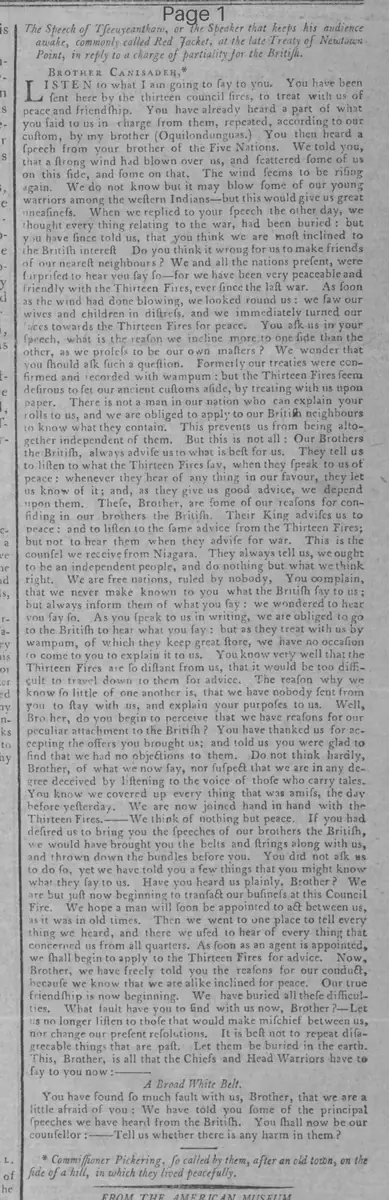
LISTEN to what I am going to say to you. You have been sent here by the thirteen council fires, to treat with us of peace and friendship. You have already heard a part of what you said to us in charge from them, repeated, according to our custom, by my brother (Oquilondunguas.) You then heard a speech from your brother of the Five Nations. We told you, that a strong wind had blown over us, and scattered some of us on this side, and some on that. The wind seems to be rising again. We do not know but it may blow some of our young warriors among the western Indians—but this would give us great uneasiness. When we replied to your speech the other day, we thought every thing relating to the war, had been buried: but you have since told us, that you think we are most inclined to the British interest. Do you think it wrong for us to make friends of our nearest neighbours? We and all the nations present, were surprised to hear you say so—for we have been very peaceable and friendly with the Thirteen Fires, ever since the last war. As soon as the wind had done blowing, we looked round us: we saw our wives and children in distress, and we immediately turned our faces towards the Thirteen Fires for peace. You ask us in your speech, what is the reason we incline more to one side than the other, as we profess to be our own masters? We wonder that you should ask such a question. Formerly our treaties were confirmed and recorded with wampum: but the Thirteen Fires seem desirous to set our ancient customs aside, by treating with us upon paper. There is not a man in our nation who can explain your rolls to us, and we are obliged to apply to our British neighbours to know what they contain. This prevents us from being altogether independent of them. But this is not all: Our Brothers the British, always advise us to what is best for us. They tell us to listen to what the Thirteen Fires say, when they speak to us of peace: whenever they hear of any thing in our favour, they let us know of it; and, as they give us good advice, we depend upon them. These, Brother, are some of our reasons for confiding in our brothers the British. Their King advises us to peace: and to listen to the same advice from the Thirteen Fires: but not to hear them when they advise for war. This is the counsel we receive from Niagara. They always tell us, we ought to be an independent people, and do nothing but what we think right. We are free nations, ruled by nobody. You complain, that we never make known to you what the British say to us; but always inform them of what you say: we wondered to hear you say so. As you speak to us in writing, we are obliged to go to the British to hear what you say: but as they treat with us by wampum, of which they keep great store, we have no occasion to come to you to explain it to us. You know very well that the Thirteen Fires are so distant from us, that it would be too difficult to travel down to them for advice. The reason why we know so little of one another is, that we have nobody sent from you to stay with us, and explain your purposes to us. Well, Brother, do you begin to perceive that we have reasons for our peculiar attachment to the British? You have thanked us for accepting the offers you brought us; and told us you were glad to find that we had no objections to them. Do not think hardly, Brother, of what we now say, nor suspect that we are in any degree deceived by listening to the voice of those who carry tales. You know we covered up every thing that was amiss, the day before yesterday. We are now joined hand in hand with the Thirteen Fires. -We think of nothing but peace. If you had desired us to bring you the speeches of our brothers the British, we would have brought you the belts and strings along with us, and thrown down the bundles before you. You did not ask us to do so, yet we have told you a few things that you might know what they say to us. Have you heard us plainly, Brother? We are but just now beginning to transact our business at this Council Fire. We hope a man will soon be appointed to act between us, as it was in old times. Then we went to one place to tell every thing we heard, and there we used to hear of every thing that concerned us from all quarters. As soon as an agent is appointed, we shall begin to apply to the Thirteen Fires for advice. Now, Brother, we have freely told you the reasons for our conduct, because we know that we are alike inclined for peace. Our true friendship is now beginning. We have buried all these difficulties. What fault have you to find with us now, Brother ?-Let us no longer listen to those that would make mischief between us, nor change our present resolutions. It is best not to repeat disagreeable things that are past. Let them be buried in the earth. This, Brother, is all that the Chiefs and Head Warriors have to say to you now :
A Broad White Belt.
You have found so much fault with us, Brother, that we are a little afraid of you: We have told you some of the principal speeches we have heard from the British. You shall now be our counsellor :—Tell us whether there is any harm in them ?
* Commissioner Pickering, So called by them, after an old town, on the side of a hill, in which they lived peacefully.
What sub-type of article is it?
What keywords are associated?
What entities or persons were involved?
Where did it happen?
Domestic News Details
Primary Location
Newtown Point
Event Date
Late Treaty
Key Persons
Outcome
affirmation of peace and friendship with the thirteen fires; burying of past difficulties and suspicions.
Event Details
Red Jacket delivers a speech at the treaty council defending the Seneca and other nations' attachment to the British due to proximity, advice on peace, and assistance in interpreting US written treaties, while affirming independence and commitment to peace with the United States.