Thank you for visiting SNEWPapers!
Sign up free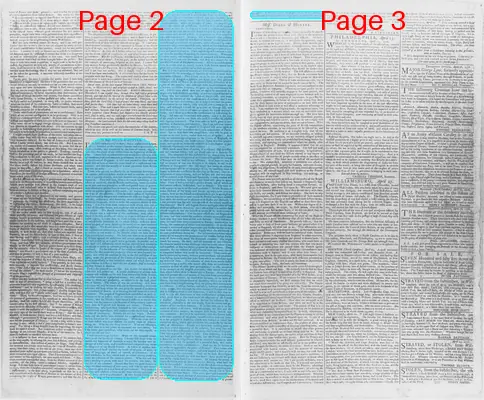
The Virginia Gazette
Richmond, Williamsburg, Richmond County, Virginia
What is this article about?
A letter advocating for constitutional independence of American colonies from British Parliament while maintaining allegiance to the Crown, arguing against total separation to avoid disunion, civil wars, and loss of British protections and trade benefits during the Revolutionary dispute.
Merged-components note: The epigraph component is the conclusion and signature of the preceding letter to the editor, continued from page 2 to page 3; relabeling from epigraph to letter_to_editor as it forms a coherent part of the same logical unit.
Clippings
1 of 2
OCR Quality
Full Text
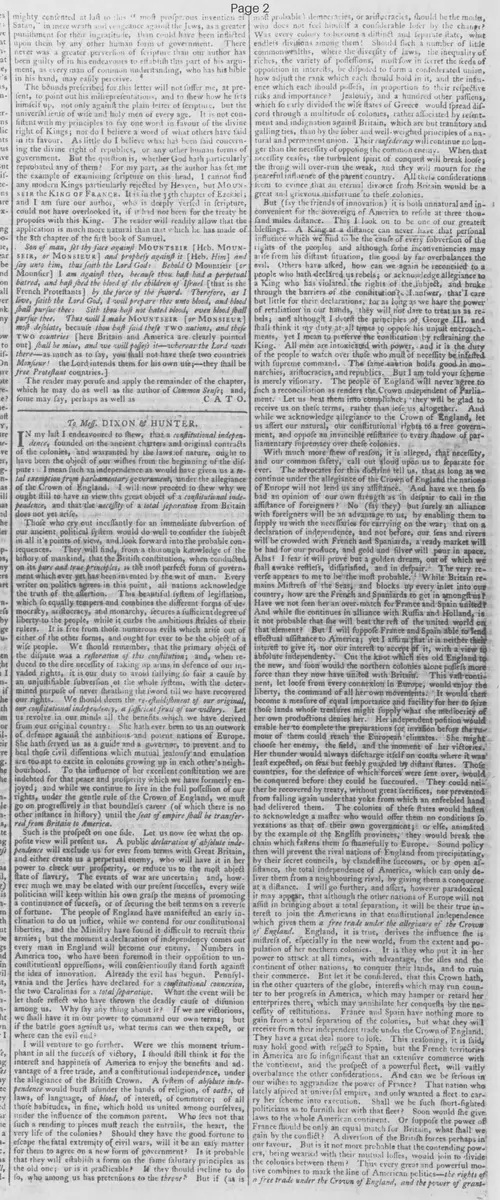
In my last I endeavoured to show, that a constitutional independence, founded on the ancient charters and original contracts of the colonies, and warranted by the laws of nature, ought to have been the object of our wishes from the beginning of the dispute: I mean such an independence as would have given us a total exemption from parliamentary government, under the allegiance of the Crown of England. I will now proceed to show why we ought still to have in view this great object of a constitutional independence, and that the necessity of a total separation from Britain does not yet arise.
Those who cry out incessantly for an immediate subversion of our ancient political system would do well to consider the subject in all its points of view, and look forward into the probable consequences. They will find, from a thorough knowledge of the history of mankind, that the British constitution, when conducted on its pure and true principles, is the most perfect form of government which ever yet has been invented by the wit of man. Every writer on politics agrees in this point, all nations acknowledge the truth of the assertion. This beautiful system of legislation, which so equally tempers and combines the different forms of democracy, aristocracy, and monarchy, secures a sufficient degree of liberty to the people, while it curbs the ambitious strides of their rulers. It is free from those numerous evils which arise out of either of the other forms, and ought for ever to be the object of a wise people. We should remember, that the primary object of the dispute was a restoration of this constitution; and, when reduced to the dire necessity of taking up arms in defence of our invaded rights, it is our duty to avoid sullying so fair a cause by an unjustifiable subversion of the whole system, with the determined purpose of never sheathing the sword till we have recovered our rights. We should deem the re-establishment of our original, our constitutional independency, a sufficient fruit of our victory. Let us revolve in our minds all the benefits which we have derived from our original country: She hath ever been to us an outwork of defence against the ambitious and potent nations of Europe. She hath served us as a guide and a governor, to prevent and to heal those civil dissensions which mutual jealousy and emulation are too apt to excite in colonies growing up in each other's neighbourhood. To the influence of her excellent constitution we are indebted for that peace and prosperity which we have formerly enjoyed; and while we continue to live in the full possession of our rights, under the gentle rule of the Crown of England, we must go on progressively in that boundless career (of which there is no other instance in history) until the seat of empire shall be transferred from Britain to America.
Such is the prospect on one side. Let us now see what the opposite view will present us. A public declaration of absolute independence will exclude us for ever from terms with Great Britain, and either create us a perpetual enemy, who will have it in her power to check our prosperity, or reduce us to the most abject state of slavery. The events of war are uncertain; and, however much we may be elated with our present successes, every wise politician will keep within his own grasp the means of promoting a continuance of success, or of securing the best terms on a reverse of fortune. The people of England have manifested an early inclination to do us justice, while we contend for our constitutional liberties, and the Ministry have found it difficult to recruit their armies; but the moment a declaration of independency comes out every man in England will become our enemy. Numbers in America too, who have been foremost in their opposition to unconstitutional oppressions, will conscientiously stand forth against the idea of innovation. Already the evil has begun. Pennsylvania and the Jerseys have declared for a constitutional connexion, the two Carolinas for a total separation. What the event will be let those reflect who have thrown the deadly cause of disunion among us. Why say any thing about it? If we are victorious, we shall have it in our power to command our own terms; but if the battle goes against us, what terms can we then expect, or where can the evil end?
I will venture to go further. Were we this moment triumphant in all the successes of victory, I should still think it for the interest and happiness of America to enjoy the benefits and advantage of a free trade, and a constitutional independence, under the allegiance of the British Crown. A system of absolute independence would burst asunder the bands of religion, of oaths, of laws, of language, of blood, of interest, of commerce; of all those habitudes, in fine, which hold us united among ourselves, under the influence of the common parent. Who sees not that such a rending to pieces must reach the entrails, the heart, the very life of the colonies? Should they have the good fortune to escape the fatal extremity of civil wars, will it be an easy matter for them to agree on a new form of government? Is it probable that they will establish a form on the same salutary principles as the old one; or is it practicable? If they should incline to do so, who among us has pretensions to the throne? But if (as is most probable) democracies, or aristocracies, should be the modes, who does not feel himself a considerable loser by the change? Was every colony to become a distinct and separate state, what endless divisions among them! Should such a number of little commonwealths, where the diversity of laws, the inequality of riches, the variety of possessions, must sow in secret the seeds of opposition in interests, be disposed to form a confederated union, how adjust the rank which each should hold in it, and the influence which each should possess, in proportion to their respective risks and importance? Jealousy, and a hundred other passions, which so early divided the wise states of Greece would spread discord through a multitude of colonies, rather associated by resentment and indignation against Britain, which are but transitory and galling ties, than by the sober and well-weighed principles of a natural and permanent union. Their confederacy will continue no longer than the necessity of opposing the common enemy. When that necessity ceases, the turbulent spirit of conquest will break loose; the strong will over-run the weak, and they will mourn for the peaceful influence of the parent country. All these considerations seem to evince that an eternal divorce from Britain would be a great and grievous misfortune to these colonies.
But (say the friends of innovation) it is both unnatural and inconvenient for the Sovereign of America to reside at three thousand miles distance. This I look on to be one of our greatest blessings. A King at a distance can never have that personal influence which we find to be the cause of every subversion of the rights of the people; and although some inconveniencies may arise from his distant situation, the good by far overbalances the evil. (Others have asked, how can we again be reconciled to a people who hath declared us rebels; or acknowledge allegiance to a King who has violated the rights of the subject, and broke through the barriers of the constitution? I answer, that I care but little for their declarations, for as long as we have the power of retaliation in our hands, they will not dare to treat us as rebels; and although I detest the principles of George III. and shall think it my duty at all times to oppose his unjust encroachments, yet I mean to preserve the constitution by restraining the King. All men are intoxicated with power, and it is the duty of the people to watch over those who must of necessity be infected with supreme command. The same caution holds good in monarchies, aristocracies, and republics. But I am told your scheme is merely visionary. The people of England will never agree to such a reconciliation as renders the Crown independent of Parliament. Let us beat them into compliance; they will be glad to receive us on these terms, rather than lose us altogether. And while we acknowledge allegiance to the Crown of England, let us assert our natural, our constitutional rights to a free government, and oppose an invincible resistance to every shadow of parliamentary supremacy over these colonies.
With much more show of reason, it is alleged, that necessity, and our common safety, call out aloud upon us to separate for ever. The advocates for this doctrine tell us, that as long as we continue under the allegiance of the Crown of England the nations of Europe will not lend us any assistance. And have we then so bad an opinion of our own strength as in despair to call in the assistance of foreigners? No (say they) but surely an alliance with foreigners will be an advantage to us, by enabling them to supply us with the necessaries for carrying on the war; that on a declaration of independence, and not before, our seas and rivers will be crowded with French and Spaniards, a ready market will be had for our produce, and gold and silver will pour in apace. Alas! I fear it will prove but a golden dream, out of which we shall awake restless, dissatisfied, and in despair. The very reverse appears to me to be the most probable. While Britain remains Mistress of the Seas, and blocks up every inlet into our country, how are the French and Spaniards to get in amongst us? Have we not seen her an over-match for France and Spain united! And while she continues in alliance with Russia and Holland, is it not probable that she will beat the rest of the united world on that element? But I will suppose France and Spain able to send effectual assistance to America; yet I affirm that it is neither their interest to give it, nor our interest to accept of it, with a view to absolute independency. Cut the knot which ties old England to the new, and soon would the northern colonies alone possess more force than they now have united with Britain. This vast continent, let loose from every connexion in Europe, would enjoy the liberty, the command of all her own movements. It would then become a measure of equal importance and facility for her to seize those lands whose treasures might supply what the mediocrity of her own productions denies her. Her independent position would enable her to complete the preparations for invasion before the rumour of them could reach the European climates. She might choose her enemy, the field, and the moment of her victories. Her thunder would always discharge itself on coasts where it was least expected, on seas but feebly guarded by distant states. Those countries, for the defence of which forces were sent over, would be conquered before they could be succoured. They could neither be recovered by treaty, without great sacrifices, nor prevented from falling again under that yoke from which an enfeebled hand had delivered them. The colonies of these states would hasten to acknowledge a master who would offer them no conditions so vexatious as that of their own government; or else, animated by the example of the English provinces, they would break the chain which fastens them so shamefully to Europe. Sound policy then will prevent the rival nations of England from precipitating, by their secret councils, by clandestine succours, or by open assistance, the total independence of America, which can only deliver them from a neighbouring rival, by giving them a conqueror at a distance. I will go further, and assert, however paradoxical it may appear, that although the other nations of Europe will not assist in bringing about a total separation, it will be their true interest to join the Americans in that constitutional independence which gives them a free trade under the allegiance of the Crown of England. England, it is true, derives the influence she is mistress of, especially in the new world, from the extent and population of her northern colonies. It is they who put it in her power to attack at all times, with advantage, the isles and the continent of other nations, to conquer their lands, and to ruin their commerce. But let it be considered, that this Crown hath, in the other quarters of the globe, interests which may run counter to her progress in America, which may hamper or retard her enterprises there, which may annihilate her conquests by the necessity of restitutions. France and Spain have nothing more to gain from a total separation of the colonies, but what they will receive from their independent trade under the Crown of England. They have a great deal more to lose. This reasoning, it is said, may hold good with respect to Spain, but the French territories in America are so insignificant that an extensive commerce with the continent, and the prospect of a powerful fleet, will vastly overbalance the other considerations. And can we be serious in our wishes to aggrandize the power of France? That nation which lately aspired at universal empire, and only wanted a fleet to carry her scheme into execution. Shall we be such short-sighted politicians as to furnish her with that fleet? Soon would she give laws to the whole American continent. Or suppose the power of France should be only an equal match for Britain, what shall we gain by the conflict? A diversion of the British forces perhaps in our favour. But is it not more probable that the contending powers, being wearied with their mutual losses, would join to divide the colonies between them? Thus every great and powerful motive combines to mark the line of American politics—the rights of a free trade under the Crown of England, and the power of granting our own money.
And supplies, as the true spirit of the people will, in the villages time, the first empire will be transferred from Britain to America.
II HAMPEN.
What sub-type of article is it?
What themes does it cover?
What keywords are associated?
What entities or persons were involved?
Letter to Editor Details
Author
Ii Hampen.
Recipient
Messrs. Dixon & Hunter.
Main Argument
the colonies should pursue constitutional independence exempting them from parliamentary government while remaining under the allegiance of the british crown, as total separation would lead to disunion, civil wars, loss of protections, and unwise foreign alliances.
Notable Details