Thank you for visiting SNEWPapers!
Sign up free
Alexandria Gazette & Daily Advertiser
Alexandria, Virginia
What is this article about?
New York Supreme Court rules that state insolvent laws of 1813 discharge debts from contracts made after passage, overturning executions in cases like Mather and Strong vs. Ira Bush; creditors plan appeal to U.S. Supreme Court.
Merged-components note: These two components are a continuation of the same article discussing insolvent laws and court decisions from New York papers, with sequential reading orders.
Clipping
OCR Quality
Full Text
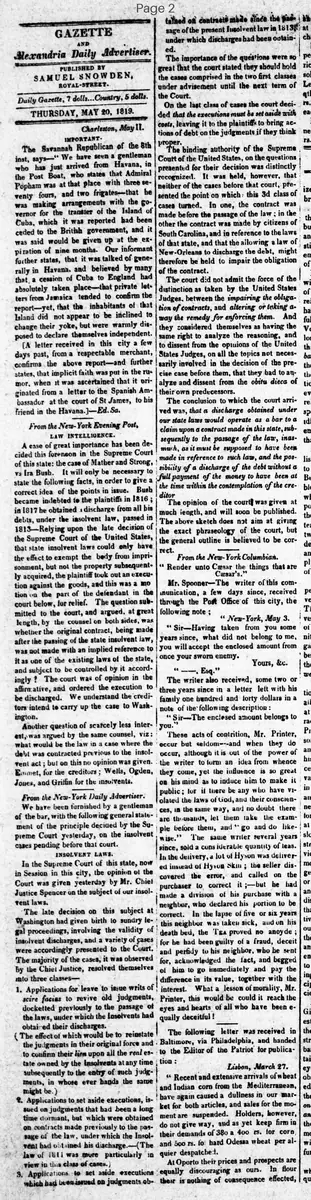
LAW INTELLIGENCE.
A case of great importance has been decided this forenoon in the Supreme Court of this state: the case of Mather and Strong, vs Ira Bush. It will only be necessary to state the following facts, in order to give a correct idea of the points in issue. Bush became indebted to the plaintiffs in 1816; in 1817 he obtained a discharge from all his debts, under the insolvent law, passed in 1813—Relying upon the late decision of the Supreme Court of the United States, that state insolvent laws could only have the effect to exempt the body from imprisonment, but not the property subsequently acquired, the plaintiff took out an execution against the goods, and this was a motion on the part of the defendant in the court below, for relief. The question submitted to the court, and argued, at great length, by the counsel on both sides, was whether the original contract, being made after the passing of the state insolvent law, was not made with an implied reference to it as one of the existing laws of the state, and subject to be controlled by it accordingly? The court was of opinion in the affirmative, and ordered the execution to be discharged. We understand the creditors intend to carry up the case to Washington.
Another question of scarcely less interest, was argued by the same counsel, viz: what would be the law in a case where the debt was contracted previous to the insolvent act; but on this no opinion was given. Emmet, for the creditors; Wells, Ogden, Jones, and Griffin for the insolvents.
From the New-York Daily Advertiser.
We have been furnished by a gentleman of the bar, with the following general statement of the principle decided by the Supreme Court yesterday, on the insolvent cases pending before that court.
INSOLVENT LAWS.
In the Supreme Court of this state, now in Session in this city, the opinion of the Court was given yesterday by Mr. Chief Justice Spencer on the subject of our insolvent laws.
The late decision on this subject at Washington had given birth to sundry legal proceedings, involving the validity of insolvent discharges, and a variety of cases were accordingly presented to the Court.
The majority of the cases, it was observed by the Chief Justice, resolved themselves into three classes—
1. Applications for leave to issue writs of scire facias to revive old judgments, docketed previously to the passage of the laws, under which the Insolvents had obtained their discharges. (The effect of which would be to reinstate the judgments in their original force and to confirm their lien upon all the real estate owned by the Insolvents at any time subsequently to the entry of such judgments, in whose ever hands the same might be.)
2. Applications to set aside executions, issued on judgments that had been a long time dormant, but which were obtained on contracts made previously to the passage of the law, under which the Insolvent had obtained his discharge.—(The law of 1811 was more particularly in view in this class of cases.)
3. Applications to set aside executions which had been issued on judgments obtained on contracts made since the passage of the present Insolvent law in 1813 under which discharges had been obtained.
The importance of the questions were so great that the court stated they should hold the cases comprised in the two first classes under advisement until the next term of the Court.
On the last class of cases the court decided that the executions must be set aside with costs, leaving it to the plaintiffs to bring actions of debt on the judgments if they think proper.
The binding authority of the Supreme Court of the United States, on the questions presented for their decision was distinctly recognized. It was held, however, that neither of the cases before that court, presented the point on which this 3d class of cases turned. In one, the contract was made before the passage of the law; in the other the contract was made by citizens of South Carolina, and in reference to the laws of that state, and that the allowing a law of New-Orleans to discharge the debt, might therefore be held to impair the obligation of the contract.
The court did not admit the force of the distinction as taken by the United States Judges, between the impairing the obligation of contracts, and altering or taking away the remedy for enforcing them. And they considered themselves as having the same right to analyze the reasoning, and to dissent from the opinions of the United States Judges, on all the topics not necessarily involved in the decision of the precise case before them, that they had to analyze and dissent from the obiter dicta of their own predecessors.
The conclusion to which the court arrived was, that a discharge obtained under our state laws would operate as a bar to a claim upon a contract made in this state, subsequently to the passage of the law, inasmuch, as it must be supposed to have been made in reference to such law, and the possibility of a discharge of the debt without a full payment of the money to have been at the time within the contemplation of the creditor.
The opinion of the court was given at much length, and will soon be published.
The above sketch does not aim at giving the exact phraseology of the court, but the general outline is believed to be correct.
What sub-type of article is it?
What keywords are associated?
What entities or persons were involved?
Where did it happen?
Domestic News Details
Primary Location
New York
Key Persons
Outcome
the court ruled in favor of the defendant, ordering the execution to be discharged. creditors intend to appeal to washington. for the third class of cases, executions must be set aside with costs.
Event Details
In the Supreme Court of New York, the case of Mather and Strong vs. Ira Bush was decided. Bush was discharged from debts under the 1813 insolvent law. Plaintiffs relied on a U.S. Supreme Court decision but the state court held that contracts made after the law's passage are subject to it, discharging the execution. Related insolvent cases were classified into three types, with decisions on the third class (contracts post-1813) to set aside executions.