Thank you for visiting SNEWPapers!
Sign up free
National Gazette
Philadelphia, Philadelphia County, Pennsylvania
What is this article about?
An American Farmer critiques the U.S. imitation of Britain's funding system and national debt, arguing it unjustly mortgages posterity's property and labor. Using philosophical axioms and mortality tables, he asserts that no generation can contract debts beyond its own lifespan, emphasizing rights of the living over the dead.
Clipping
OCR Quality
Full Text
No III.
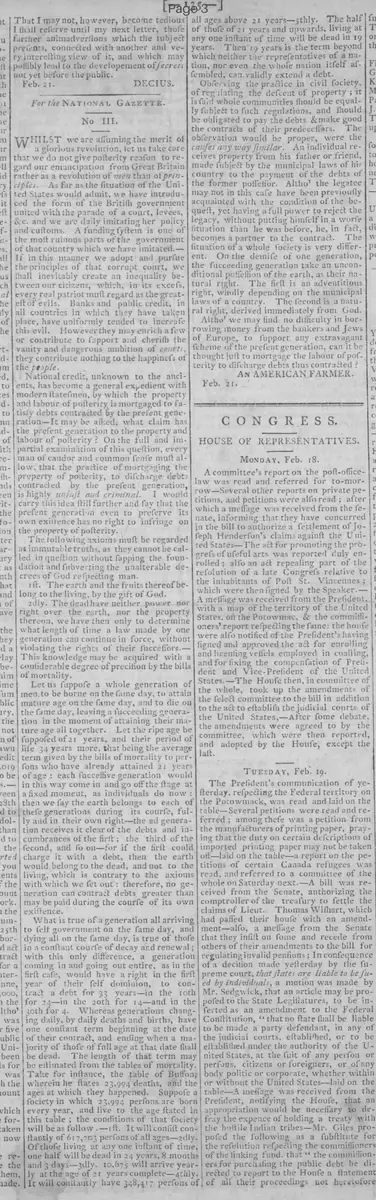
WHILST we are assuming the merit of a glorious revolution, let us take care that we do not give posterity reason to regard our emancipation from Great Britain rather as a revolution of men than of principles. As far as the situation of the United States would admit, we have introduced the form of the British government united with the parade of a court, levees, &c. and we are daily imitating her policy and customs. A funding system is one of the most ruinous parts of the government of that country which we have imitated.
If in this manner we adopt and pursue the principles of that corrupt court, we shall inevitably create an inequality between our citizens, which, in its excess, every real patriot must regard as the greatest of evils. Banks and public credit, in all countries in which they have taken place, have uniformly tended to increase this evil. However they may enrich a few or contribute to support and cherish the vanity and dangerous ambition of courts, they contribute nothing to the happiness of the people.
National credit, unknown to the ancients, has become a general expedient with modern statesmen, by which the property and labour of posterity is mortgaged to satisfy debts contracted by the present generation. It may be asked, what claim has the present generation to the property and labour of posterity? On the full and impartial examination of this question, every man of candor and common sense must allow, that the practice of mortgaging the property of posterity, to discharge debts contracted by the present generation, is highly unjust and criminal. I would carry this idea still further and say that the present generation even to preserve its own existence has no right to infringe on the property of posterity.
The following axioms must be regarded as immutable truths, as they cannot be called in question without sapping the foundation and subverting the unalterable decrees of God respecting man.
1st. The earth and the fruits thereof belong to the living, by the gift of God.
2dly. The dead have neither power nor right over the earth, nor the property thereon, we have then only to determine what length of time a law made by one generation can continue in force, without violating the rights of their successors.
This knowledge may be acquired with a considerable degree of precision by the bills of mortality.
Let us suppose a whole generation of men to be born on the same day, to attain mature age on the same day, and to die on the same day, leaving a succeeding generation in the moment of attaining their mature age all together. Let the ripe age be supposed of 21 years, and their period of life 34 years more, that being the average term given by the bills of mortality to persons who have already attained 21 years of age: each successive generation would in this way come in and go off the stage at a fixed moment, as individuals do now: then we say the earth belongs to each of these generations during its course, fully and in their own right—the 2d generation receives it clear of the debts and incumbrances of the first; the third of the second, and so on—for if the first could charge it with a debt, then the earth would belong to the dead, and not to the living, which is contrary to the axioms with which we set out: therefore, no generation can contract debts greater than may be paid during the course of its own existence.
What is true of a generation all arriving to self government on the same day, and dying all on the same day, is true of those in a constant course of decay and renewal; with this only difference, a generation coming in and going out entire, as in the first case, would have a right in the first year of their self dominion, to contract a debt for 33 years—in the 10th for 24—in the 20th for 14—and in the 30th for 4. Whereas generations changing daily, by daily deaths and births, have one constant term beginning at the date of their contract, and ending when a majority of those of full age at that date shall be dead. The length of that term may be estimated from the tables of mortality. Take for instance, the table of Buffon, wherein he states 23,994 deaths, and the ages at which they happened. Suppose a society in which 23,994 persons are born every year, and live to the age stated in this table; the conditions of that society will be as follow: 1st. It will consist constantly of 617,703 persons of all ages—2dly. Of those living at any one instant of time, one half will be dead in 24 years, 8 months and 3 days—3dly. 10,675 will arrive yearly at the age of 21 years complete—4thly. It will constantly have 348,417 persons of all ages above 21 years—5thly. The half of those of 21 years and upwards, living at any one instant of time will be dead in 19 years. Then 19 years is the term beyond which neither the representatives of a nation, nor even the whole nation itself assembled, can validly extend a debt.
Observing the practice in civil society, of regulating the descent of property; it is said whole communities should be equally subject to such regulations, and should be obligated to pay the debts & make good the contracts of their predecessors. The observation would be proper, were the causes any way similar. "An individual receives property from his father or friend, made subject by the municipal laws of his country to the payment of the debts of the former possessor. Altho' the legatee may not in this case have been previously acquainted with the condition of the bequest, yet having a full power to reject the legacy, without putting himself in a worse situation than he was before, he, in fact, becomes a partner to the contract. The situation of a whole society is very different. On the demise of one generation, the succeeding generation take an unconditional possession of the earth, as their natural right. The first is an adventitious right, wholly depending on the municipal laws of a country. The second is a natural right, derived immediately from God."
Altho' we may find no difficulty in borrowing money from the bankers and Jews of Europe, to support any extravagant scheme of the present generation, can it be thought just to mortgage the labour of posterity to discharge debts thus contracted?
AN AMERICAN FARMER.
Feb. 21.
What sub-type of article is it?
What themes does it cover?
What keywords are associated?
What entities or persons were involved?
Letter to Editor Details
Author
An American Farmer
Recipient
National Gazette
Main Argument
the present generation has no right to mortgage the property and labor of posterity through national debt and funding systems, as the earth belongs to the living; debts should not exceed a generation's lifespan, estimated at about 19 years based on mortality tables.
Notable Details