Thank you for visiting SNEWPapers!
Sign up free
The Hillsborough Recorder
Hillsboro, Orange County, North Carolina
What is this article about?
Commentary on the radical nature of Queen of England's responses to seamen, fueling discontent and opposition in Britain. Her influence unites radicals, with the army concentrated near the capital amid fears of revolution, drawing parallels to recent upheavals in Spain and Naples.
Clipping
OCR Quality
Full Text
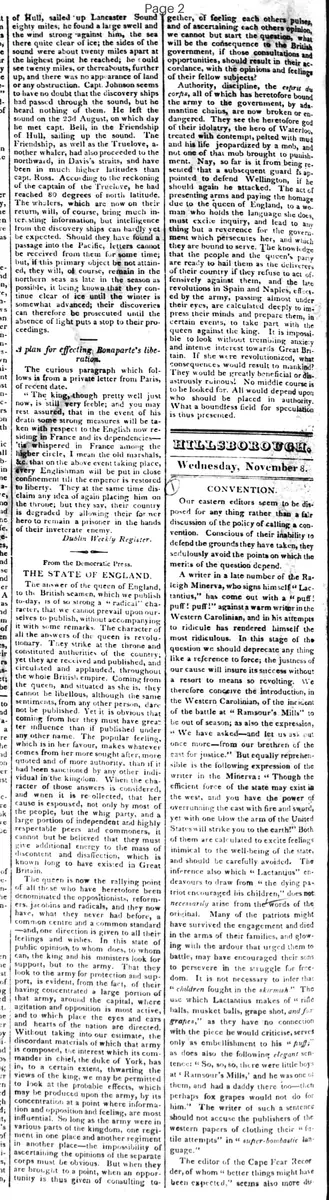
THE STATE OF ENGLAND.
The answer of the queen of England, to the British seamen, which we publish to-day, is of so strong a "radical" character, that we cannot prevail upon ourselves to publish, without accompanying it with some remarks. The character of all the answers of the queen is revolutionary. They strike at the throne and constituted authorities of the country; yet they are received and published, and circulated and applauded, throughout the whole British empire. Coming from the queen, and situated as she is, they cannot be libellous, although the same sentiments, from any other person, dare not be published. Yet it is obvious that coming from her they must have greater influence than if published under any other name. The popular feeling, which is in her favour, makes whatever comes from her more sought after, more quoted and of more authority, than if it had been sanctioned by any other individual in the kingdom. When the character of those answers is considered, and when it is recollected, that her cause is espoused, not only by most of the people, but the whig party, and a large portion of independent and highly respectable peers and commoners, it cannot but be believed that they must give additional energy to the mass of discontent and disaffection, which is known long to have existed in Great Britain. The queen is now the rallying point of all those who have heretofore been denominated the oppositionists, reformers, jacobins and radicals, and they now have, what they never had before, a common centre and a common standard—and, one direction is given to all their feelings and wishes. In this state of public opinion, to whom does, to whom can, the king and his ministers look for support, but to the army. That they look to the army for protection and support, is evident, from the fact, of their having concentrated a large portion of that army, around the capital, where agitation and opposition is most active, and to which place the eyes and ears and hearts of the nation are directed. Without taking into our estimate, the discordant materials of which that army is composed, the interest which its commander in chief, the duke of York, has in, to a certain extent, thwarting the views of the king, we may be permitted to look at the probable effects, which may be produced upon the army, by its concentration at a point where information and opposition and feeling, are most influential. So long as the army were in various parts of the kingdom, one regiment in one place and another regiment in another place—the impossibility of ascertaining the opinions of the separate corps must be obvious. But when they are brought to a point, when an opportunity is thus given of consulting together, of feeling each others pulses, and of ascertaining each others opinion, we cannot but start the question, what will be the consequence to the British government, if those consultations and opportunities, should result in their accordance, with the opinions and feelings of their fellow subjects? Authority, discipline, the esprit du corps, all of which has heretofore bound the army to the government, by adamantine chains, are now broken or endangered. They see the heretofore god of their idolatry, the hero of Waterloo, treated with contempt, pelted with mud and his life jeopardized by a mob, and not one of that mob brought to punishment. Nay, so far is it from being resented that a subsequent guard is appointed to defend Wellington, if he should again be attacked. The act of presenting arms and paying the homage due to the queen of England, to a woman who holds the language she does must excite inquiry, and lead to any thing but a reverence for the government which persecutes her, and which they are bound to serve. The knowledge that the people and the queen's party are ready to hail them as the deliverers of their country if they refuse to act offensively against them, and the late revolutions in Spain and Naples, effected by the army, passing almost under their eyes, are calculated deeply to impress their minds and prepare them, in certain events, to take part with the queen against the king. It is impossible to look without trembling anxiety and intense interest towards Great Britain. If she were revolutionized, what consequences would result to mankind? They would be greatly beneficial or disastrously ruinous! No middle course is to be looked for. All would depend upon who should be placed in authority. What a boundless field for speculation is thus presented.
What sub-type of article is it?
What keywords are associated?
What entities or persons were involved?
Where did it happen?
Foreign News Details
Primary Location
Great Britain
Key Persons
Outcome
speculation on potential revolution and army defection
Event Details
The queen's radical responses to seamen are published and applauded, uniting oppositionists, reformers, jacobins, and radicals against the throne. Public discontent grows, with the army concentrated near the capital for support, but risks influence from popular sentiments and recent revolutions in Spain and Naples, potentially leading to army alignment with the queen against the king.