Thank you for visiting SNEWPapers!
Sign up free
The Western Democrat
Charlotte, Mecklenburg County, North Carolina
What is this article about?
A Southern newspaper publishes and critiques President Lincoln's message to Congress on December 1, proposing a constitutional amendment to purchase and colonize slaves by 1900 to end the Civil War, which is rejected outright by the South. It also notes Union military strength, finances, and failed foreign negotiations.
Clipping
OCR Quality
Full Text
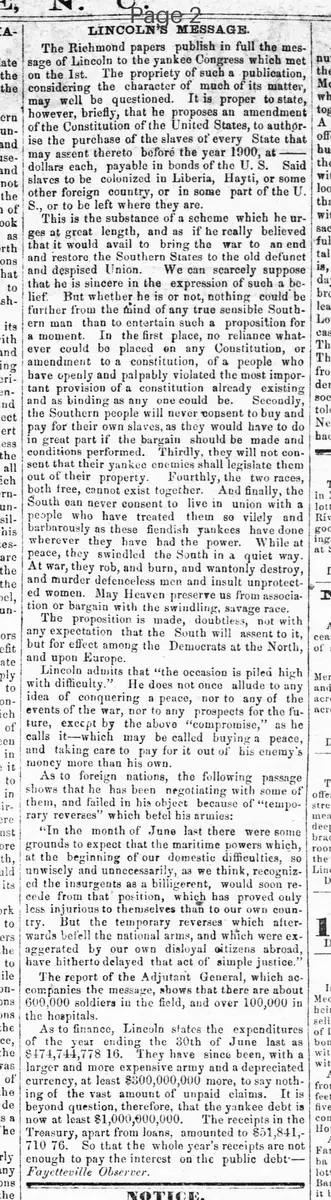
The Richmond papers publish in full the message of Lincoln to the Yankee Congress which met
on the 1st. The propriety of such a publication,
considering the character of much of its matter,
may well be questioned. It is proper to state,
however, briefly, that he proposes an amendment
of the Constitution of the United States, to authorize the purchase of the slaves of every State that
may assent thereto before the year 1900, at $400
each, payable in bonds of the U. S. Said
slaves to be colonized in Liberia, Hayti, or some
other foreign country, or in some part of the U.
S., or to be left where they are.
This is the substance of a scheme which he urges at great length, and as if he really believed
that it would avail to bring the war to an end
and restore the Southern States to the old defunct
and despised Union. We can scarcely suppose
that he is sincere in the expression of such a belief. But whether he is or not, nothing could be
further from the mind of any true sensible Southern man than to entertain such a proposition for
a moment. In the first place, no reliance whatever could be placed on any Constitution, or
amendment to a constitution, of a people who
have openly and palpably violated the most important provision of a constitution already existing
and as binding as any one could be. Secondly,
the Southern people will never consent to buy and
pay for their own slaves, as they would have to do
in great part if the bargain should be made and
conditions performed. Thirdly, they will not consent that their Yankee enemies shall legislate them out of their property. Fourthly, the two races,
both free, cannot exist together. And finally, the
South can never consent to live in union with a
people who have treated them so vilely and
barbarously as these fiendish Yankees have done
wherever they have had the power. While at
peace, they swindled the South in a quiet way.
At war, they rob, and burn, and wantonly destroy,
and murder defenceless men and insult unprotected women. May Heaven preserve us from association or bargain with the swindling, savage race.
The proposition is made, doubtless, not with
any expectation that the South will assent to it,
but for effect among the Democrats at the North,
and upon Europe.
Lincoln admits that "the occasion is piled high
with difficulty." He does not once allude to any
idea of conquering a peace, nor to any of the
events of the war, nor to any prospects for the future, except by the above "compromise," as he
calls it—which may be called buying a peace,
and taking care to pay for it out of his enemy's
money more than his own.
As to foreign nations, the following passage
shows that he has been negotiating with some of
them, and failed in his object because of "temporary reverses" which befell his armies:
"In the month of June last there were some
grounds to expect that the maritime powers which,
at the beginning of our domestic difficulties, so
unwisely and unnecessarily, as we think, recognized the insurgents as a belligerent, would soon reconsider from that position, which has proved only
less injurious to themselves than to our own country. But the temporary reverses which afterwards befell the national arms, and which were exaggerated by our own disloyal citizens abroad
have hitherto delayed that act of simple justice."
The report of the Adjutant General, which accompanies the message, shows that there are about
600,000 soldiers in the field, and over 100,000 in
the hospitals.
As to finance, Lincoln states the expenditures
of the year ending the 30th of June last as
$474,744,778 16. They have since been, with a
larger and more expensive army and a depreciated
currency, at least $300,000,000 more, to say nothing of the vast amount of unpaid claims. It is
beyond question, therefore, that the Yankee debt is
now at least $1,000,000,000. The receipts in the
Treasury, apart from loans, amounted to $51,841,
710 76. So that the whole year's receipts are not
enough to pay the interest on the public debt.—
Fayetteville Observer.
What sub-type of article is it?
What keywords are associated?
What entities or persons were involved?
Where did it happen?
Domestic News Details
Primary Location
United States
Event Date
On The 1st
Key Persons
Event Details
Lincoln proposes an amendment to the Constitution to authorize the purchase of slaves from assenting states before 1900 at $400 each, payable in U.S. bonds, with slaves to be colonized abroad or in the U.S. or left in place, aiming to end the war and restore the Union. The Southern perspective rejects this proposal on multiple grounds including distrust of the Union, refusal to pay for their own slaves, opposition to Yankee legislation over property, racial coexistence issues, and unwillingness to reunite after mistreatment.