Thank you for visiting SNEWPapers!
Sign up free
Editorial
April 29, 1852
Fayetteville Observer
Fayetteville, Lincoln County, Tennessee
What is this article about?
Editorial argues that the Democratic Party is more trustworthy than the Whig Party on the finality of the 1850 Compromise and protection of Southern slavery interests, citing Whig voting records in Congress and state legislatures like Pennsylvania.
Clipping
OCR Quality
95%
Excellent
Full Text
Which Will You Trust?
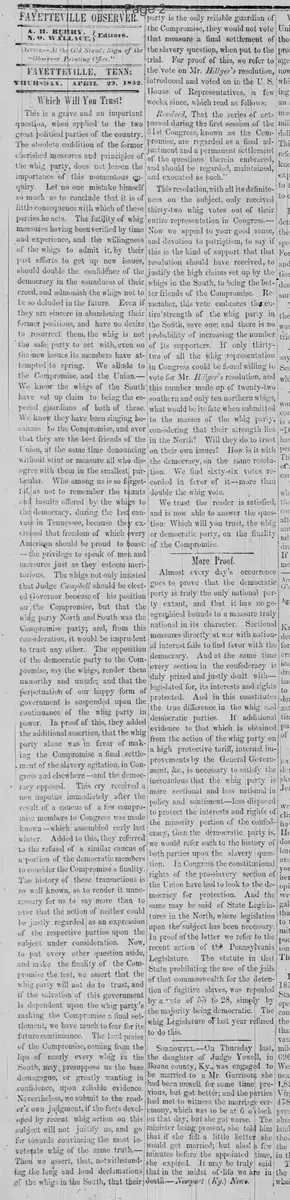
This is a grave and an important question, when applied to the two great political parties of the country. The obsolete condition of the former cherished measures and principles of the whig party, does not lessen the importance of this momentous enquiry. Let no one mistake himself so much as to conclude that it is of little consequence with which of these parties he acts. The futility of whig measures having been verified by time and experience, and the willingness of the whigs to admit it, by their past efforts to get up new issues, should double the confidence of the democracy in the soundness of their creed, and admonish the whigs not to be so deluded in the future. Even if they are sincere in abandoning their former positions, and have no desire to resurrect them, the whig is not the safe party to act with, even on the new issues its members have attempted to spring. We allude to the Compromise, and the Union. We know the whigs of the South have set up claim to being the especial guardians of both of these. We know they have been singing hossannas to the Compromise, and aver that they are the best friends of the Union, at the same time denouncing without stint or measure all who disagree with them in the smallest particular. Who among us is so forgetful, as not to remember the taunts and insults offered by the whigs to the democracy, during the last canvass in Tennessee, because they exercised that freedom of which every American should be proud to boast: the privilege to speak of men and measures just as they esteem meritorious. The whigs not only insisted that Judge Campbell should be elected Governor because of his position on the Compromise, but that the whig party North and South was the Compromise party; and, from this consideration, it would be imprudent to trust any other. The opposition of the democratic party to the Compromise, say the whigs, render them unworthy and unsafe; and that the perpetuation of our happy form of government is suspended upon the continuance of the whig party in power. In proof of this, they added the additional assertion, that the whig party alone was in favor of making the Compromise a final settlement of the slavery agitation, in Congress and elsewhere—and the democracy opposed. This cry received a new impetus immediately after the result of a caucus of a few compromise members to Congress was made known—which assembled early last winter. Added to this, they referred to the refusal of a similar caucus of a portion of the democratic members to consider the Compromise a finality. The history of these transactions is so well known, as to render it unnecessary for us to say more than to aver that the action of neither could be justly regarded as an expression of the respective parties upon the subject under consideration. Now, to put every other question aside, and make the finality of the Compromise the test, we assert that the whig party will not do to trust, and if the salvation of this government is dependent upon the whig party's making the Compromise a final settlement, we have much to fear for its future continuance. The lord praise of the Compromise, coming from the lips of nearly every whig in the South, may presuppose us the base demagogue, or greatly wanting in confidence, upon reliable evidence. Nevertheless, we submit to the reader's own judgment, if the facts developed by recent whig action on this subject will not justify us, and go far towards convincing the most inveterate whig of the same truth. Then we assert, that, notwithstanding the long and loud declamations of the whigs in the South, that their party is the only reliable guardian of the Compromise, they would not vote that measure a final settlement of the slavery question, when put to the trial. For proof of this, we refer to the vote on Mr. Hillyer's resolution, introduced and voted on in the U. S. House of Representatives, a few weeks since, which read as follows:
Resolved, That the series of acts passed during the first session of the 31st Congress, known as the Compromise, are regarded as a final adjustment and a permanent settlement of the questions therein embraced, and should be regarded, maintained, and executed as such.
This resolution, with all its definiteness on the subject, only received thirty-two whig votes out of their entire representation in Congress. Now we appeal to your good sense and devotion to patriotism, to say if this is the kind of support that that resolution should have received, to justify the high claims set up by the whigs in the South, to being the better friends of the Compromise. Remember, this vote embraces the entire strength of the whig party in the South, save one; and there is no probability of increasing the number of its supporters. If only thirty-two of all the whig representation in Congress could be found willing to vote for Mr. Hillyer's resolution, and this number made up of twenty-two southern and only ten northern whigs, what would be its fate when submitted to the masses of the whig party considering that their strength lies in the North? Will they do to trust on their own issues? How is it with the democracy, on the same resolution! We find sixty-six votes recorded in favor of it—more than double the whig vote.
We trust the reader is satisfied, and is now able to answer the question: Which will you trust, the whig or democratic party, on the finality of the Compromise?
More Proof.
Almost every day's occurrence goes to prove that the democratic party is truly the only national party extant, and that it has no geographical bounds to a measure truly national in its character. Sectional measures directly at war with national interest fails to find favor with the democracy. And at the same time every section in the confederacy is duly prized and justly dealt with—legislated for, its interests and rights protected. And in this constitutes the true difference in the whig and democratic parties. If additional evidence to that which is obtained from the action of the whig party on a high protective tariff, internal improvements by the General Government, &c., is necessary to satisfy the incredulous that the whig party is more sectional and less national in policy and sentiment—less disposed to protect the interests and rights of the minority portion of the confederacy, than the democratic party is, we would refer such to the history of both parties upon the slavery question. In Congress the constitutional rights of the pro-slavery section of the Union have had to look to the democracy for protection. And the same may be said of State Legislatures in the North, where legislation upon the subject has been necessary. In proof of the latter we refer to the recent action of the Pennsylvania Legislature. The statute in that State prohibiting the use of the jails of that commonwealth for the detention of fugitive slaves, was repealed by a vote of 55 to 28, simply by the majority being democratic. The whig Legislature of last year refused to do this.
This is a grave and an important question, when applied to the two great political parties of the country. The obsolete condition of the former cherished measures and principles of the whig party, does not lessen the importance of this momentous enquiry. Let no one mistake himself so much as to conclude that it is of little consequence with which of these parties he acts. The futility of whig measures having been verified by time and experience, and the willingness of the whigs to admit it, by their past efforts to get up new issues, should double the confidence of the democracy in the soundness of their creed, and admonish the whigs not to be so deluded in the future. Even if they are sincere in abandoning their former positions, and have no desire to resurrect them, the whig is not the safe party to act with, even on the new issues its members have attempted to spring. We allude to the Compromise, and the Union. We know the whigs of the South have set up claim to being the especial guardians of both of these. We know they have been singing hossannas to the Compromise, and aver that they are the best friends of the Union, at the same time denouncing without stint or measure all who disagree with them in the smallest particular. Who among us is so forgetful, as not to remember the taunts and insults offered by the whigs to the democracy, during the last canvass in Tennessee, because they exercised that freedom of which every American should be proud to boast: the privilege to speak of men and measures just as they esteem meritorious. The whigs not only insisted that Judge Campbell should be elected Governor because of his position on the Compromise, but that the whig party North and South was the Compromise party; and, from this consideration, it would be imprudent to trust any other. The opposition of the democratic party to the Compromise, say the whigs, render them unworthy and unsafe; and that the perpetuation of our happy form of government is suspended upon the continuance of the whig party in power. In proof of this, they added the additional assertion, that the whig party alone was in favor of making the Compromise a final settlement of the slavery agitation, in Congress and elsewhere—and the democracy opposed. This cry received a new impetus immediately after the result of a caucus of a few compromise members to Congress was made known—which assembled early last winter. Added to this, they referred to the refusal of a similar caucus of a portion of the democratic members to consider the Compromise a finality. The history of these transactions is so well known, as to render it unnecessary for us to say more than to aver that the action of neither could be justly regarded as an expression of the respective parties upon the subject under consideration. Now, to put every other question aside, and make the finality of the Compromise the test, we assert that the whig party will not do to trust, and if the salvation of this government is dependent upon the whig party's making the Compromise a final settlement, we have much to fear for its future continuance. The lord praise of the Compromise, coming from the lips of nearly every whig in the South, may presuppose us the base demagogue, or greatly wanting in confidence, upon reliable evidence. Nevertheless, we submit to the reader's own judgment, if the facts developed by recent whig action on this subject will not justify us, and go far towards convincing the most inveterate whig of the same truth. Then we assert, that, notwithstanding the long and loud declamations of the whigs in the South, that their party is the only reliable guardian of the Compromise, they would not vote that measure a final settlement of the slavery question, when put to the trial. For proof of this, we refer to the vote on Mr. Hillyer's resolution, introduced and voted on in the U. S. House of Representatives, a few weeks since, which read as follows:
Resolved, That the series of acts passed during the first session of the 31st Congress, known as the Compromise, are regarded as a final adjustment and a permanent settlement of the questions therein embraced, and should be regarded, maintained, and executed as such.
This resolution, with all its definiteness on the subject, only received thirty-two whig votes out of their entire representation in Congress. Now we appeal to your good sense and devotion to patriotism, to say if this is the kind of support that that resolution should have received, to justify the high claims set up by the whigs in the South, to being the better friends of the Compromise. Remember, this vote embraces the entire strength of the whig party in the South, save one; and there is no probability of increasing the number of its supporters. If only thirty-two of all the whig representation in Congress could be found willing to vote for Mr. Hillyer's resolution, and this number made up of twenty-two southern and only ten northern whigs, what would be its fate when submitted to the masses of the whig party considering that their strength lies in the North? Will they do to trust on their own issues? How is it with the democracy, on the same resolution! We find sixty-six votes recorded in favor of it—more than double the whig vote.
We trust the reader is satisfied, and is now able to answer the question: Which will you trust, the whig or democratic party, on the finality of the Compromise?
More Proof.
Almost every day's occurrence goes to prove that the democratic party is truly the only national party extant, and that it has no geographical bounds to a measure truly national in its character. Sectional measures directly at war with national interest fails to find favor with the democracy. And at the same time every section in the confederacy is duly prized and justly dealt with—legislated for, its interests and rights protected. And in this constitutes the true difference in the whig and democratic parties. If additional evidence to that which is obtained from the action of the whig party on a high protective tariff, internal improvements by the General Government, &c., is necessary to satisfy the incredulous that the whig party is more sectional and less national in policy and sentiment—less disposed to protect the interests and rights of the minority portion of the confederacy, than the democratic party is, we would refer such to the history of both parties upon the slavery question. In Congress the constitutional rights of the pro-slavery section of the Union have had to look to the democracy for protection. And the same may be said of State Legislatures in the North, where legislation upon the subject has been necessary. In proof of the latter we refer to the recent action of the Pennsylvania Legislature. The statute in that State prohibiting the use of the jails of that commonwealth for the detention of fugitive slaves, was repealed by a vote of 55 to 28, simply by the majority being democratic. The whig Legislature of last year refused to do this.
What sub-type of article is it?
Partisan Politics
Slavery Abolition
What keywords are associated?
Whig Party
Democratic Party
Compromise Finality
Slavery Question
Hillyer Resolution
Tennessee Canvass
Pennsylvania Legislature
Fugitive Slaves
What entities or persons were involved?
Whig Party
Democratic Party
Judge Campbell
Mr. Hillyer
U. S. House Of Representatives
Pennsylvania Legislature
Editorial Details
Primary Topic
Trustworthiness Of Whig Vs Democratic Parties On Compromise Finality And Slavery Protection
Stance / Tone
Strongly Pro Democratic And Anti Whig, Arguing Democrats Are More Reliable Guardians Of Compromise And Southern Interests
Key Figures
Whig Party
Democratic Party
Judge Campbell
Mr. Hillyer
U. S. House Of Representatives
Pennsylvania Legislature
Key Arguments
Whig Measures Are Obsolete And Futile
Whigs Claim To Be Guardians Of Compromise And Union But Fail To Support It In Votes
Only 32 Whig Votes For Hillyer's Resolution On Compromise Finality Vs 66 Democratic Votes
Democrats Are The True National Party Protecting All Sections, Especially Pro Slavery Interests
Whigs Are Sectional And Less Protective Of Southern Rights, As Shown In Pennsylvania Jail Law Repeal