Thank you for visiting SNEWPapers!
Sign up free
Virginia Argus
Richmond, Virginia
What is this article about?
In the U.S. House of Representatives on December 31, Mr. Randolph presented documents alleging General James Wilkinson received money from Spanish officials and moved for a presidential inquiry into his conduct. Mr. Clark refused to share information without a house resolution. Debate on the motion's handling was postponed to Monday.
Merged-components note: Continuation of domestic news on U.S. House proceedings regarding Wilkinson inquiry; same topic.
Clipping
OCR Quality
Full Text
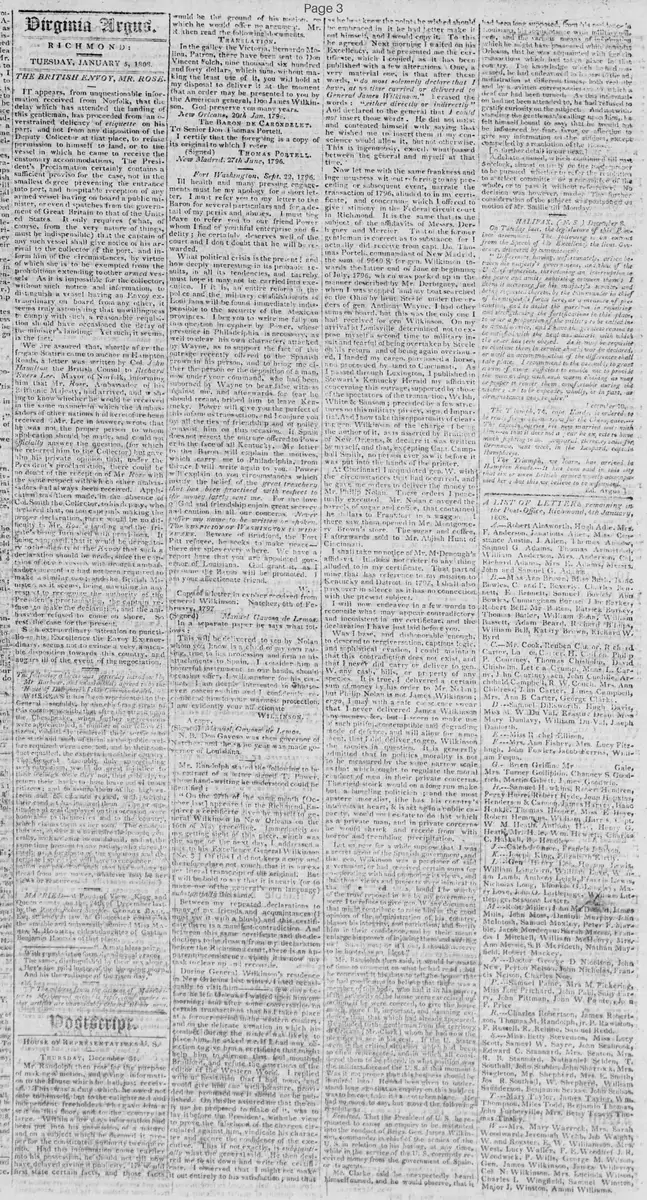
HOUSE OF REPRESENTATIVES U.S.
Thursday, December 31.
Mr. Randolph then rose for the purpose of making a motion, and giving information to the house which he had just received. This was a duty which he owed not only to himself but to the enlightened and independent freeholders who gave him a seat on this floor, and to the country at large. Within a few days information had been put into his possession, of a nature and on a subject which he deemed it proper for the Constitutional authority to enquire into. Had this information come earlier into his possession, he should not till now have delayed giving it publicity. It would first state certain facts, and those facts would be the ground of his motion, on which he would offer no argument. Mr. R. then read the following documents.
Translation.
In the galley the Victoria, Bernardo Molina, Patron. there have been sent to Don Vincent Folch, nine thousand six hundred and forty dollars, which sum, without making the least use of it, you will hold at my disposal to deliver it at the moment that an order may be presented to you by the American general, Don James Wilkinson. God preserve you many years.
New Orleans, 20th Jan. 1796.
The Baron De Carondelet.
To Senor Don Thomas Portell.
I certify that the foregoing is a copy of its original to which I refer
(Signed)
Thomas Portell.
New Madrid, 27th June, 1796.
Fort Washington, Sept. 22, 1796.
In ill health and many pressing engagements must be my apology for a short letter. I must refer you to my letter to the Baron for several particulars and for a detail of my perils and abuses. I must beg leave to refer you to our friend Power whom I find of youthful enterprise and fidelity; he certainly deserves well of the court and I don't doubt that he will be rewarded.
What political crisis is the present! and how deeply interesting in its probable results, in all its tendencies, and thereby must hope it may not be carried into execution. If it is, an entire reform in the police and the military establishments of Louisiana will be found immediately indispensable to the security of the Mexican provinces. I beg you to write to me fully on this question in cypher by Power, whose presence in Philadelphia is necessary, as well to clear his own character, attacked by Wayne, as to support the fact of the outrage recently offered to the Spanish crown in his person, and to bring me either the person or the deposition of a man, now under your command, who had been suborned by Wayne to bear false witness against me, and afterwards for fear he should recant, bribed him to leave Kentucky. Power will give you the perfect of this infamous transaction, and I conjure you by all the ties of friendship and of policy to assist him on this occasion. If Spain does not resent the outrage offered to Power in the face of all Kentucky. My letter to the Baron will explain the motives, which carry me to Philadelphia, from thence I will write again to you. Power will explain to you circumstances which justify the belief of the great treachery that has been practised with respect to the money lately sent me. For the love of God and friendship enjoin great secrecy and caution in all our concerns. Never suffer my name to be written or spoken. The Suspicion of Washington is wide awake. Beware of Bradford, the Fort Pitt refugee. he seeks to make peace— there are spies every where. We have a report here that you are appointed governor of Louisiana. God grant it, as I presume the Baron will be promoted. I am your affectionate friend.
Copy of a letter in cypher received from general Wilkinson: Natchez, 6th of February, 1797
(Signed)
Manuel Cayona de Lemos.
In a separate paper he says what follows:
This will be delivered to you by Nolan whom you know is a child of my own raising, true to his profession and firm in his attachments to Spain. I consider him a powerful instrument in our hands, should occasion offer, I will answer for his conduct. I am deeply interested in whatsoever concerns him and I confidently recommend him to your warmest protection. I am evidently your affectionate
WILKINSON.
A copy.
(Signed) Manuel Gayond de Lemos.
N. B. Don Gayoso was then governor of Natchez: and in the year was made Governor of Louisiana
Mr. Randolph stated the following to be an extract of a letter signed T. Power, whose hand-writing he understood could be identified:
"On the 27th of the same month October last) appeared in the Richmond Enquirer a certificate given by myself to general Wilkinson in New Orleans on the 16th of May preceding. Immediately on my getting sight of this piece, which was the same or the next day. I addressed a note, to his Excellency General Wilkinson No. 3 I of this I did not keep a copy and therefore dare not vouch that it is an exact literal transcrip of the original. But I will be bold to say that it is nearly (or to make use of the general's own language) substantially the same.altho
Between my repeated declarations to many of my friends and acquaintances (I must say it with a blush) and this certificate there is a manifest contradiction. And between this same certificate and the deductions to be drawn from my declaration before the Richmond court, there is an apparent inconsistency which it is now my task to clear up and reconcile.
During General Wilkinson's residence in New Orleans last winter. I used occasionally to visit him on few days before he left Orleans I waited upon him one morning and after some conversation, on certain transactions that had taken place at a former period in the western country, and on the delicate situation in which his conduct during the winter was likely to place him, he asked me, if I had any objection to give him a certificate that might help him, to silence that foul mouthed Bradford, and refute the assertions of the editor of The Western World. I replied without hesitation that I had none, and would give him one with pleasure. provided he promised me it should not be published. On this he assured me that the only use he proposed to make of it, was to lay it before the President. with the view to prove the falsehood of the charges circulated against him, vindicate his character and secure the confidence of the executive. This if not exactly, is substantially what the general said. He then desired me to sit down and write the certificate. I observed that I might not make it out entirely to his satisfaction ; and that as he best knew the point: he wished should be embraced in it he had better make it out himself. and I would copy it. To this he agreed. Next morning I waited on his Excellency, and he presented me the certificate, which I copied, as it has been published with a few alterations. One, a very material one, is that after these words, " do most solemnly declare that I have, at no time carried or delivered to General James Wilkinson." ! erased the words: "either directly or indirectly" And declared to the general that I could not insert those words. He did not insist and contented himself with saying that he wished me to insert them if my conscience would allow it, but not otherwise. This is ingenuously, exactly what passed between the general and myself at that time.
Now let me with the same frankness and ingenuousness without referring to any preceding or subsequent event, narrate the transaction of 1796, alluded to in my certificate, and concerning which I offered to give testimony in the Federal circuit court in Richmond. It is the same that is the subject of the affidavits of Messrs. Derbigny and Mercier That the former gentleman is correct as to substance for I actually did receive from capt. Dn. Thomas Portell. commandant of New Madrid, the sum of 9640 $ for gen. Wilkinson towards the latter end of June or beginning of July, 1796, which was packed up in the manner described by Mr. Derbigny, and when I was stopped and my boat searched entire Ohio by lieut. Steele under the orders of gen. Anthony Wayne. I had other sums on board, but this was the only one I had received for gen Wilkinson. On my arrival at Louisville determined not to expose myself a second time to military insult and fearful of being overtaken by Steele on his return and of being again overhauled, I landed my cargo. purchased a horse, and proceeded by land to Cincinnati. As I passed through Lexington, I published in Stewart's Kentucky Herald my affidavit concerning this outrage, supported by those of the spectators of the transaction, Weish, White & Sansom : preceded by a few strictures on this military piracy, signed Impartial. And I now take this opportunity of clearing Gen. Wilkinson of the charge of being the author of it. as is asserted by Bradford of New-Orleans, & declare it was written by myself, and that, excepting Capt. Campbell Smith, no person ever saw it before it was put into the hands of the printer.
At Cincinnati I acquainted gen. W. with the circumstances that had occurred, and he gave me orders to deliver the money to Mr. Philip Nolan." There orders I punctually executed Mr. Nolan conveyed the barrels of sugar and coffee, that contained the dollars to Frankfort in a waggon there saw them opened in Mr. Montgomery Brown's store. The sugar and coffee, I afterwards sold to Mr. Abijah Hunt of Cincinnati.
I shall take no notice of Mr. M Donough's affidv't It does not refer to any thing alluded to in my certificate, That part of mine that has reference to my mission to Kentucky and Detroit in 1797, I shall also pass, over in silence as it has no connection with the present subject.
I will now endeavor in a few words to reconcile what may appear contradictory and inconsistent in my certificate. and the declaration I have just laid before you. Was I base. and dishonorable enough; to descend to tergiversation, captious logic, and sophistical evasion, I could maintain that this contradiction does not exist, and that I never did carry or deliver to gen. W. any cash, bills, or property of any species. It is true, I delivered a certain sum of money by his order to Mr. Nolan; but Philip Nolan is not James Wilkinson ; ergo. I may with a safe conscience swear that I never delivered James Wilkinson any money. &c. but I scorn to make use of such pitiful, contemptible and degrading mode of defence, and will allow for a moment. that I did deliver to gen. Wilkinson the money in question. It is generally admitted that in politics morality is not to be measured by the same narrow scale as that which ought to regulate the moral conduct of men in their private concerns. The rigid stoic would on a long run make but a bungling politician ; and the most austere moralist, if he has his country's interests at heart, & is acting in a public capacity, would not hesitate to do what which as a private man, and in private concerns he would shrink and recede from with horror and trembling precipitation.
Let us now for a while suppose that I was a secret agent of the Spanish government, and that gen. Wilkinson was a pensioner of said government, or had received certain sums for operating with and promoting its views. and that those views and projects were inimical to the United States, should I be worthy of the trust reposed in me by my government, were I to refuse to give Gen. W. any document that might contribute to raise him in the good opinion of the administration of his country, blazon his integrity, and patriotism; and fortify him in their confidence, and by their means enlarge his power of injuring them and serving us "Such is not; or if it is, I should deserve to be hooted as a poltroon"
Mr. Randolph then said, it would be waste of time to comment on what he had read ; but he conceived it his duty to tell the house that he had good cause to believe that there was a member of this body, who had it in his power, if in authority of the house were exercised upon him if he were coerced, to give the house much more full, important, and damning evidence than that which had already appeared. He alluded to the gentleman from the territory of Orleans: (Mr. Clark) whom he had now the pleasure to see in his seat. If the U. States were in the critical situation which had been so often represented, and in which all considered them to be placed, in what position was the military force of the U. S. at this moment? Was it not proper that this house should be inquired into? He had been given to understand long ago that an enquiry on this subject was to be had: it a fitter place He had no more to say, but moved the following resolution
Resolved, That the President of U S. be requested to cause an enquiry to be instituted into the conduct of Briga. Gen. James Wilkinson, commander in chief of the armies of the U. S. in relation to his having, at any time while in the service of the U. S. corruptly received money from the government of Spain, or to agents.
Mr. Clarke said he unexpectedly heard himself named, and he would observe, that it had been long supposed. from his residence in Louisiana, his acquaintance with military officers, and the various means of information which he might have possessed while doing business in New Orleans, that he was acquainted with certain transactions which had taken place in that country. The knowledge which he had possessed, he had endeavored to impart to the administration at different times both verbally and by written correspondence, ) which is deaf ear had been turned As this information had not been attended to, he had refused to gratify curiosity on the subject. And notwithstanding the gentleman's calling upon him,, he felt himself bound to say, that he would not be influenced by fear. favor or affection to give any information on the subject, except compelled by a resolution of the house.
[I further detail in our next.]
A debate ensued, which continued till last So'clock, almost entirely on the mode proper to be pursued whether to refer the resolution to a select committee: or a committee of the whole, or to pass it without reference? No decision was however, made. The further consideration of the subject was postponed on motion of Mr. Smilie till Monday
What sub-type of article is it?
What keywords are associated?
What entities or persons were involved?
Where did it happen?
Domestic News Details
Primary Location
U.S. House Of Representatives
Event Date
Thursday, December 31.
Key Persons
Outcome
debate on the resolution's handling postponed till monday; no decision made.
Event Details
Mr. Randolph presented documents including letters and a statement by T. Power alleging General James Wilkinson received $9,640 from Spanish officials in 1796 and moved a resolution requesting the President to inquire into Wilkinson's conduct regarding corrupt receipt of money from Spain. Mr. Clark declined to provide information without compulsion by the house. Debate ensued on procedure.