Thank you for visiting SNEWPapers!
Sign up free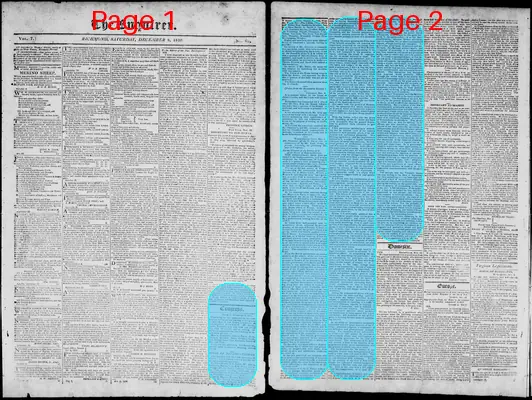
The Enquirer
Richmond, Henrico County, Virginia
What is this article about?
The 12th U.S. Congress convened on December 3, 1810, in Washington. The Senate lacked a quorum and adjourned, while the House formed one, appointed a committee to notify President Madison, and adjourned. On December 4, both houses confirmed quorums. On December 5, Madison delivered his annual message addressing foreign relations, French decree revocation, British orders, West Florida occupation, domestic prosperity, manufactures, navigation, education, slave trade, military preparations, and finances.
Merged-components note: This is a continuation of the report on the opening of Congress, including the roll call and the President's message, spanning across pages 1 and 2. The original label for the second part was 'story', but it fits better as 'domestic_news' overall.
Clippings
1 of 2
OCR Quality
Full Text
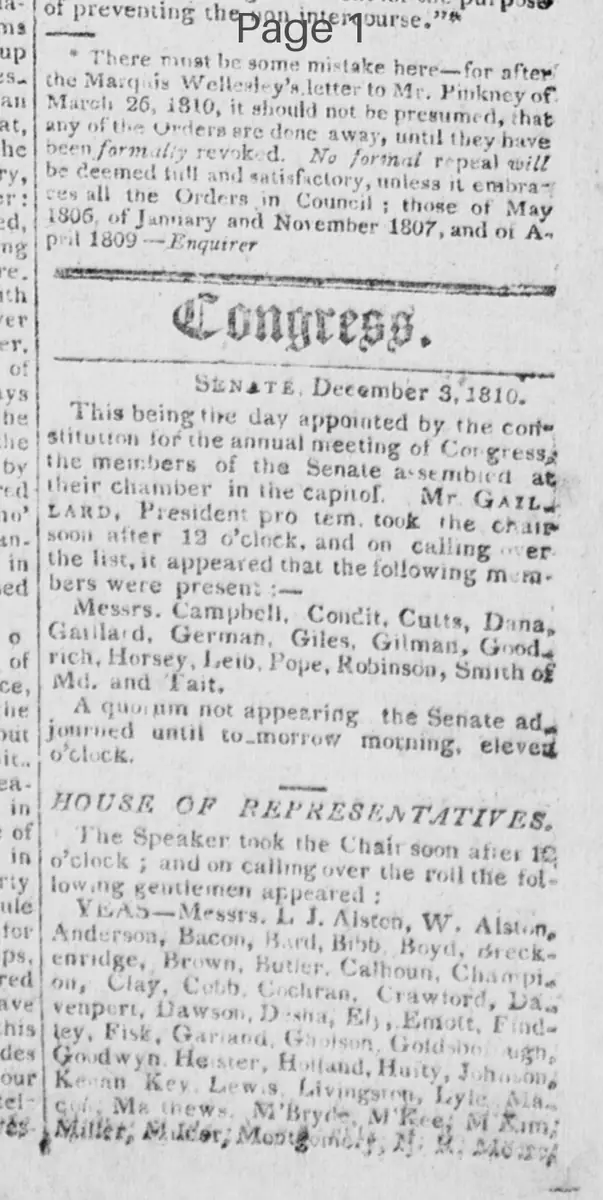
SENATE. December 3, 1810.
This being the day appointed by the constitution for the annual meeting of Congress, the members of the Senate assembled at their chamber in the capitol. Mr. GAILLARD, President pro tem. took the chair soon after 12 o'clock, and on calling the list, it appeared that the following members were present:—
Messrs. Campbell, Condit, Cutts, Dana, Gaillard, German, Giles, Gilman, Goodrich, Horsey, Leib, Pope, Robinson, Smith of Md. and White.
A quorum not appearing the Senate adjourned until to-morrow morning, eleven o'clock.
HOUSE OF REPRESENTATIVES.
The Speaker took the Chair soon after 12 o'clock; and on calling over the roll the following gentlemen appeared:
YEAS—Messrs. L. J. Alston, W. Alston, Anderson, Bacon, Bard, Bibb, Boyd, Breckenridge, Brown, Butler, Calhoun, Chapman, Clay, Cobb, Cochran, Crawford, Davenport, Dawson, Desha, Ely, Emott, Findley, Fisk, Garnett, Gaston, Goldborough, Goodwyn, Hester, Holland, Hulsey, J. R. O'Keen, Key, Lewis, Livingston, Lyle, Macon, M'Bride, M'Kee, M'Kim, Miller, Muldon, Montville, N. K. Van Rensselaer, T. Moore, Morrow, Mosely, Newton, Pearson, Pitkin, Rea. (Pen.) Rhea. (Ten.) Richards, Roane, Root, Sammons, Scudder, Seybert, Shaw, Smilie, G. Smith, J. Smith, S. Smith, Southard, Stanley, Stanford, Stephenson, Tallmadge, Taylor, Thompson, Tracy, Troup, Van Dyke, Van Horn, Van Rensselaer, Weakley, Whitehill, Wilson, Winn, Witherspoon, Wright.
Eighty-one members, nine more than sufficient to constitute a quorum, having appeared—
On motion of Mr. Dawson, a committee was appointed, jointly with such committee as should be appointed by the Senate, to wait on the President of the U. S. & inform him that a quorum of the two Houses were assembled, and ready to receive any communications which he may have to make.
Messrs. Dawson and Shaw were named on this committee.
On motion of Mr. Smilie, the usual rule was adopted for furnishing the members with newspapers.
The Clerk of the House having returned from the Senate, and apprized the House that a quorum of that body was not yet assembled—
The House adjourned till to-morrow morning 11 o'clock.
[Taken from the Alexandria Gazette]
Tuesday, Dec. 4.
At a quarter before 12 the house was called to order, and the Clerk read the journal.
No business was transacted till 1 o'clock, when Mr. Otis from the Senate informed the house that a quorum of the Senate was convened, and were ready to proceed to business.
A few minutes afterwards Mr. Otis again entered the house with a message from the Senate announcing their appointment of a committee to join the committee of the house for the purpose of waiting on the President, &c.
At 2 o'clock the committee returned from the President's, and Mr. Dawson reported that the President would communicate by message, to-morrow at 12 o'clock, and the house immediately adjourned.
Washington City, Dec. 5.
The President of the U. States this day communicated by Mr. Edw. Coles, his private Secretary, the following Message to Congress:
Fellow Citizens of the Senate, and of the House of Representatives,
THE embarrassments which have prevailed in our foreign relations, and so much employed the deliberations of Congress, make it a primary duty, in meeting you, to communicate whatever may have occurred, in that branch of our national affairs.
The act of the last session of Congress "concerning the commercial intercourse between the U. States and G. Britain and France & their dependencies" having invited, in a new form, a termination of their edicts against our neutral commerce, copies of the act were immediately forwarded to our ministers at London and Paris; with a view that its object might be within the early attention of the French and British governments.
By the communication received through our Minister at Paris, it appeared, that a knowledge of the act by the French government, was followed by a declaration that the Berlin and Milan decrees were revoked, and would cease to have effect on the first day of November ensuing. These being the only known edicts of France, within the description of the act, and the revocation of them, being such that they ceased, at that date, to violate our neutral commerce; the fact, as prescribed by law, was announced by a proclamation bearing date the 2d day of Nov.
It would have well accorded with the conciliatory views, indicated by this proceeding on the part of France, to have extended them to all the grounds of just complaint, which now remain unadjusted with the U. States. It was particularly anticipated that, as a further evidence of just dispositions towards them, restoration would have been immediately made of the property of our citizens seized under a misapplication of the principle of reprisals, combined with a misconstruction of a law of the U. States. This expectation has not been fulfilled.
From the British government no communication on the subject of the act has been received. To a communication from our minister at London of the revocation, by the French government, of its Berlin and Milan decrees, it was answered, that the British system would be relinquished as soon as the repeal of the French decrees should have actually taken effect, and the commerce of neutral nations have been restored to the condition in which it stood, previously to the promulgation of those decrees. This pledge, although it does not necessarily import, does not exclude the intention of relinquishing along with the orders in council, the practice of those novel blockades which have a like effect of interrupting our neutral commerce. And this further justice to the U. S. is the rather to be looked for, inasmuch as the blockades in question, being not more contrary to the established law of nations, than inconsistent with the rules of blockade formerly recognized by G. B. herself, could have no alleged basis, other than the plea of retaliation, alleged as the basis of the orders in council. Under the modification of the original orders of November 1807, into the orders of April 1809, there is indeed scarcely a nominal distinction between the orders and the blockades. One of those illegitimate blockades, bearing date in May 1806, having been expressly avowed to be still unrescinded, and to be, in effect, comprehended in the orders in council, was too distinctly brought within the purview of the act of Congress, not to be comprehended in the explanation of the requisites to a compliance with it. The British government was accordingly apprized by our minister near it, that such was the light in which the subject was to be regarded.
On the other important subjects depending between the U. States and that government, no progress has been made, from which an early and satisfactory result can be relied on.
In this new posture of our relations with those powers, the consideration of congress will be properly turned towards a removal of doubts which may occur in the exposition, and of difficulties in the execution, of the act above cited.
The commerce of the U. States with the North of Europe, heretofore much vexed by licentious cruizers, particularly by the Danish flag, has lately been visited with fresh and extensive depredations. The measures pursued in behalf of our injured citizens not having obtained justice for them, a further and more formal interposition with the Danish government is contemplated. The principles which have been maintained by that government in relation to neutral commerce, and the friendly professions of his Danish majesty towards the U. States are valuable pledges in favor of a successful issue.
Among the events growing out of the state of the Spanish monarchy our attention was imperiously attracted to the change developing itself in that portion of West Florida, which though of right appertaining to the U. S., had remained in the possession of Spain, awaiting the result of negociations for its actual delivery to them. The Spanish authority was subverted: and a situation produced exposing the country to ulterior events, which might essentially affect the rights and welfare of the union. In such a conjuncture, I did not delay the interposition required for the occupancy of the territory west of the river Perdido, to which the title of the U. S. extends, and to which the laws provided for the territory of Orleans are applicable. With this view, the Proclamation, a copy of which is laid before you, was confided to the governor of that territory to be carried into effect. The legality and necessity of the course pursued, assure me of the favorable light in which it will present itself to the legislature, and of the promptitude with which they will supply whatever provisions may be due to the essential rights and equitable interests of the people thus brought into the bosom of the American family.
Our amity with the powers of Barbary, with the exception of a recent occurrence at Tunis, of which an explanation is just received, appears to have been uninterrupted, and to have become more firmly established.
With the Indian tribes also the peace and friendship of the U. States are found to be so eligible, that the general disposition to preserve both continues to gain strength.
I feel particular satisfaction in remarking that an interior view of our country presents us with grateful proofs of its substantial and increasing prosperity. To a thriving agriculture and the improvements related to it, is added a highly interesting extension of useful manufactures; the combined product of professional occupations, and of household industry. Such indeed is the experience of economy, as well as policy, in these substitutes for supplies heretofore obtained by foreign commerce, that in a national view the change is justly regarded as of itself more than a recompence for those privations and losses resulting from foreign injustice, which furnished the general impulse, required for its accomplishment.
How far it may be expedient to guard the infancy of this improvement in the distribution of labor, by regulations of the commercial tariff, is a subject which cannot fail to suggest itself to your patriotic reflections.
It will rest with the consideration of congress also whether a provident as well as fair encouragement would not be given to our navigation by such regulations as will place it on a level of competition with foreign vessels, particularly in transporting the important and bulky productions of our own soil. The failure of equality and reciprocity in the existing regulations on this subject operates, in our ports, as a premium to foreign competitors; and the inconvenience must increase as these may be multiplied, under more favorable circumstances, by the more than countervailing encouragements now given them, by the laws of their respective countries.
Whilst it is universally admitted that a well instructed people alone can be permanently a free people; and whilst it is evident that the means of diffusing and improving useful knowledge form so small a proportion of the expenditures for national purposes, I cannot presume it to be unseasonable to invite your attention to the advantages of superadding, to the means of education provided by the several states, a seminary of learning, instituted by the national legislature, within the limits of their exclusive jurisdiction; the expence of which might be defrayed, or reimbursed, out of the vacant grounds which have accrued to the nation within these limits. Such an institution, though local in its legal character, would be universal in its beneficial effects. By enlightening the opinions; by expanding the patriotism; and by assimilating the principles, the sentiments and the manners of those who might resort to this temple of science, to be redistributed, in due time, through every part of the community; sources of jealousy and prejudice would be diminished, the features of national character would be multiplied, and greater extent given to social harmony. But above all, a well constituted seminary, in the centre of the nation, is recommended by the consideration that the additional instruction emanating from it, would contribute no less to strengthen the foundation, than to adorn the structure, of our free and happy system of government.
Among the commercial abuses still committed under the American flag, and leaving in force my former reference to that subject, it appears that American citizens are instrumental in carrying on a traffic in enslaved Africans, equally in violation of the laws of humanity, and in defiance of those of their own country. The same just and benevolent motives which produced the interdiction in force against this criminal conduct, will doubtless be felt by Congress in devising further means of suppressing the evil.
In the midst of uncertainties necessarily connected with the great interests of the U. States, prudence requires a continuance of our defensive and precautionary arrangements. The secretary of war and secretary of the navy will submit the statements and estimates which may aid Congress in their ensuing provisions for the land and naval forces. The statements of the latter will include a view of the transfers of appropriations in the naval expenditures, and the grounds on which they were made.
The fortifications for the defence of our maritime frontier have been prosecuted according to the plan laid down in 1808. The works, with some exceptions, are completed, and furnished with ordinance. Those for the security of the City of New York, though far advanced towards completion, will require a further time and appropriation. This is the case with a few others, either not completed, or in need of repairs.
The improvements, in quality and quantity, made in the manufactory of cannon; and of small arms, both at the public armories and private factories, warranted additional confidence in the competency of these resources, for supplying the public exigencies.
These preparations for arming the militia having thus far provided for one of the objects contemplated by the power vested in Congress, with respect to that great bulwark of the public safety; it is for their consideration, whether further provisions are not requisite, for the other contemplated objects, of organization and discipline. To give to this great mass of physical and moral force, the efficiency which it merits, and is capable of receiving: it is indispensible that they should be instructed and practised in the rules by which they are to be governed. Towards an accomplishment of this important work, I recommend for the consideration of Congress, the expediency of instituting a system, which shall, in the first instance, call into the field, at the public expense, and for a given time, certain portions of the commissioned and non-commissioned officers. The instruction and discipline thus acquired would gradually diffuse through the entire body of the militia that practical knowledge and promptitude for active service, which are the great ends to be pursued. Experience has left no doubt, either of the necessity, or of the efficacy, of competent military skill in those portions of an army, in fitting it for the final duties, which it may have to perform.
The corps of Engineers, with the Military Academy, are entitled to the early attention of Congress. The buildings at the seat, fixed by law, for the present Academy are so far in decay, as not to afford the necessary accommodation. But a revision of the law is recommended, principally with a view to a more enlarged cultivation and diffusion of the advantages of such institutions, by providing professorships for all the necessary branches of military instruction, and by the establishment of an additional Academy, at the Seat of Government, or elsewhere. The means by which war, as well for defence, as for offence, are now carried on, render these schools of the more scientific operations an indispensable part of every adequate system. Even among nations whose large standing armies and frequent wars afford every other opportunity of instruction, these establishments are found to be indispensable for the due attainment of the branches of military science, which require a regular course of study and experiment. In a government, happily without the other opportunities, seminaries, where the elementary principles of the art of war can be taught without actual war and without the expense of extensive and standing armies, have the precious advantage of uniting an essential preparation against external danger, with a scrupulous regard to internal safety. In no other way, probably, can a provision of equal efficacy for the public defence be made at so little expense or more consistently with the public liberty.
The receipts into the Treasury during the year ending on the 30th of September last (and amounting to more than eight millions and a half of dollars) have exceeded the current expenses of the Government, including the interest on the public debt.—For the purpose of reimbursing at the end of the year 3,750,000 dollars of the principal of a loan as authorised by law, had been negociated to that amount: but has since been reduced to 2,750,000 dollars; the reduction being permitted by the state of the Treasury; in which there will be a balance, remaining at the end of the year, estimated at 2,000,000 dollars. For the probable receipts of the next year, and other details I refer to statements which will be transmitted from the Treasury, and which will enable you to judge what further provisions may be necessary for the ensuing years:
Reserving for future occasions, in the course of the Session, whatever other communications may claim your attention, I close the present, by expressing my reliance, under the blessing of Divine Providence on the judgment and patriotism which will guide your measures, at a period particularly calling for united Councils, and inflexible exertions for the welfare of our country; and by assuring you of the fidelity and alacrity with which my co-operation will be afforded.
JAMES MADISON.
What sub-type of article is it?
What keywords are associated?
What entities or persons were involved?
Where did it happen?
Domestic News Details
Primary Location
Washington City
Event Date
December 3, 1810
Key Persons
Event Details
The 12th Congress assembled on December 3, 1810; Senate lacked quorum and adjourned, House achieved quorum, appointed committee to inform President, adopted newspaper rule, and adjourned. On December 4, quorums confirmed in both houses, joint committee waited on President who promised message next day. On December 5, President Madison delivered annual message covering foreign relations with France, Britain, Denmark, Spain (West Florida occupation), Barbary powers, Indians; domestic prosperity in agriculture and manufactures; recommendations for tariffs, navigation, national university, suppressing slave trade; continuance of defenses, fortifications, militia training, Military Academy; and financial statements.