Thank you for visiting SNEWPapers!
Sign up free
Alexandria Daily Advertiser
Alexandria, Virginia
What is this article about?
In the U.S. House of Representatives on January 23, members debated defending ports against foreign aggressions as recommended by the President. Speakers like Dana pushed for firm action, while Nelson and Smilie sought more details and time, linking it to broader foreign policy.
Merged-components note: Merged as continuation of the congressional debate on defense of ports and harbors
Clipping
OCR Quality
Full Text
UNITED STATES OF AMERICA.
OF THE
HOUSE OF REPRESENTATIVES
Thursday, January 23.
DEFENCE OF OUR PORTS AND HARBOURS.
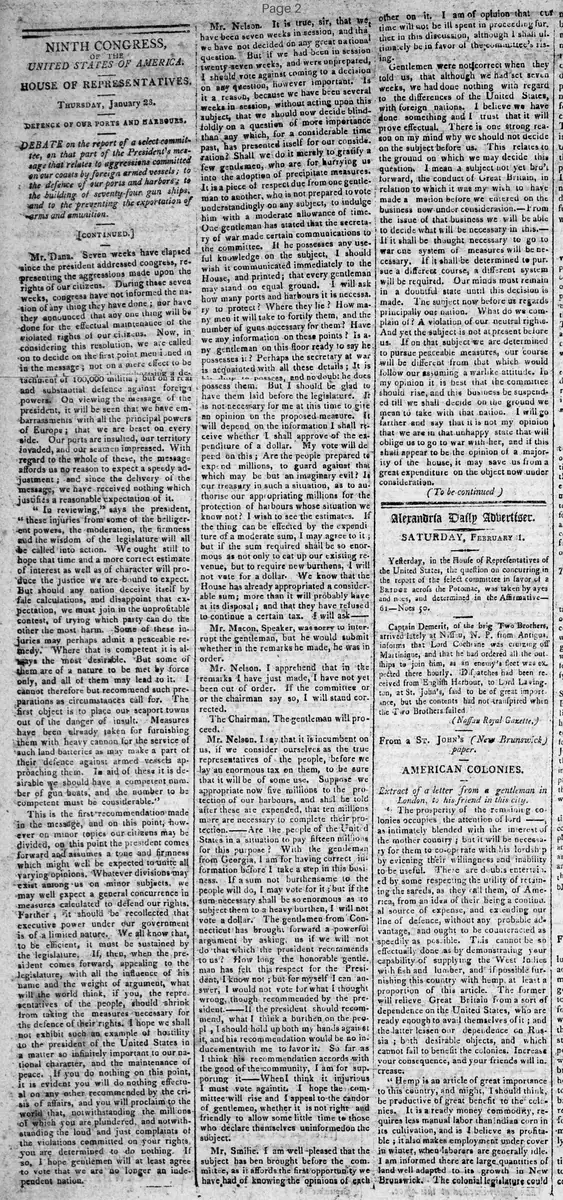
DEBATE on the report of a select committee, on that part of the President's message that relates to aggressions committed on our coasts by foreign armed vessels; to the defence of our ports and harbors; to the building of seventy-four gun ships, and to the preventing the exportation of arms and ammunition.
[CONTINUED.]
Mr. Dana. Seven weeks have elapsed since the president addressed congress, representing the aggressions made upon the rights of our citizens. During these seven weeks, congress have not informed the nation of any thing they have done; nor have they announced that any one thing will be done for the effectual maintenance of the violated rights of our citizens. Now, in considering this resolution, we are called on to decide on the first point mentioned in the message; not on a mere effect to be produced by the detachment of 100,000 militia; but on a plan nourishing a defence and substantial defence against foreign powers. On viewing the message of the president, it will be seen that we have embarrassments with all the principal powers of Europe; that we are beset on every side. Our ports are insulted, our territory invaded, and our seamen impressed. With regard to the whole of these, the message affords us no reason to expect a speedy adjustment; and since the delivery of the message, we have received nothing which justifies a reasonable expectation of it.
"In reviewing," says the president, "these injuries from some of the belligerent powers, the moderation, the firmness and the wisdom of the legislature will all be called into action. We ought still to hope that time and a more correct estimate of interest as well as of character will produce the justice we are bound to expect. But should any nation deceive itself by false calculations, and disappoint that expectation, we must join in the unprofitable contest, of trying which party can do the other the most harm. Some of these injuries may perhaps admit a peaceable remedy." Where that is competent it is always the most desirable. But some of them are of a nature to be met by force only, and all of them may lead to it. I cannot therefore but recommend such preparations as circumstances call for. The first object is to place our seaport towns out of the danger of insult. Measures have been already taken for furnishing them with heavy cannon for the service of such land batteries as may make a part of their defence against armed vessels approaching them. In aid of these it is desirable we should have a competent number of gun boats, and the number to be competent must be considerable."
This is the first recommendation made in the message, and on this point, however on minor topics our citizens may be divided, on this point the president comes forward and assumes a tone and firmness which might well be expected to unite all varying opinions. Whatever divisions may exist among us on minor subjects, we may well expect a general concurrence in measures calculated to defend our rights. Farther; it should be recollected that executive power under our government is of a limited nature. We all know that to be efficient, it must be sustained by the legislature. If, then, when the president comes forward, appealing to the legislatures, with all the influence of his name and the weight of argument, what will the world think, if you, the representatives of the people, should shrink from taking the measures necessary for the defence of their rights. I hope we shall not exhibit such an example of hostility to the president of the United States in a matter so infinitely important to our national character, and the maintenance of peace. If you do nothing on this point, it is evident you will do nothing effectual on any other recommended by the crisis of affairs, and you will proclaim to the world that, notwithstanding the millions of which you are plundered, and notwithstanding the loud and just complaints of the violations committed on your rights, you are determined to do nothing. If so, I hope gentlemen will at least agree to vote that we are no longer an independent nation.
Mr. Nelson. It is true, Sir, that we have been seven weeks in session, and have not decided on any great national question. But if we had been in session twenty-seven weeks, and were unprepared, I should vote against coming to a decision on any question, however important. Is it a reason, because we have been several weeks in session, without acting upon this subject, that we should now decide blindly on a question of more importance than any which, for a considerable time past, has presented itself for our consideration? Shall we do it merely to gratify a few gentlemen, who are for hurrying us into the adoption of precipitate measures. It is a piece of respect due from one gentleman to another, who is not prepared to vote understandingly on any subject, to indulge him with a moderate allowance of time. One gentleman has stated that the secretary of war made certain communications to the committee. If he possesses any useful knowledge on the subject, I should wish it communicated immediately to the House, and printed; that every gentleman may stand on equal ground. I will ask how many ports and harbors it is necessary to protect? Where they lie? How many men it will take to fortify them, and the number of guns necessary for them? Have we any information on these points? Is any gentleman on this floor ready to say he possesses it? Perhaps the secretary at war is acquainted with all these details; It is his duty to possess, and no doubt he does possess them. But I should be glad to have them laid before the legislature. It is not necessary for me at this time to give an opinion on the proposed measure. It will depend on the information I shall receive whether I shall approve of the expenditure of a dollar. My vote will depend on this; Are the people prepared to expend millions, to guard against that which may be but an imaginary evil? Is our treasury in such a situation, as to authorize our appropriating millions for the protection of harbors whose situation we know not? I wish to see the estimates. If the thing can be effected by the expenditure of a moderate sum, I may agree to it; but if the sum required shall be so enormous as not only to eat up our existing revenue, but to require new burthens, I will not vote for a dollar. We know that the House has already appropriated a considerable sum; more than it will probably have at its disposal; and that they have refused to continue a certain tax.
Mr. Macon, Speaker, was sorry to interrupt the gentleman, but he would submit whether in the remarks he made, he was in order.
Mr. Nelson. I apprehend that in the remarks I have just made, I have not yet been out of order. If the committee or the chairman say so, I will stand corrected.
The Chairman. The gentleman will proceed.
Mr. Nelson. I say that it is incumbent on us, if we consider ourselves as the true representatives of the people, before we lay an enormous tax on them, to be sure that it will be of some use. Suppose we appropriate now five millions to the protection of our harbors, and shall be told after these are expended, that ten millions more are necessary to complete their protection. Are the people of the United States in a situation to pay fifteen millions for this purpose? With the gentleman from Georgia, I am for having correct information before I take a step in this business. If a sum not burthensome to the people will do, I may vote for it but if the sum necessary shall be so enormous as to subject them to a heavy burthen, I will not vote a dollar. The gentleman from Connecticut has brought forward a powerful argument by asking, us if we will not do that which the president recommends to us? How long the honorable gentleman has felt this respect for the President, I know not; but for myself I can answer, I would not vote for what I thought wrong, though recommended by the president. If the president should recommend, what I think a burthen on the people, I should hold up both my hands against it, and his recommendation would be no inducement with me to favor it. So far as I think his recommendation accords with the good of the community, I am for supporting it. When I think it injurious I must vote against it. I hope the committee will rise and I appeal to the candor of gentlemen, whether it is not right and friendly to allow some little time to those who declare themselves uninformed on the subject.
Mr. Smilie. I am well-pleased that the subject has been brought before the committee, as it affords the first opportunity we have had of knowing the opinions of each other on it. I am of opinion that time will not be ill spent in proceeding further in this discussion, although I shall ultimately be in favor of the committee's rising. Gentlemen were not correct when they told us, that although we had set seven weeks, we had done nothing with regard to the differences of the United States, with foreign nations. I believe we have done something and I trust that it will prove effectual. There is one strong reason on my mind why we should not decide on the subject before us. This relates to the ground on which we may decide this question. I mean a subject not yet bro't forward, the conduct of Great Britain, in relation to which it was my wish to have made a motion before we entered on the business now under consideration. From the issue of that business we will be able to decide what will be necessary in this. If it shall be thought necessary to go to war one system of measures will be necessary. If it shall be determined to pursue a different course, a different system will be required. Our minds must remain in a doubtful state until this decision is made. The subject now before us regards principally one nation. What do we complain of? A violation of our neutral rights. And yet the subject is not at present before us. If on that subject we are determined to pursue peaceable measures, our course will be different from that which would follow our assuming a warlike attitude. In my opinion it is best that the committee should rise, and this business be suspended till we shall decide on the ground we mean to take with that nation. I will go farther and say that it is not my opinion that we are in that unhappy state that will oblige us to go to war with her, and if this shall appear to be the opinion of a majority of the house, it may save us from a great expenditure on the object now under consideration.
(To be continued)
What sub-type of article is it?
What keywords are associated?
What entities or persons were involved?
Where did it happen?
Domestic News Details
Primary Location
United States House Of Representatives
Event Date
Thursday, January 23.
Key Persons
Event Details
Debate in the House of Representatives on the report of a select committee regarding the President's message on foreign aggressions on coasts, defense of ports and harbors, building seventy-four gun ships, and preventing exportation of arms and ammunition. Mr. Dana urges action for substantial defense. Mr. Nelson calls for more information and time before deciding on expenditures. Mr. Smilie suggests suspending until decisions on foreign relations, particularly with Great Britain.