Thank you for visiting SNEWPapers!
Sign up free
Editorial
February 27, 1851
Glasgow Weekly Times
Glasgow, Howard County, Missouri
What is this article about?
An editorial argues that government must promote the moral and intellectual elevation of its people, emphasizing that moral principles are essential for societal bonds, political integrity, and preserving the voluntary union of the United States against corruption and sectionalism.
Clipping
OCR Quality
98%
Excellent
Full Text
For the Times.
GOVERNMENT:
ITS OBLIGATION TO CONTRIBUTE BY VARIOUS MEANS TO THE MORAL AND INTELLECTUAL ELEVATION OF A PEOPLE.
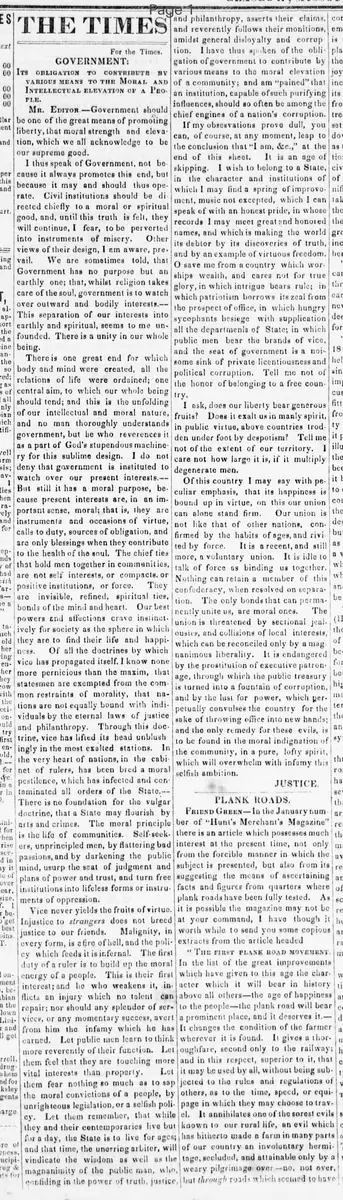
Mr. Editor.—Government should be one of the great means of promoting liberty, that moral strength and elevation, which we all acknowledge to be our supreme good. I thus speak of Government, not because it always promotes this end, but because it may and should thus operate. Civil institutions should be directed chiefly to a moral or spiritual good, and, until this truth is felt, they will continue, I fear, to be perverted into instruments of misery. Other views of their design, I am aware, prevail. We are sometimes told, that Government has no purpose but an earthly one; that, whilst religion takes care of the soul, government is to watch over outward and bodily interests.—This separation of our interests into earthly and spiritual, seems to me unfounded. There is a unity in our whole being. There is one great end for which body and mind were created, all the relations of life were ordained; one central aim, to which our whole being should tend; and this is the unfolding of our intellectual and moral nature, and no man thoroughly understands government, but he who reverences it as a part of God's stupendous machinery for this sublime design. I do not deny that government is instituted to watch over our present interests.—But still it has a moral purpose, because present interests are, in an important sense, moral; that is, they are instruments and occasions of virtue, calls to duty, sources of obligation, and are only blessings when they contribute to the health of the soul. The chief ties that hold men together in communities, are not self interests, or compacts, or positive institutions, or force. They are invisible, refined, spiritual ties, bonds of the mind and heart. Our best powers and affections crave instinctively for society as the sphere in which they are to find their life and happiness. Of all the doctrines by which vice has propagated itself, I know none more pernicious than the maxim, that statesmen are exempted from the common restraints of morality, that nations are not equally bound with individuals by the eternal laws of justice and philanthropy. Through this doctrine, vice has lifted its head unblushingly in the most exalted stations. In the very heart of nations, in the cabinet of rulers, has been bred a moral pestilence, which has infected and contaminated all orders of the State.—There is no foundation for the vulgar doctrine, that a State may flourish by arts and crimes. The moral principle is the life of communities. Self-seekers, unprincipled men, by flattering bad passions, and by darkening the public mind, usurp the seat of judgment and plans of power and trust, and turn free institutions into lifeless forms or instruments of oppression. Vice never yields the fruits of virtue. Injustice to strangers does not breed justice to our friends. Malignity, in every form, is a fire of hell, and the policy which feeds it is infernal. The first duty of a ruler is to build up the moral energy of a people. This is their first interest; and he who weakens it, inflicts an injury which no talent can repair; nor should any splendor of services, or any momentary success, avert from him the infamy which he has earned. Let public men learn to think more reverently of their function. Let them feel that they are touching more vital interests than property. Let them fear nothing so much as to sap the moral convictions of a people, by unrighteous legislation, or a selfish policy. Let them remember, that while they and their contemporaries live but for a day, the State is to live for ages; and that time, the unerring arbiter, will vindicate the wisdom as well as the magnanimity of the public man, who confiding in the power of truth, justice and philanthropy, asserts their claims, and reverently follows their monitions. amidst general disloyalty and corruption. I have thus spoken of the obligation of government to contribute by various means to the moral elevation of a community; and am "pained" that an institution, capable of such purifying influences, should so often be among the chief engines of a nation's corruption. If my observations prove dull, you can, of course, at any moment, leap to the conclusion that "I am, &c.," at the end of this sheet. It is an age of skipping. I wish to belong to a State, in the character and institutions of which I may find a spring of improvement, music not excepted, which I can speak of with an honest pride, in whose records I may meet great and honored names, and which is making the world its debtor by its discoveries of truth, and by an example of virtuous freedom. O save me from a country which worships wealth, and cares not for true glory, in which intrigue bears rule; in which patriotism borrows its zeal from the prospect of office, in which hungry sycophants besiege with supplication all the departments of State; in which public men bear the brands of vice, and the seat of government is a noisome sink of private licentiousness and political corruption. Tell me not of the honor of belonging to a free country. I ask, does our liberty bear generous fruits? Does it exalt us in manly spirit, in public virtue, above countries trodden under foot by despotism? Tell me not of the extent of our territory. I care not how large it is, if it multiply degenerate men. Of this country I may say with peculiar emphasis, that its happiness is bound up in virtue, on this our union can alone stand firm. Our union is not like that of other nations, confirmed by the habits of ages, and riveted by force. It is a recent, and still more, a voluntary union. It is idle to talk of force as binding us together. Nothing can retain a member of this confederacy, when resolved on separation. The only bonds that can permanently unite us, are moral ones. The union is threatened by sectional jealousies, and collisions of local interests, which can be reconciled only by a magnanimous liberality. It is endangered by the prostitution of executive patronage, through which the public treasury is turned into a fountain of corruption, and by the lust for power, which perpetually convulses the country for the sake of throwing office into new hands; and the only remedy for these evils, is to be found in the moral indignation of the community, in a pure, lofty spirit, which will overwhelm with infamy this selfish ambition.
GOVERNMENT:
ITS OBLIGATION TO CONTRIBUTE BY VARIOUS MEANS TO THE MORAL AND INTELLECTUAL ELEVATION OF A PEOPLE.
Mr. Editor.—Government should be one of the great means of promoting liberty, that moral strength and elevation, which we all acknowledge to be our supreme good. I thus speak of Government, not because it always promotes this end, but because it may and should thus operate. Civil institutions should be directed chiefly to a moral or spiritual good, and, until this truth is felt, they will continue, I fear, to be perverted into instruments of misery. Other views of their design, I am aware, prevail. We are sometimes told, that Government has no purpose but an earthly one; that, whilst religion takes care of the soul, government is to watch over outward and bodily interests.—This separation of our interests into earthly and spiritual, seems to me unfounded. There is a unity in our whole being. There is one great end for which body and mind were created, all the relations of life were ordained; one central aim, to which our whole being should tend; and this is the unfolding of our intellectual and moral nature, and no man thoroughly understands government, but he who reverences it as a part of God's stupendous machinery for this sublime design. I do not deny that government is instituted to watch over our present interests.—But still it has a moral purpose, because present interests are, in an important sense, moral; that is, they are instruments and occasions of virtue, calls to duty, sources of obligation, and are only blessings when they contribute to the health of the soul. The chief ties that hold men together in communities, are not self interests, or compacts, or positive institutions, or force. They are invisible, refined, spiritual ties, bonds of the mind and heart. Our best powers and affections crave instinctively for society as the sphere in which they are to find their life and happiness. Of all the doctrines by which vice has propagated itself, I know none more pernicious than the maxim, that statesmen are exempted from the common restraints of morality, that nations are not equally bound with individuals by the eternal laws of justice and philanthropy. Through this doctrine, vice has lifted its head unblushingly in the most exalted stations. In the very heart of nations, in the cabinet of rulers, has been bred a moral pestilence, which has infected and contaminated all orders of the State.—There is no foundation for the vulgar doctrine, that a State may flourish by arts and crimes. The moral principle is the life of communities. Self-seekers, unprincipled men, by flattering bad passions, and by darkening the public mind, usurp the seat of judgment and plans of power and trust, and turn free institutions into lifeless forms or instruments of oppression. Vice never yields the fruits of virtue. Injustice to strangers does not breed justice to our friends. Malignity, in every form, is a fire of hell, and the policy which feeds it is infernal. The first duty of a ruler is to build up the moral energy of a people. This is their first interest; and he who weakens it, inflicts an injury which no talent can repair; nor should any splendor of services, or any momentary success, avert from him the infamy which he has earned. Let public men learn to think more reverently of their function. Let them feel that they are touching more vital interests than property. Let them fear nothing so much as to sap the moral convictions of a people, by unrighteous legislation, or a selfish policy. Let them remember, that while they and their contemporaries live but for a day, the State is to live for ages; and that time, the unerring arbiter, will vindicate the wisdom as well as the magnanimity of the public man, who confiding in the power of truth, justice and philanthropy, asserts their claims, and reverently follows their monitions. amidst general disloyalty and corruption. I have thus spoken of the obligation of government to contribute by various means to the moral elevation of a community; and am "pained" that an institution, capable of such purifying influences, should so often be among the chief engines of a nation's corruption. If my observations prove dull, you can, of course, at any moment, leap to the conclusion that "I am, &c.," at the end of this sheet. It is an age of skipping. I wish to belong to a State, in the character and institutions of which I may find a spring of improvement, music not excepted, which I can speak of with an honest pride, in whose records I may meet great and honored names, and which is making the world its debtor by its discoveries of truth, and by an example of virtuous freedom. O save me from a country which worships wealth, and cares not for true glory, in which intrigue bears rule; in which patriotism borrows its zeal from the prospect of office, in which hungry sycophants besiege with supplication all the departments of State; in which public men bear the brands of vice, and the seat of government is a noisome sink of private licentiousness and political corruption. Tell me not of the honor of belonging to a free country. I ask, does our liberty bear generous fruits? Does it exalt us in manly spirit, in public virtue, above countries trodden under foot by despotism? Tell me not of the extent of our territory. I care not how large it is, if it multiply degenerate men. Of this country I may say with peculiar emphasis, that its happiness is bound up in virtue, on this our union can alone stand firm. Our union is not like that of other nations, confirmed by the habits of ages, and riveted by force. It is a recent, and still more, a voluntary union. It is idle to talk of force as binding us together. Nothing can retain a member of this confederacy, when resolved on separation. The only bonds that can permanently unite us, are moral ones. The union is threatened by sectional jealousies, and collisions of local interests, which can be reconciled only by a magnanimous liberality. It is endangered by the prostitution of executive patronage, through which the public treasury is turned into a fountain of corruption, and by the lust for power, which perpetually convulses the country for the sake of throwing office into new hands; and the only remedy for these evils, is to be found in the moral indignation of the community, in a pure, lofty spirit, which will overwhelm with infamy this selfish ambition.
What sub-type of article is it?
Moral Or Religious
Social Reform
What keywords are associated?
Moral Elevation
Government Obligation
Virtue In Politics
Union Preservation
Political Corruption
Sectional Jealousies
Executive Patronage
What entities or persons were involved?
Government
Rulers
Public Men
The State
This Country
Editorial Details
Primary Topic
Government's Obligation To Contribute To The Moral And Intellectual Elevation Of A People
Stance / Tone
Moral Exhortation Advocating Virtuous Governance
Key Figures
Government
Rulers
Public Men
The State
This Country
Key Arguments
Government Should Promote Moral And Spiritual Good As Its Primary Aim
Separation Of Earthly And Spiritual Interests Is Unfounded; There Is Unity In Human Being
Moral Ties, Not Force Or Self Interest, Hold Communities Together
Statesmen Are Bound By Morality Like Individuals; Exemption Leads To Vice In High Places
Moral Principle Is The Life Of Communities; Vice Cannot Yield Fruits Of Virtue
Rulers' First Duty Is To Build Moral Energy Of The People
Public Men Must Revere Their Function And Avoid Sapping Moral Convictions
The Union Depends On Moral Bonds, Threatened By Sectional Jealousies And Corruption
Remedy For Political Evils Is Moral Indignation Of The Community