Thank you for visiting SNEWPapers!
Sign up free
Daily National Intelligencer
Washington, District Of Columbia
What is this article about?
A letter to the National Intelligencer defends John C. Calhoun's political consistency and qualifications as Secretary of War against criticisms in a prior letter by 'A Foreigner' in the National Register. It recounts Calhoun's sound positions on trade restrictions, naval expansion, the War of 1812, national bank, and internal improvements, portraying him as a visionary statesman.
Clipping
OCR Quality
Full Text
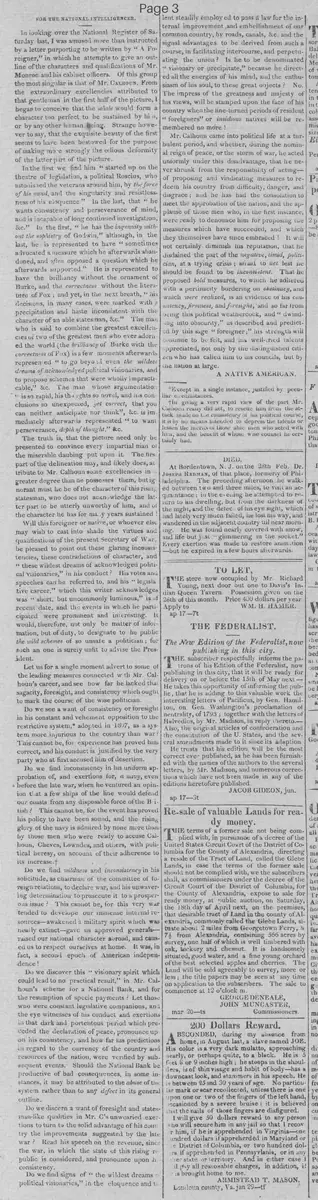
In looking over the National Register of Saturday last, I was amused more than instructed by a letter purporting to be written by "A Foreigner," in which he attempts to give an outline of the characters and qualifications of Mr. Monroe and his cabinet officers. Of this group the most singular is that of Mr. Calhoun. From the extraordinary excellencies attributed to that gentleman in the first half of the picture, I began to conceive that the whole would form a character too perfect to be sustained by him, or by any other human being. Strange however to say, that the exquisite beauty of the first seems to have been bestowed for the purpose of making more strongly the odious deformity of the latter part of the picture.
In the first we find him "started up on the theatre of legislation, a political Roscius, who astonished the veterans around him, by the force of his mind, and the singularity and resistlessness of his eloquence." In the last, that "he wants consistency and perseverance of mind, and is incapable of long continued investigation, &c." In the first. "he has the ingenuity without the sophistry of Godwin," although, in the last, he is represented to have "sometimes advocated a measure which he afterwards abandoned, and often opposed a question which he afterwards supported." He is represented to have the brilliancy without the ornament of Burke, and the correctness without the literature of Fox; and yet, in the next breath, "his decisions, in many cases, were marked with a precipitation and haste inconsistent with the character of an able statesman, &c." The man who is said to combine the greatest excellencies of two of the greatest men who ever adorned the world (the brilliancy of Burke with the correctness of Fox) is a few moments afterwards represented "to go beyond even the wildest dreams of acknowledged political visionaries, and to propose schemes that were wholly impracticable." &c. The man whose argumentation "is so rapid, his thoughts so novel, and his conclusions so unexpected, yet correct, that you can neither anticipate nor think", &c. is immediately afterwards represented "to want perseverance, depth of thought," &c.
The truth is, that the picture need only be presented to convince every impartial man of the miserable daubing put upon it. The first part of the delineation may, and likely does, attribute to Mr. Calhoun some excellencies in greater degree than he possesses them, but ignorant must he be of the character of this rising statesman, who does not acknowledge the latter part to be utterly unworthy of him, and of the character he has for many years sustained!
Will this foreigner or native, or whoever else may wish to cast into shade the virtues and qualifications of the present Secretary of War, be pleased to point out these glaring inconsistencies, these contradictions of character, and "these wildest dreams of acknowledged political visionaries," in his conduct? His votes and speeches can be referred to, and his "legislative career," which this writer acknowledges was "short, but uncommonly luminous," is of recent date, and the events in which he participated were prominent and interesting. It would, therefore, not only be matter of information, but of duty, to designate to the public the wild schemes of so unsafe a politician; for such an one is surely unfit to advise the President.
Let us for a single moment advert to some of the leading measures connected with Mr. Calhoun's career, and see how far he lacked that sagacity, foresight, and consistency which ought to mark the course of the wise politician.
Do we see a want of consistency or foresight in his constant and vehement opposition to the restrictive system, adopted in 1807, as a system more injurious to the country than war? This cannot be, for experience has proved him correct, and his conduct is justified by the very party who at first accused him of desertion.
Do we find inconsistency in his uniform approbation of, and exertions for, a navy, even before the late war, when he ventured an opinion that a few ships of the line would defend our coasts from any disposable force of the British? This cannot be, for the event has proved his policy to have been sound, and the rising glory of the navy is admired by none more than by those men who were ready to accuse Calhoun, Cheves, Lowndes, and others, with political heresy, on account of their adherence to its increase.
Do we find wildness and inconsistency in his solicitude, as chairman of the committee of foreign relations, to declare war, and his unwavering determination to prosecute it to a prosperous issue? This cannot be, for this very war tended to develope our immense internal resources—awakened a military spirit which was nearly extinct—gave us approved generals—raised our national character abroad, and caused us to respect ourselves at home. It was, in fact, a second epoch of American independence!
Do we discover this "visionary spirit which could lead to no practical result," in Mr. Calhoun's scheme for a National Bank, and for the resumption of specie payments? Let those who were constant legislative companions, and the eye witnesses of his conduct and exertions in that dark and portentous period which preceded the declaration of peace, pronounce upon his consistency, and how far his predictions in regard to the currency of the country and resources of the nation, were verified by subsequent events. Should the National Bank be productive of bad consequences, in some instances, it may be attributed to the abuse of the system rather than to any defect in its general outline.
Do we discern a want of foresight and statesman-like qualities in Mr. C's unwearied exertions to turn to the solid advantage of his country the improvements suggested by the late war? Read his speech on the revenue, since the war, in which the state of this rising republic is considered, and pronounce upon his consistency.
Do we find signs of "the wildest dreams of political visionaries," in the eloquence and talents steadily employed to pass a law for the internal improvement and embellishment of our common country, by roads, canals, &c. and the signal advantages to be derived from such a course, in facilitating intercourse, and perpetuating the union? Is he to be denominated "visionary or precipitate," because he directed all the energies of his mind, and the enthusiasm of his soul, to these great objects? No. The impress of the greatness and majesty of his views, will be stamped upon the face of his country when the fine-turned periods of resident "foreigners" or insidious natives will be remembered no more!
Mr. Calhoun came into political life at a turbulent period, and whether, during the nominal reign of peace, or the storm of war, he acted uniformly under this disadvantage, that he never shrunk from the responsibility of acting—of proposing and vindicating measures to redeem his country from difficulty, danger, and disgrace; and he has had the consolation to meet the approbation of the nation, and the applause of those men who, in the first instance, were ready to denounce him for proposing the measures which have succeeded, and which they themselves have since embraced! It will not certainly diminish his reputation, that he disdained the part of the negative, timid, politician, at a trying crisis; afraid to act lest he should be found to be inconsistent. That he proposed bold measures, to which he adhered with a pertinacity bordering on obstinacy, and which were realized, is an evidence of his consistency, firmness, and foresight, and so far from owning this political weathercock, and "dwinding into obscurity," as described and predicted by this sage "foreigner;" his strength will continue to be felt, and his well-tried talents appreciated, not only by the distinguished citizen who has called him to his councils, but by the nation at large.
A NATIVE AMERICAN.
*Except in a single instance, justified by peculiar circumstances.
In giving a very rapid view of the part Mr. Calhoun really did act, to rescue him from the attack made on the consistency of his political course, it is by no means intended to depress the talents or lessen the merits of those able men who acted with him, and the benefit of whose wise counsel he certainly had.
What sub-type of article is it?
What themes does it cover?
What keywords are associated?
What entities or persons were involved?
Letter to Editor Details
Author
A Native American
Recipient
For The National Intelligencer
Main Argument
john c. calhoun possesses consistency, foresight, and statesmanlike qualities, as demonstrated by his opposition to trade restrictions, support for naval expansion, advocacy for the war of 1812, promotion of a national bank, and efforts for internal improvements; criticisms portraying him as inconsistent and visionary are unfounded and contradicted by his successful record.
Notable Details