Thank you for visiting SNEWPapers!
Sign up free
Atlanta Daily World
Atlanta, Fulton County, Georgia
What is this article about?
An article highlighting the need for specialized teachers for handicapped and exceptional children in the South, using an anecdote of a partially-sighted boy to illustrate challenges. The Southern Regional Education Board recommends regional training programs at institutions like George Peabody College and University of Texas to address a shortage of over 26,000 teachers identified in a 1954 survey.
Clipping
OCR Quality
Full Text
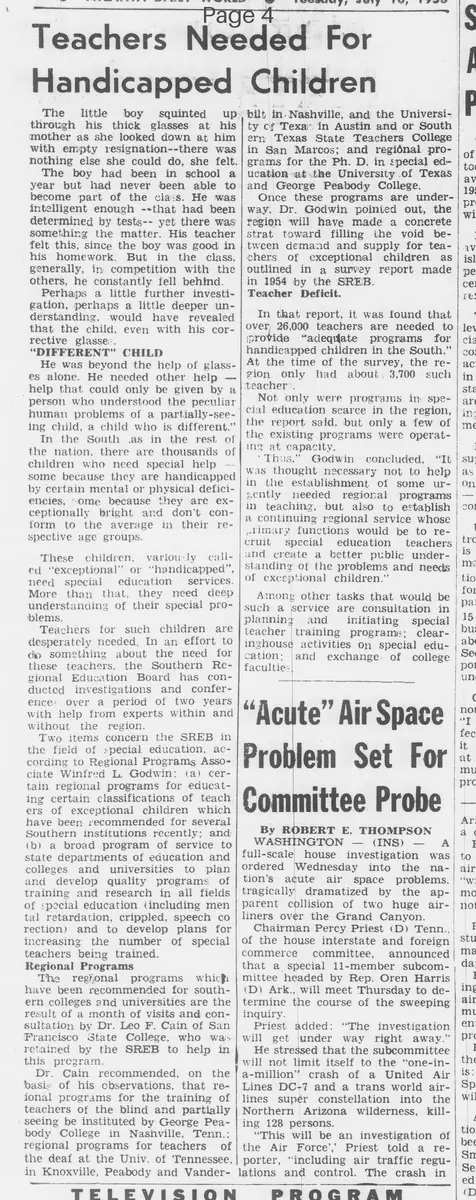
The little boy squinted up through his thick glasses at his mother as she looked down at him with empty resignation—there was nothing else she could do. She felt the boy had been in school a year but had never been able to become part of the class. He was intelligent enough—that had been determined by tests—yet there was something the matter. His teacher felt this, since the boy was good in his homework. But in the class, generally, in competition with the others, he constantly fell behind.
Perhaps a little further investigation, perhaps a little deeper understanding, would have revealed that the child, even with his corrective glasses,
"DIFFERENT" CHILD
He was beyond the help of glasses alone. He needed other help—help that could only be given by a person who understood the peculiar human problems of a partially-seeing child, a child who is different."
In the South as in the rest of the nation, there are thousands of children who need special help some because they are handicapped by certain mental or physical deficiencies, some because they are exceptionally bright and don't conform to the average in their respective age groups.
These children, variously called "exceptional" or "handicapped" need special education services.
More than that, they need deep understanding of their special problems.
Teachers for such children are desperately needed. In an effort to do something about the need for these teachers, the Southern Regional Education Board has conducted investigations and conferences over a period of two years with help from experts within and without the region.
Two items concern the SREB in the field of special education, according to Regional Programs Associate Winfred L. Godwin: (a) certain regional programs for educating certain classifications of teachers of exceptional children which have been recommended for several Southern institutions recently; and (b) a broad program of service to state departments of education and colleges and universities to plan and develop quality programs of training and research in all fields of special education (including mental retardation, crippled, speech correction) and to develop plans for increasing the number of special teachers being trained.
Regional Programs
The regional programs which have been recommended for southern colleges and universities are the result of a month of visits and consultation by Dr. Leo F. Cain of San Francisco State College, who was retained by the SREB to help in this program.
Dr. Cain recommended, on the basis of his observations, that regional programs for the training of teachers of the blind and partially seeing be instituted by George Peabody College in Nashville, Tenn.; regional programs for teachers of the deaf at the Univ. of Tennessee, in Knoxville. Peabody and Vanderbilt in Nashville, and the University of Texas in Austin and or Southern Texas State Teachers College in San Marcos; and regional programs for the Ph. D. in special education at the University of Texas and George Peabody College.
Once these programs are underway, Dr. Godwin pointed out, the region will have made a concrete start toward filling the void between demand and supply for teachers of exceptional children as outlined in a survey report made in 1954 by the SREB.
Teacher Deficit.
In that report, it was found that over 26,000 teachers are needed to provide "adequate programs for handicapped children in the South."
At the time of the survey, the region only had about 3,700 such teachers.
Not only were programs in special education scarce in the region, the report said, but only a few of the existing programs were operating at capacity.
Thus, Godwin concluded, "It was thought necessary not to help in the establishment of some urgently needed regional programs in teaching, but also to establish a continuing regional service whose primary functions would be to recruit special education teachers and create a better public understanding of the problems and needs of exceptional children."
Among other tasks that would be such a service are consultation in planning and initiating special teacher training programs; clearinghouse activities on special education; and exchange of college faculties.
What sub-type of article is it?
What themes does it cover?
What keywords are associated?
What entities or persons were involved?
Where did it happen?
Story Details
Key Persons
Location
Southern United States
Event Date
1954
Story Details
An illustrative anecdote of a partially-seeing boy struggling in school despite intelligence leads to discussion of thousands of exceptional children needing special education. SREB's two-year effort recommends regional teacher training programs at southern institutions to address a 1954-identified shortage of over 26,000 teachers.