Thank you for visiting SNEWPapers!
Sign up free
Editorial
November 5, 1870
The Evening Telegraph
Philadelphia, Philadelphia County, Pennsylvania
What is this article about?
The New York World editorial criticizes President Grant for dismissing Secretary Cox over his civil service reform efforts, portraying Grant as sympathetic to corruption and quoting Republican papers like the Missouri Democrat and Chicago Republican decrying the move as a betrayal of reform pledges and capitulation to unscrupulous politicians.
Clipping
OCR Quality
98%
Excellent
Full Text
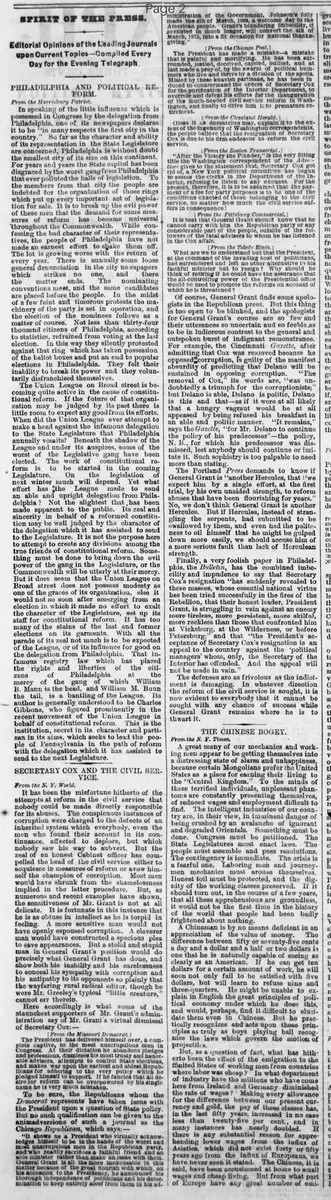
SECRETARY COX AND THE CIVIL SERVICE.
From the N. Y. World.
It has been the misfortune hitherto of the attempts at reform in the civil service that nobody could be made directly responsible for its abuses. The conspicuous instances of corruption were charged to the defects of an inherited system which everybody, even the men who found their account in its continuance, affected to deplore, but which nobody saw his way to subvert. But the zeal of an honest Cabinet officer has compelled the head of the civil service either to acquiesce in measures of reform or avow himself the champion of corruption. Most men would have shrunk from the shamelessness implied in the latter procedure. But, as numerous and recent examples have shown, the sensitiveness of Mr. Grant is not at all delicate. It is fortunate in this instance that he is as obtuse in intellect as he is torpid in feeling. A more sensitive man would not have openly espoused corruption. A cleverer man would have constructed a specious plea to save appearances. But a stolid and stupid man in General Grant's position would do precisely what General Grant has done, and show both his inability and his carelessness to conceal his sympathy with corruption and his antipathy to its opponents so plainly that the wayfaring rural radical editor, though he were Mr. Greeley's typical little creature, cannot err therein. Here accordingly is what some of the staunchest supporters of Mr. Grant's administration say of Mr. Grant's virtual dismissal of Secretary Cox:-
[From the Missouri Democrat.]
The President has delivered himself over, a complete captive, to the most unscrupulous men in Congress. At their dictation he abandons pledges and professions, dismisses his most trusty and honorable advisers, attempts to control State elections, and makes war upon the earnest and ablest Republicans for adhering to the very policy which he pledged himself to support. If he fancies that all desire for reform can be overpowered by his single name he is very much mistaken. To be sure, the Republicans whom the Democrat represents have taken issue with the President upon a question of State policy. But no such qualification can be given to the animadversions of such a journal as the Chicago Republican, which says:-
"It shows us a President who virtually acknowledges himself to be in the hands of the worst and most unscrupulous men in the Republican party, and who readily sacrifices a faithful friend and an able minister rather than make an issue with them. General Grant is all the more inexcusable in this matter because of the great flourish with which, on his accession to the Presidency, he announced his thorough independence of politicians and his determination to keep entirely aloof from them in his administration of the Government. Johnson's folly made the 4th of March, 1869, a welcome day to the American people. Grant's blundering imbecility, if persisted in much longer, will convert the 4th of March, 1873, into a fit occasion for national thanksgiving."
[From the Chicago Post.]
The President has made a mistake—a mistake that is painful and mortifying. He has been surrounded, jostled, deceived, cajoled, bullied, and at last made a prey of, by the swarm of political bummers who live and thrive by a division of the spoils. Misled by these knavish partisans, he has been induced to countermand the orders of Secretary Cox for the purification of the Interior Department, to overrule and defeat his efforts for the inauguration of the much-needed civil service reform in Washington, and finally to drive him into premature retirement.
[From the Cleveland Herald.]
Gloss it as despatches may, explain it to the extent of the ingenuity of Washington correspondents, the people believe that the resignation of Secretary Cox is due to his firm endeavor to reform the civil service.
[From the Boston Transcript.]
"After the Victory the Plunder," is the very fitting title the Washington correspondent of the Advertiser gives to the statement that, Secretary Cox got rid of, a New York political committee has begun to assess the clerks in the Department of the Interior, refusing to listen to any excuses. For the present, therefore, it is to be assumed that the payment of a fee for party purposes is to be one of the conditions exacted of those belonging to the civil service, no matter how much the civil service suffers in consequence!
[From the Pittsburg Commercial,]
It is best that General Grant should know that he cannot carry with him the Republican party or any considerable part of the people, outside of the followers of the fatal advisers to whom he has listened in the Cox affair.
[From the Toledo Blade.]
What are we to understand but that the President, at the command of the invading host of politicians, had surrendered and left no other alternative to his faithful minister but to resign? Why should he think of retiring if he could have the assurance that the all-controlling power of the Presidential office would be used to promote the reforms on account of which he is threatened? Of course, General Grant finds some apologists in the Republican press. But this thing is too open to be blinked, and the apologists for General Grant's course are so few and their utterances so uncertain and so feeble as to be in ludicrous contrast to the general and outspoken burst of indignant remonstrance. For example, the Cincinnati Gazette, after admitting that Cox was removed because he opposed corruption, is guilty of the manifest absurdity of predicting that Delano will be sustained in opposing corruption. "The removal of Cox," its words are, "was undoubtedly a triumph for the corruptionists;" but Delano is able, Delano is politic, Delano is this and that—as if it were at all likely that a hungry vagrant would be at all appeased by being refused his breakfast in an able and politic manner. "It remains," says the Gazette, "for Mr. Delano to continue the policy of his predecessor"—the policy, N. B., for which his predecessor was dismissed, lest anybody should continue or imitate it. Such sophistry is too palpable to need more than stating. The Portland Press demands to know if General Grant is "another Hercules, that we expect him by a single effort, at the first trial, by his own unaided strength, to reform abuses that have been flourishing for years." No, we don't think General Grant is another Hercules. But if Hercules, instead of strangling the serpents, had submitted to be swallowed by them, and even had the politeness to oil himself that he might be gulped down more easily, we should accuse him of a more serious fault than lack of Herculean strength. Finally, a very foolish paper in Philadelphia, the Bulletin, has the combined imbecility and impudence to say that Secretary Cox's resignation "has suddenly revealed to these masses, whose essential national virtue has been tried successfully in the fires of the Rebellion, that their honest leader, President Grant, is struggling in vain against an enemy more tireless, more persistent, more skilful, more reckless than those that confronted him at Vicksburg, at the Wilderness, or before Petersburg;" and that "the President's acceptance of Secretary Cox's resignation is an appeal to the country against the political managers, whom, only, the Secretary of the Interior has offended. And the appeal will not be made in vain." The defenses are as frivolous as the indictment is damaging. In whatever direction the reform of the civil service is sought, it is now evident to everybody that it cannot be sought with any chance of success while General Grant remains where he is to thwart it.
From the N. Y. World.
It has been the misfortune hitherto of the attempts at reform in the civil service that nobody could be made directly responsible for its abuses. The conspicuous instances of corruption were charged to the defects of an inherited system which everybody, even the men who found their account in its continuance, affected to deplore, but which nobody saw his way to subvert. But the zeal of an honest Cabinet officer has compelled the head of the civil service either to acquiesce in measures of reform or avow himself the champion of corruption. Most men would have shrunk from the shamelessness implied in the latter procedure. But, as numerous and recent examples have shown, the sensitiveness of Mr. Grant is not at all delicate. It is fortunate in this instance that he is as obtuse in intellect as he is torpid in feeling. A more sensitive man would not have openly espoused corruption. A cleverer man would have constructed a specious plea to save appearances. But a stolid and stupid man in General Grant's position would do precisely what General Grant has done, and show both his inability and his carelessness to conceal his sympathy with corruption and his antipathy to its opponents so plainly that the wayfaring rural radical editor, though he were Mr. Greeley's typical little creature, cannot err therein. Here accordingly is what some of the staunchest supporters of Mr. Grant's administration say of Mr. Grant's virtual dismissal of Secretary Cox:-
[From the Missouri Democrat.]
The President has delivered himself over, a complete captive, to the most unscrupulous men in Congress. At their dictation he abandons pledges and professions, dismisses his most trusty and honorable advisers, attempts to control State elections, and makes war upon the earnest and ablest Republicans for adhering to the very policy which he pledged himself to support. If he fancies that all desire for reform can be overpowered by his single name he is very much mistaken. To be sure, the Republicans whom the Democrat represents have taken issue with the President upon a question of State policy. But no such qualification can be given to the animadversions of such a journal as the Chicago Republican, which says:-
"It shows us a President who virtually acknowledges himself to be in the hands of the worst and most unscrupulous men in the Republican party, and who readily sacrifices a faithful friend and an able minister rather than make an issue with them. General Grant is all the more inexcusable in this matter because of the great flourish with which, on his accession to the Presidency, he announced his thorough independence of politicians and his determination to keep entirely aloof from them in his administration of the Government. Johnson's folly made the 4th of March, 1869, a welcome day to the American people. Grant's blundering imbecility, if persisted in much longer, will convert the 4th of March, 1873, into a fit occasion for national thanksgiving."
[From the Chicago Post.]
The President has made a mistake—a mistake that is painful and mortifying. He has been surrounded, jostled, deceived, cajoled, bullied, and at last made a prey of, by the swarm of political bummers who live and thrive by a division of the spoils. Misled by these knavish partisans, he has been induced to countermand the orders of Secretary Cox for the purification of the Interior Department, to overrule and defeat his efforts for the inauguration of the much-needed civil service reform in Washington, and finally to drive him into premature retirement.
[From the Cleveland Herald.]
Gloss it as despatches may, explain it to the extent of the ingenuity of Washington correspondents, the people believe that the resignation of Secretary Cox is due to his firm endeavor to reform the civil service.
[From the Boston Transcript.]
"After the Victory the Plunder," is the very fitting title the Washington correspondent of the Advertiser gives to the statement that, Secretary Cox got rid of, a New York political committee has begun to assess the clerks in the Department of the Interior, refusing to listen to any excuses. For the present, therefore, it is to be assumed that the payment of a fee for party purposes is to be one of the conditions exacted of those belonging to the civil service, no matter how much the civil service suffers in consequence!
[From the Pittsburg Commercial,]
It is best that General Grant should know that he cannot carry with him the Republican party or any considerable part of the people, outside of the followers of the fatal advisers to whom he has listened in the Cox affair.
[From the Toledo Blade.]
What are we to understand but that the President, at the command of the invading host of politicians, had surrendered and left no other alternative to his faithful minister but to resign? Why should he think of retiring if he could have the assurance that the all-controlling power of the Presidential office would be used to promote the reforms on account of which he is threatened? Of course, General Grant finds some apologists in the Republican press. But this thing is too open to be blinked, and the apologists for General Grant's course are so few and their utterances so uncertain and so feeble as to be in ludicrous contrast to the general and outspoken burst of indignant remonstrance. For example, the Cincinnati Gazette, after admitting that Cox was removed because he opposed corruption, is guilty of the manifest absurdity of predicting that Delano will be sustained in opposing corruption. "The removal of Cox," its words are, "was undoubtedly a triumph for the corruptionists;" but Delano is able, Delano is politic, Delano is this and that—as if it were at all likely that a hungry vagrant would be at all appeased by being refused his breakfast in an able and politic manner. "It remains," says the Gazette, "for Mr. Delano to continue the policy of his predecessor"—the policy, N. B., for which his predecessor was dismissed, lest anybody should continue or imitate it. Such sophistry is too palpable to need more than stating. The Portland Press demands to know if General Grant is "another Hercules, that we expect him by a single effort, at the first trial, by his own unaided strength, to reform abuses that have been flourishing for years." No, we don't think General Grant is another Hercules. But if Hercules, instead of strangling the serpents, had submitted to be swallowed by them, and even had the politeness to oil himself that he might be gulped down more easily, we should accuse him of a more serious fault than lack of Herculean strength. Finally, a very foolish paper in Philadelphia, the Bulletin, has the combined imbecility and impudence to say that Secretary Cox's resignation "has suddenly revealed to these masses, whose essential national virtue has been tried successfully in the fires of the Rebellion, that their honest leader, President Grant, is struggling in vain against an enemy more tireless, more persistent, more skilful, more reckless than those that confronted him at Vicksburg, at the Wilderness, or before Petersburg;" and that "the President's acceptance of Secretary Cox's resignation is an appeal to the country against the political managers, whom, only, the Secretary of the Interior has offended. And the appeal will not be made in vain." The defenses are as frivolous as the indictment is damaging. In whatever direction the reform of the civil service is sought, it is now evident to everybody that it cannot be sought with any chance of success while General Grant remains where he is to thwart it.
What sub-type of article is it?
Partisan Politics
Legal Reform
What keywords are associated?
Civil Service Reform
Secretary Cox
President Grant
Political Corruption
Republican Party
Spoils System
Interior Department
What entities or persons were involved?
President Grant
Secretary Cox
N. Y. World
Missouri Democrat
Chicago Republican
Chicago Post
Cleveland Herald
Boston Transcript
Pittsburg Commercial
Toledo Blade
Cincinnati Gazette
Portland Press
Philadelphia Bulletin
Editorial Details
Primary Topic
Criticism Of President Grant's Dismissal Of Secretary Cox For Pursuing Civil Service Reform
Stance / Tone
Strongly Critical Of Grant And Supportive Of Civil Service Reform
Key Figures
President Grant
Secretary Cox
N. Y. World
Missouri Democrat
Chicago Republican
Chicago Post
Cleveland Herald
Boston Transcript
Pittsburg Commercial
Toledo Blade
Cincinnati Gazette
Portland Press
Philadelphia Bulletin
Key Arguments
Attempts At Civil Service Reform Previously Evaded Responsibility
Grant Forced To Choose Between Reform And Corruption, Chose Latter
Grant Insensitive And Obtuse, Openly Supports Corruption
Republican Papers Decry Grant's Capitulation To Unscrupulous Politicians
Cox Dismissed For Purifying Interior Department And Promoting Reform
Post Cox, Political Assessments On Clerks Indicate Return To Spoils System
Grant Cannot Carry Republican Party With This Policy
Apologists For Grant's Action Are Feeble And Sophistic
Civil Service Reform Impossible Under Grant's Thwarting