Thank you for visiting SNEWPapers!
Sign up free
Literary
January 22, 1840
Danbury Times
Danbury, Fairfield County, Connecticut
What is this article about?
A legend recounting the 17th-century feud in Scotland's Western Highlands between Sir Donald Campbell and M'Lean of Ardgower, sparked by Montrose's wars. It involves betrayal, murder, trial, cruel execution, and ends with the wife's remorseful suicide, naming 'Lady's Leap' and extinguishing both families.
Clipping
OCR Quality
95%
Excellent
Full Text
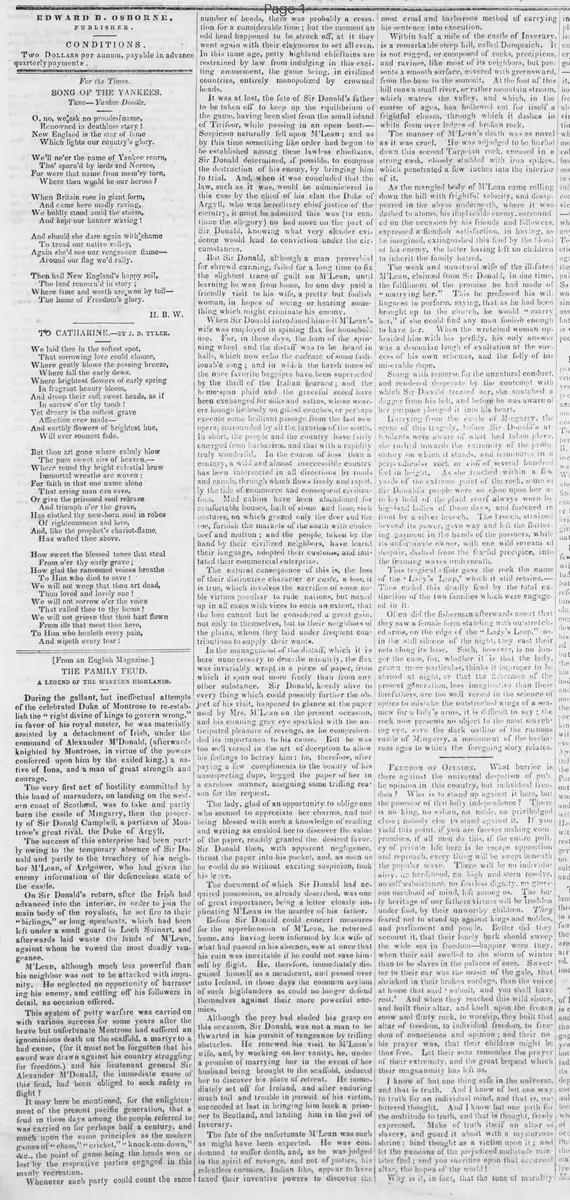
[From an English Magazine.]
THE FAMILY FEUD.
A LEGEND OF THE WESTERN HIGHLANDS.
During the gallant, but ineffectual attempts of the celebrated Duke of Montrose to re-establish the "right divine of kings to govern wrong," in favor of his royal master, he was materially assisted by a detachment of Irish, under the command of Alexander M'Donald. (afterwards knighted by Montrose, in virtue of the powers conferred upon him by the exiled king.) a native of Iona, and a man of great strength and courage.
The very first act of hostility committed by this band of marauders, on landing on the western coast of Scotland, was to take and partly burn the castle of Mingarry, then the property of Sir Donald Campbell, a partizan of Montrose's great rival, the Duke of Argyll.
The success of this enterprise had been partly owing to the temporary absence of Sir Donald and partly to the treachery of his neighbor M'Lean, of Ardgower, who had given the enemy information of the defenceless state of the castle.
On Sir Donald's return, after the Irish had advanced into the interior, in order to join the main body of the royalists, he set fire to their "birlings," or long open boats, which had been left under a small guard in Loch Sunart, and afterwards laid waste the lands of M'Lean, against whom he vowed the most deadly vengeance.
M'Lean, although much less powerful than his neighbor was not to be attacked with impunity. He neglected no opportunity of harrassing his enemy, and cutting off his followers in detail, as occasion offered.
This system of petty warfare was carried on with various success for some years after the brave but unfortunate Montrose had suffered an ignominious death on the scaffold, a martyr to a bad cause, (for it must not be forgotten that his sword was drawn against his country struggling for freedom,) and his lieutenant general Sir Alexander M'Donald, the immediate cause of this feud, had been obliged to seek safety in flight?
It may here be mentioned, for the enlightenment of the present pacific generation, that a feud in those days among the people referred to was carried on for perhaps half a century, and much upon the same principles as the modern games of "chess," "cricket," "knock-em-down," &c., the point of game being the heads won or lost by the respective parties engaged in this manly recreation.
Whenever each party could count the same number of heads, there was probably a cessation for a considerable time; but the moment an odd head happened to be struck off, at it they went again with their claymores to set all even.
In this tame age, petty highland chieftains are restrained by law from indulging in this exciting amusement, the game being, in civilized countries, entirely monopolized by crowned heads.
It was at last, the fate of Sir Donald's father to be taken off to keep up the equilibrium of the game, having been shot from the small island of Tirifoor, while passing in an open boat.—
Suspicion naturally fell upon M'Lean; and as by this time something like order had begun to be established among these lawless chieftains, Sir Donald determined, if possible, to compass the destruction of his enemy, by bringing him to trial. And, when it was concluded that the law, such as it was, would be administered in this case by the chief of his clan the Duke of Argyll, who was hereditary chief justice of the country, it must be admitted this was (to continue the allegory) no bad move on the part of Sir Donald, knowing what very slender evidence would lead to conviction under the circumstances.
But Sir Donald, although a man proverbial for shrewd cunning, failed for a long time to fix the slightest trace of guilt on M'Lean, until learning he was from home, he one day paid a friendly visit to his wife, a pretty but foolish woman, in hopes of seeing or hearing something which might criminate his enemy.
When Sir Donald introduced himself M'Lean's wife was employed in spinning flax for household use. For, in these days, the hum of the spinning wheel and the distaff was to be heard in halls, which now echo the cadences of some fashionable song; and in which the harsh tones of the once favorite bagpipes have been superseded by the thrill of the Italian bravura; and the home-spun plaid and the graceful snood have been exchanged for silks and satins, whose wearers lounge listlessly on gilded couches, or perhaps execute some brilliant passage from the last new opera, surrounded by all the luxuries of the south.
In short, the people and the country have fairly emerged from barbarism, and that with a rapidity truly wonderful. In the course of less than a century, a wild and almost inaccessible country has been intersected in all directions by roads and canals, through which flows freely and rapidly the tide of commerce and consequent civilization. Mud cabins have been abandoned for comfortable houses, built of stone and lime, rich pastures, on which grazed only the deer and the roe, furnish the markets of the south with choice beef and mutton; and the people, taken by the hand by their civilized neighbors, have learned their language, adopted their customs, and imitated their commercial enterprise.
The natural consequence of this is, the loss of their distinctive character or caste, a loss, it is true, which involves the sacrifice of some noble virtues peculiar to rude nations, but mixed up in all cases with vices to such an extent, that the loss cannot but be considered a great gain, not only to themselves, but to their neighbors of the plains, whom they laid under frequent contributions to supply their wants.
In the management of the distaff, which it is here unnecessary to describe minutely, the flax was invariably wrapt in a piece of paper, from which it spun out more freely than from any other substance. Sir Donald, keenly alive to every thing which could possibly further the object of his visit, happened to glance at the paper used by Mrs. M'Lean on the present occasion, and his cunning grey eye sparkled with the anticipated pleasure of revenge, as he comprehended its importance to his cause. But he was too well versed in the art of deception to allow his feelings to betray him: he, therefore, after paying a few compliments to the beauty of his unsuspecting dupe, begged the paper of her in a careless manner, assigning some trifling reason for the request.
The lady, glad of an opportunity to oblige one who seemed to appreciate her charms, and not being blessed with such a knowledge of reading and writing as enabled her to discover the value of the paper, readily granted the desired favor.
Sir Donald then, with apparent negligence, thrust the paper into his pocket, and, as soon as he could do so without exciting suspicion, took his leave.
The document of which Sir Donald had acquired possession, as already described, was one of great importance, being a letter clearly implicating M'Lean in the murder of his father.
Before Sir Donald could concert measures for the apprehension of M'Lean, he returned home, and having been informed by his wife of what had passed in his absence, saw at once that his ruin was inevitable if he could not save himself by flight. He, therefore, immediately disguised himself as a mendicant, and passed over into Ireland, in those days the common asylum of such highlanders as could no longer defend themselves against their more powerful enemies.
Although the prey had eluded his grasp on this occasion, Sir Donald, was not a man to be thwarted in his pursuit of vengeance by trifling obstacles. He renewed his visit to M'Lean's wife, and, by working on her vanity, he, under a promise of marrying her in the event of her husband being brought to the scaffold, induced her to discover his place of retreat. He immediately set off for Ireland, and after enduring much toil and trouble in pursuit of his victim, succeeded at last in bringing him back a prisoner to Scotland, and landing him in the jail of Inverary.
The fate of the unfortunate M'Lean was such as might have been expected. He was condemned to suffer death, and, as he was judged in the spirit of revenge, and not of justice, his relentless enemies, Indian like, appear to have taxed their inventive powers to discover the most cruel and barbarous method of carrying his sentence into execution.
Within half a mile of the castle of Inverary, is a remarkable steep hill, called Dunquaich. It is not rugged, or composed of rocks, precipices, and ravines, like most of its neighbors, but presents a smooth surface, covered with greensward, from the base to the summit. At the foot of this hill runs a small river, or rather mountain stream, which waters the valley, and which, in the course of ages, has hollowed out for itself a frightful chasm, through which it dashes in white foam over ledges of broken rock.
The manner of M'Lean's death was as novel as it was cruel. He was adjudged to be hurled down this second Tarpeian rock, encased in a strong cask, closely studded with iron spikes, which penetrated a few inches into the interior of it.
As the mangled body of M'Lean came rolling down the hill with frightful velocity, and disappeared in the abyss underneath, where it was dashed to atoms, his implacable enemy, surrounded on the occasion by his friends and followers, expressed a fiendish satisfaction, in having, as he imagined, extinguished this feud by the blood of his enemy, the latter having left no children to inherit the family hatred.
The weak and unnatural wife of the ill-fated M'Lean, claimed from Sir Donald, in due time, the fulfilment of the promise he had made of "marrying her." This he professed his willingness to perform, saying, that as he had been brought up to the church, he would "marry her," if she could find any man foolish enough to have her. When the wretched woman upbraided him with his perfidy, his only answer was a demoniac laugh of exultation at the success of his own schemes, and the folly of his miserable dupe.
Stung with remorse for the unnatural conduct, and rendered desperate by the contempt with which Sir Donald treated her, she snatched a dagger from his belt, and before he was aware of her purpose plunged it into his heart.
Hurrying from the castle of Mingarry, the scene of this tragedy, before Sir Donald's attendants were aware of what had taken place, she rushed towards the extremity of the promontory on which it stands, and terminates in a perpendicular rock or cliff of several hundred feet in height. As she reached within a few yards of the extreme point of the rock, some of Sir Donald's people were so close upon her as to lay hold of the plaid scarf always worn by highland ladies of those days, and fastened in front by a silver brooch. The brooch, strained beyond its power, gave way and left the fluttering garment in the hands of the pursuers, while its unfortunate owner, with one wild scream of despair, dashed from the fearful precipice, into the foaming waves underneath.
This tragical affair gave the rock the name of the "Lady's Leap," which it still retains.—
Thus ended this deadly feud by the total extinction of the two families which were engaged in it.
Often did the fisherman afterwards assert that they saw a female form standing with outstretched arms, on the edge of the "Lady's Leap," as, in the still silence of the night, they cast their nets along its base. Such, however, is no longer the case, for, whether it is that the lady, grown more particular, thinks it improper to be abroad at night, or that the fishermen of the present generation, less imaginative than their forefathers, are too well versed in the science of optics to mistake the outstretched wings of a sea-mew for a lady's arms, it is difficult to say; the rock now presents no object to the most searching eye, save the dark outline of the ruinous castle of Mingarry, a monument of the barbarous ages to which the foregoing story relates.
THE FAMILY FEUD.
A LEGEND OF THE WESTERN HIGHLANDS.
During the gallant, but ineffectual attempts of the celebrated Duke of Montrose to re-establish the "right divine of kings to govern wrong," in favor of his royal master, he was materially assisted by a detachment of Irish, under the command of Alexander M'Donald. (afterwards knighted by Montrose, in virtue of the powers conferred upon him by the exiled king.) a native of Iona, and a man of great strength and courage.
The very first act of hostility committed by this band of marauders, on landing on the western coast of Scotland, was to take and partly burn the castle of Mingarry, then the property of Sir Donald Campbell, a partizan of Montrose's great rival, the Duke of Argyll.
The success of this enterprise had been partly owing to the temporary absence of Sir Donald and partly to the treachery of his neighbor M'Lean, of Ardgower, who had given the enemy information of the defenceless state of the castle.
On Sir Donald's return, after the Irish had advanced into the interior, in order to join the main body of the royalists, he set fire to their "birlings," or long open boats, which had been left under a small guard in Loch Sunart, and afterwards laid waste the lands of M'Lean, against whom he vowed the most deadly vengeance.
M'Lean, although much less powerful than his neighbor was not to be attacked with impunity. He neglected no opportunity of harrassing his enemy, and cutting off his followers in detail, as occasion offered.
This system of petty warfare was carried on with various success for some years after the brave but unfortunate Montrose had suffered an ignominious death on the scaffold, a martyr to a bad cause, (for it must not be forgotten that his sword was drawn against his country struggling for freedom,) and his lieutenant general Sir Alexander M'Donald, the immediate cause of this feud, had been obliged to seek safety in flight?
It may here be mentioned, for the enlightenment of the present pacific generation, that a feud in those days among the people referred to was carried on for perhaps half a century, and much upon the same principles as the modern games of "chess," "cricket," "knock-em-down," &c., the point of game being the heads won or lost by the respective parties engaged in this manly recreation.
Whenever each party could count the same number of heads, there was probably a cessation for a considerable time; but the moment an odd head happened to be struck off, at it they went again with their claymores to set all even.
In this tame age, petty highland chieftains are restrained by law from indulging in this exciting amusement, the game being, in civilized countries, entirely monopolized by crowned heads.
It was at last, the fate of Sir Donald's father to be taken off to keep up the equilibrium of the game, having been shot from the small island of Tirifoor, while passing in an open boat.—
Suspicion naturally fell upon M'Lean; and as by this time something like order had begun to be established among these lawless chieftains, Sir Donald determined, if possible, to compass the destruction of his enemy, by bringing him to trial. And, when it was concluded that the law, such as it was, would be administered in this case by the chief of his clan the Duke of Argyll, who was hereditary chief justice of the country, it must be admitted this was (to continue the allegory) no bad move on the part of Sir Donald, knowing what very slender evidence would lead to conviction under the circumstances.
But Sir Donald, although a man proverbial for shrewd cunning, failed for a long time to fix the slightest trace of guilt on M'Lean, until learning he was from home, he one day paid a friendly visit to his wife, a pretty but foolish woman, in hopes of seeing or hearing something which might criminate his enemy.
When Sir Donald introduced himself M'Lean's wife was employed in spinning flax for household use. For, in these days, the hum of the spinning wheel and the distaff was to be heard in halls, which now echo the cadences of some fashionable song; and in which the harsh tones of the once favorite bagpipes have been superseded by the thrill of the Italian bravura; and the home-spun plaid and the graceful snood have been exchanged for silks and satins, whose wearers lounge listlessly on gilded couches, or perhaps execute some brilliant passage from the last new opera, surrounded by all the luxuries of the south.
In short, the people and the country have fairly emerged from barbarism, and that with a rapidity truly wonderful. In the course of less than a century, a wild and almost inaccessible country has been intersected in all directions by roads and canals, through which flows freely and rapidly the tide of commerce and consequent civilization. Mud cabins have been abandoned for comfortable houses, built of stone and lime, rich pastures, on which grazed only the deer and the roe, furnish the markets of the south with choice beef and mutton; and the people, taken by the hand by their civilized neighbors, have learned their language, adopted their customs, and imitated their commercial enterprise.
The natural consequence of this is, the loss of their distinctive character or caste, a loss, it is true, which involves the sacrifice of some noble virtues peculiar to rude nations, but mixed up in all cases with vices to such an extent, that the loss cannot but be considered a great gain, not only to themselves, but to their neighbors of the plains, whom they laid under frequent contributions to supply their wants.
In the management of the distaff, which it is here unnecessary to describe minutely, the flax was invariably wrapt in a piece of paper, from which it spun out more freely than from any other substance. Sir Donald, keenly alive to every thing which could possibly further the object of his visit, happened to glance at the paper used by Mrs. M'Lean on the present occasion, and his cunning grey eye sparkled with the anticipated pleasure of revenge, as he comprehended its importance to his cause. But he was too well versed in the art of deception to allow his feelings to betray him: he, therefore, after paying a few compliments to the beauty of his unsuspecting dupe, begged the paper of her in a careless manner, assigning some trifling reason for the request.
The lady, glad of an opportunity to oblige one who seemed to appreciate her charms, and not being blessed with such a knowledge of reading and writing as enabled her to discover the value of the paper, readily granted the desired favor.
Sir Donald then, with apparent negligence, thrust the paper into his pocket, and, as soon as he could do so without exciting suspicion, took his leave.
The document of which Sir Donald had acquired possession, as already described, was one of great importance, being a letter clearly implicating M'Lean in the murder of his father.
Before Sir Donald could concert measures for the apprehension of M'Lean, he returned home, and having been informed by his wife of what had passed in his absence, saw at once that his ruin was inevitable if he could not save himself by flight. He, therefore, immediately disguised himself as a mendicant, and passed over into Ireland, in those days the common asylum of such highlanders as could no longer defend themselves against their more powerful enemies.
Although the prey had eluded his grasp on this occasion, Sir Donald, was not a man to be thwarted in his pursuit of vengeance by trifling obstacles. He renewed his visit to M'Lean's wife, and, by working on her vanity, he, under a promise of marrying her in the event of her husband being brought to the scaffold, induced her to discover his place of retreat. He immediately set off for Ireland, and after enduring much toil and trouble in pursuit of his victim, succeeded at last in bringing him back a prisoner to Scotland, and landing him in the jail of Inverary.
The fate of the unfortunate M'Lean was such as might have been expected. He was condemned to suffer death, and, as he was judged in the spirit of revenge, and not of justice, his relentless enemies, Indian like, appear to have taxed their inventive powers to discover the most cruel and barbarous method of carrying his sentence into execution.
Within half a mile of the castle of Inverary, is a remarkable steep hill, called Dunquaich. It is not rugged, or composed of rocks, precipices, and ravines, like most of its neighbors, but presents a smooth surface, covered with greensward, from the base to the summit. At the foot of this hill runs a small river, or rather mountain stream, which waters the valley, and which, in the course of ages, has hollowed out for itself a frightful chasm, through which it dashes in white foam over ledges of broken rock.
The manner of M'Lean's death was as novel as it was cruel. He was adjudged to be hurled down this second Tarpeian rock, encased in a strong cask, closely studded with iron spikes, which penetrated a few inches into the interior of it.
As the mangled body of M'Lean came rolling down the hill with frightful velocity, and disappeared in the abyss underneath, where it was dashed to atoms, his implacable enemy, surrounded on the occasion by his friends and followers, expressed a fiendish satisfaction, in having, as he imagined, extinguished this feud by the blood of his enemy, the latter having left no children to inherit the family hatred.
The weak and unnatural wife of the ill-fated M'Lean, claimed from Sir Donald, in due time, the fulfilment of the promise he had made of "marrying her." This he professed his willingness to perform, saying, that as he had been brought up to the church, he would "marry her," if she could find any man foolish enough to have her. When the wretched woman upbraided him with his perfidy, his only answer was a demoniac laugh of exultation at the success of his own schemes, and the folly of his miserable dupe.
Stung with remorse for the unnatural conduct, and rendered desperate by the contempt with which Sir Donald treated her, she snatched a dagger from his belt, and before he was aware of her purpose plunged it into his heart.
Hurrying from the castle of Mingarry, the scene of this tragedy, before Sir Donald's attendants were aware of what had taken place, she rushed towards the extremity of the promontory on which it stands, and terminates in a perpendicular rock or cliff of several hundred feet in height. As she reached within a few yards of the extreme point of the rock, some of Sir Donald's people were so close upon her as to lay hold of the plaid scarf always worn by highland ladies of those days, and fastened in front by a silver brooch. The brooch, strained beyond its power, gave way and left the fluttering garment in the hands of the pursuers, while its unfortunate owner, with one wild scream of despair, dashed from the fearful precipice, into the foaming waves underneath.
This tragical affair gave the rock the name of the "Lady's Leap," which it still retains.—
Thus ended this deadly feud by the total extinction of the two families which were engaged in it.
Often did the fisherman afterwards assert that they saw a female form standing with outstretched arms, on the edge of the "Lady's Leap," as, in the still silence of the night, they cast their nets along its base. Such, however, is no longer the case, for, whether it is that the lady, grown more particular, thinks it improper to be abroad at night, or that the fishermen of the present generation, less imaginative than their forefathers, are too well versed in the science of optics to mistake the outstretched wings of a sea-mew for a lady's arms, it is difficult to say; the rock now presents no object to the most searching eye, save the dark outline of the ruinous castle of Mingarry, a monument of the barbarous ages to which the foregoing story relates.
What sub-type of article is it?
Prose Fiction
What themes does it cover?
War Peace
Moral Virtue
Political
What keywords are associated?
Family Feud
Western Highlands
Montrose
Vengeance
Lady's Leap
Mcleans Death
Highland Customs
Civilization Progress
What entities or persons were involved?
[From An English Magazine.]
Literary Details
Title
The Family Feud. A Legend Of The Western Highlands.
Author
[From An English Magazine.]
Subject
A Legend Of A Family Feud In The Western Highlands During Montrose's Campaigns.
Form / Style
Prose Narrative Legend With Satirical Commentary On Highland Feuds And Civilization.
Key Lines
It May Here Be Mentioned, For The Enlightenment Of The Present Pacific Generation, That A Feud In Those Days Among The People Referred To Was Carried On For Perhaps Half A Century, And Much Upon The Same Principles As The Modern Games Of "Chess," "Cricket," "Knock Em Down," &C., The Point Of Game Being The Heads Won Or Lost By The Respective Parties Engaged In This Manly Recreation.
The Manner Of M'lean's Death Was As Novel As It Was Cruel. He Was Adjudged To Be Hurled Down This Second Tarpeian Rock, Encased In A Strong Cask, Closely Studded With Iron Spikes, Which Penetrated A Few Inches Into The Interior Of It.
This Tragical Affair Gave The Rock The Name Of The "Lady's Leap," Which It Still Retains.—
Thus Ended This Deadly Feud By The Total Extinction Of The Two Families Which Were Engaged In It.