Thank you for visiting SNEWPapers!
Sign up free
Domestic News
December 26, 1883
The Lambertville Record
Lambertville, Hunterdon County, New Jersey
What is this article about?
A fishing trip near Marblehead, Mass., yields catches of cod and other fish while a naturalist studies sounds produced by species like sculpins, dogfish, and eels, interpreting them as fish 'voices' with various production mechanisms.
Clipping
OCR Quality
95%
Excellent
Full Text
VOICES FROM THE SEA.
How the Old Fisherman Knows the Fish by Its Talk.
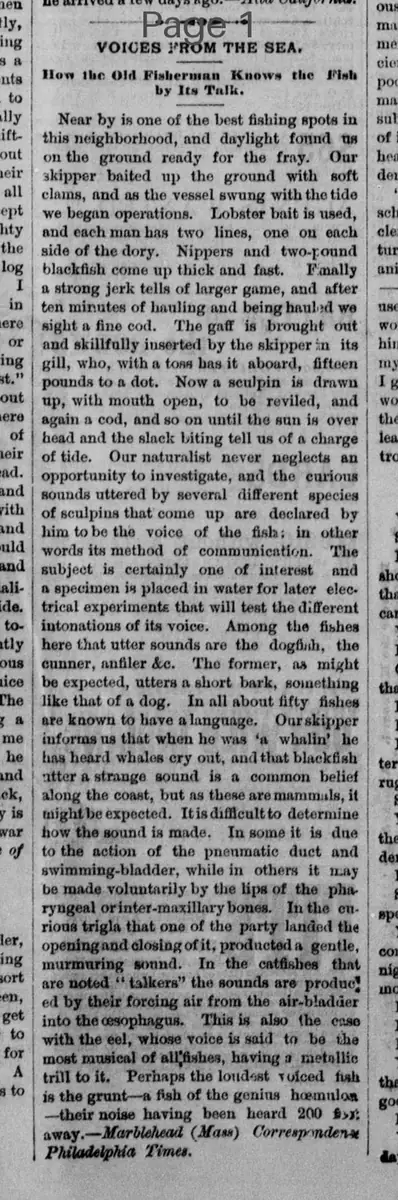
Near by is one of the best fishing spots in this neighborhood, and daylight found us on the ground ready for the fray. Our skipper baited up the ground with soft clams, and as the vessel swung with the tide we began operations. Lobster bait is used, and each man has two lines, one on each side of the dory. Nippers and two-pound blackfish come up thick and fast. Finally a strong jerk tells of larger game, and after ten minutes of hauling and being hauled we sight a fine cod. The gaff is brought out and skillfully inserted by the skipper in its gill, who, with a toss has it aboard, fifteen pounds to a dot. Now a sculpin is drawn up, with mouth open, to be reviled, and again a cod, and so on until the sun is over head and the slack biting tell us of a change of tide. Our naturalist never neglects an opportunity to investigate, and the curious sounds uttered by several different species of sculpins that come up are declared by him to be the voice of the fish: in other words its method of communication. The subject is certainly one of interest and a specimen is placed in water for later electrical experiments that will test the different intonations of its voice. Among the fishes here that utter sounds are the dogfish, the cunner, sea-raven, etc. The former, as might be expected, utters a short bark, something like that of a dog. In all about fifty fishes are known to have a language. Our skipper informs us that when he was 'a whalin' he has heard whales cry out, and that blackfish utter a strange sound is a common belief along the coast, but as these are mammals, it might be expected. It is difficult to determine how the sound is made. In some it is due to the action of the pneumatic duct and swimming-bladder, while in others it may be made voluntarily by the lips of the pharyngeal or inter-maxillary bones. In the curious trigla that one of the party landed the opening and closing of it, produced a gentle murmuring sound. In the catfishes that are noted "talkers" the sounds are produced by their forcing air from the air-bladder into the oesophagus. This is also the case with the eel, whose voice is said to be the most musical of all fishes, having a metallic trill to it. Perhaps the loudest voiced fish is the grunt—a fish of the genus haemulon—their noise having been heard 200 yards away.—Marblehead (Mass) Correspondence Philadelphia Times.
How the Old Fisherman Knows the Fish by Its Talk.
Near by is one of the best fishing spots in this neighborhood, and daylight found us on the ground ready for the fray. Our skipper baited up the ground with soft clams, and as the vessel swung with the tide we began operations. Lobster bait is used, and each man has two lines, one on each side of the dory. Nippers and two-pound blackfish come up thick and fast. Finally a strong jerk tells of larger game, and after ten minutes of hauling and being hauled we sight a fine cod. The gaff is brought out and skillfully inserted by the skipper in its gill, who, with a toss has it aboard, fifteen pounds to a dot. Now a sculpin is drawn up, with mouth open, to be reviled, and again a cod, and so on until the sun is over head and the slack biting tell us of a change of tide. Our naturalist never neglects an opportunity to investigate, and the curious sounds uttered by several different species of sculpins that come up are declared by him to be the voice of the fish: in other words its method of communication. The subject is certainly one of interest and a specimen is placed in water for later electrical experiments that will test the different intonations of its voice. Among the fishes here that utter sounds are the dogfish, the cunner, sea-raven, etc. The former, as might be expected, utters a short bark, something like that of a dog. In all about fifty fishes are known to have a language. Our skipper informs us that when he was 'a whalin' he has heard whales cry out, and that blackfish utter a strange sound is a common belief along the coast, but as these are mammals, it might be expected. It is difficult to determine how the sound is made. In some it is due to the action of the pneumatic duct and swimming-bladder, while in others it may be made voluntarily by the lips of the pharyngeal or inter-maxillary bones. In the curious trigla that one of the party landed the opening and closing of it, produced a gentle murmuring sound. In the catfishes that are noted "talkers" the sounds are produced by their forcing air from the air-bladder into the oesophagus. This is also the case with the eel, whose voice is said to be the most musical of all fishes, having a metallic trill to it. Perhaps the loudest voiced fish is the grunt—a fish of the genus haemulon—their noise having been heard 200 yards away.—Marblehead (Mass) Correspondence Philadelphia Times.
What sub-type of article is it?
Shipping
What keywords are associated?
Fish Sounds
Fishing Expedition
Marblehead
Sculpins
Cod
Naturalist Observation
Where did it happen?
Marblehead (Mass)
Domestic News Details
Primary Location
Marblehead (Mass)
Event Details
Description of a fishing expedition near Marblehead where fishermen catch various fish including cod, blackfish, sculpin, and observe sounds made by fish such as sculpins, dogfish, cunner, sea-raven, trigla, catfishes, eel, and grunt. A naturalist investigates these sounds as the 'voice' of the fish, noting mechanisms of sound production in different species.