Thank you for visiting SNEWPapers!
Sign up free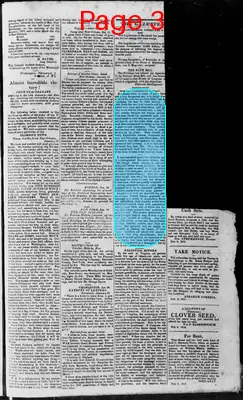
Editorial
February 9, 1815
Martinsburgh Gazette
Martinsburg, Berkeley County, West Virginia
What is this article about?
Editorial critiques the partisan tendency to judge actions by the performers rather than their merit, leading to rejection of good counsel and embrace of tyranny. Draws on historical examples like Caligula, warns of Americans' acclimation to political follies and liberty encroachments that will shock posterity.
Clipping
OCR Quality
98%
Excellent
Full Text
FROM THE CONNECTICUT COURANT.
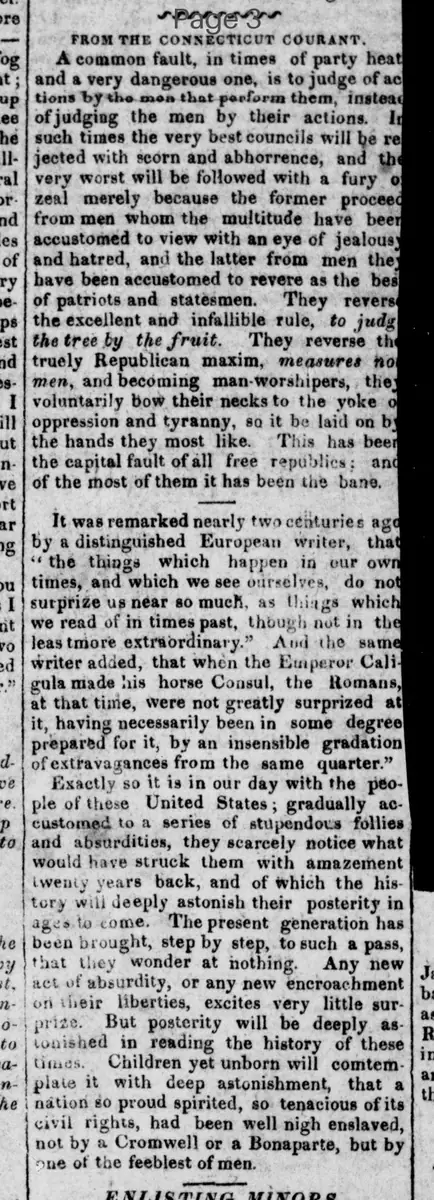
A common fault, in times of party heat and a very dangerous one, is to judge of actions by the men that perform them, instead of judging the men by their actions. In such times the very best councils will be rejected with scorn and abhorrence, and the very worst will be followed with a fury of zeal merely because the former proceed from men whom the multitude have been accustomed to view with an eye of jealousy and hatred, and the latter from men they have been accustomed to revere as the best of patriots and statesmen. They reverse the excellent and infallible rule, to judge the tree by the fruit. They reverse the truly Republican maxim, measures not men, and becoming man-worshipers, they voluntarily bow their necks to the yoke of oppression and tyranny, so it be laid on by the hands they most like. This has been the capital fault of all free republics: and of the most of them it has been the bane.
It was remarked nearly two centuries ago by a distinguished European writer, that "the things which happen in our own times, and which we see ourselves, do not surprize us near so much, as things which we read of in times past, though not in the least more extraordinary." And the same writer added, that when the Emperor Caligula made his horse Consul, the Romans, at that time, were not greatly surprized at it, having necessarily been in some degree prepared for it, by an insensible gradation of extravagances from the same quarter.
Exactly so it is in our day with the people of these United States; gradually accustomed to a series of stupendous follies and absurdities, they scarcely notice what would have struck them with amazement twenty years back, and of which the history will deeply astonish their posterity in ages to come. The present generation has been brought, step by step, to such a pass, that they wonder at nothing. Any new act of absurdity, or any new encroachment on their liberties, excites very little surprize. But posterity will be deeply astonished in reading the history of these times. Children yet unborn will contemplate it with deep astonishment, that a nation so proud spirited, so tenacious of its civil rights, had been well nigh enslaved not by a Cromwell or a Bonaparte, but by one of the feeblest of men.
A common fault, in times of party heat and a very dangerous one, is to judge of actions by the men that perform them, instead of judging the men by their actions. In such times the very best councils will be rejected with scorn and abhorrence, and the very worst will be followed with a fury of zeal merely because the former proceed from men whom the multitude have been accustomed to view with an eye of jealousy and hatred, and the latter from men they have been accustomed to revere as the best of patriots and statesmen. They reverse the excellent and infallible rule, to judge the tree by the fruit. They reverse the truly Republican maxim, measures not men, and becoming man-worshipers, they voluntarily bow their necks to the yoke of oppression and tyranny, so it be laid on by the hands they most like. This has been the capital fault of all free republics: and of the most of them it has been the bane.
It was remarked nearly two centuries ago by a distinguished European writer, that "the things which happen in our own times, and which we see ourselves, do not surprize us near so much, as things which we read of in times past, though not in the least more extraordinary." And the same writer added, that when the Emperor Caligula made his horse Consul, the Romans, at that time, were not greatly surprized at it, having necessarily been in some degree prepared for it, by an insensible gradation of extravagances from the same quarter.
Exactly so it is in our day with the people of these United States; gradually accustomed to a series of stupendous follies and absurdities, they scarcely notice what would have struck them with amazement twenty years back, and of which the history will deeply astonish their posterity in ages to come. The present generation has been brought, step by step, to such a pass, that they wonder at nothing. Any new act of absurdity, or any new encroachment on their liberties, excites very little surprize. But posterity will be deeply astonished in reading the history of these times. Children yet unborn will contemplate it with deep astonishment, that a nation so proud spirited, so tenacious of its civil rights, had been well nigh enslaved not by a Cromwell or a Bonaparte, but by one of the feeblest of men.
What sub-type of article is it?
Partisan Politics
Constitutional
What keywords are associated?
Partisan Heat
Measures Not Men
Political Follies
Encroachments On Liberties
Republican Faults
Historical Astonishment
What entities or persons were involved?
Emperor Caligula
Cromwell
Bonaparte
Editorial Details
Primary Topic
Dangers Of Judging Political Actions By Men Rather Than Measures
Stance / Tone
Cautionary Critique Of Partisan Bias And Gradual Loss Of Liberties
Key Figures
Emperor Caligula
Cromwell
Bonaparte
Key Arguments
Judging Actions By Performers Leads To Rejecting Good Advice And Embracing Bad
This Fault Has Doomed Free Republics
Contemporary Absurdities Do Not Surprise Due To Gradual Acclimation
Posterity Will Be Astonished By Near Enslavement Of Liberty Loving Nation By A Feeble Leader