Thank you for visiting SNEWPapers!
Sign up free
Story
November 20, 1790
Gazette Of The United States
New York, New York County, New York
What is this article about?
A correspondent comments on the paradoxical emigration of French citizens to America during the French Revolution, viewing it as evidence of their grasp of true liberty amid fears of despotic majority rule and property confiscations in France.
Clipping
OCR Quality
98%
Excellent
Full Text
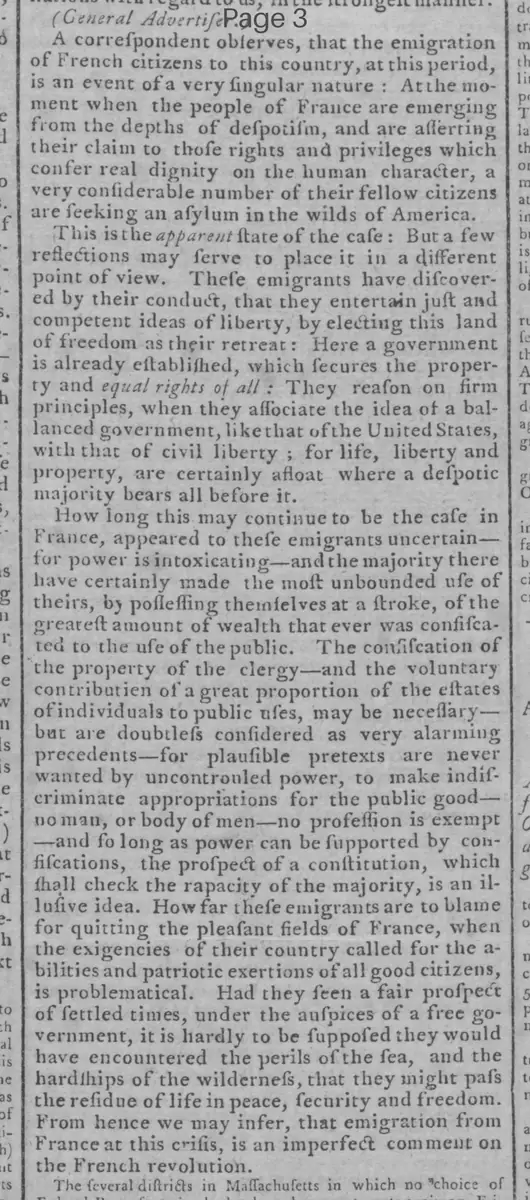
A correspondent observes, that the emigration of French citizens to this country, at this period, is an event of a very singular nature: At the moment when the people of France are emerging from the depths of despotism, and are asserting their claim to those rights and privileges which confer real dignity on the human character, a very considerable number of their fellow citizens are seeking an asylum in the wilds of America.
This is the apparent state of the case: But a few reflections may serve to place it in a different point of view. These emigrants have discovered by their conduct, that they entertain just and competent ideas of liberty, by electing this land of freedom as their retreat: Here a government is already established, which secures the property and equal rights of all: They reason on firm principles, when they associate the idea of a balanced government, like that of the United States, with that of civil liberty; for life, liberty and property, are certainly afloat where a despotic majority bears all before it.
How long this may continue to be the case in France, appeared to these emigrants uncertain—for power is intoxicating—and the majority there have certainly made the most unbounded use of theirs, by possessing themselves at a stroke, of the greatest amount of wealth that ever was confiscated to the use of the public. The confiscation of the property of the clergy—and the voluntary contribution of a great proportion of the estates of individuals to public uses, may be necessary—but are doubtless considered as very alarming precedents—for plausible pretexts are never wanted by uncontrouled power, to make indiscriminate appropriations for the public good—no man, or body of men—no profession is exempt—and so long as power can be supported by confiscations, the prospect of a constitution, which shall check the rapacity of the majority, is an illusive idea.
How far these emigrants are to blame for quitting the pleasant fields of France, when the exigencies of their country called for the abilities and patriotic exertions of all good citizens, is problematical. Had they seen a fair prospect of settled times, under the auspices of a free government, it is hardly to be supposed they would have encountered the perils of the sea, and the hardships of the wilderness, that they might pass the residue of life in peace, security and freedom. From hence we may infer, that emigration from France at this crisis, is an imperfect comment on the French revolution.
This is the apparent state of the case: But a few reflections may serve to place it in a different point of view. These emigrants have discovered by their conduct, that they entertain just and competent ideas of liberty, by electing this land of freedom as their retreat: Here a government is already established, which secures the property and equal rights of all: They reason on firm principles, when they associate the idea of a balanced government, like that of the United States, with that of civil liberty; for life, liberty and property, are certainly afloat where a despotic majority bears all before it.
How long this may continue to be the case in France, appeared to these emigrants uncertain—for power is intoxicating—and the majority there have certainly made the most unbounded use of theirs, by possessing themselves at a stroke, of the greatest amount of wealth that ever was confiscated to the use of the public. The confiscation of the property of the clergy—and the voluntary contribution of a great proportion of the estates of individuals to public uses, may be necessary—but are doubtless considered as very alarming precedents—for plausible pretexts are never wanted by uncontrouled power, to make indiscriminate appropriations for the public good—no man, or body of men—no profession is exempt—and so long as power can be supported by confiscations, the prospect of a constitution, which shall check the rapacity of the majority, is an illusive idea.
How far these emigrants are to blame for quitting the pleasant fields of France, when the exigencies of their country called for the abilities and patriotic exertions of all good citizens, is problematical. Had they seen a fair prospect of settled times, under the auspices of a free government, it is hardly to be supposed they would have encountered the perils of the sea, and the hardships of the wilderness, that they might pass the residue of life in peace, security and freedom. From hence we may infer, that emigration from France at this crisis, is an imperfect comment on the French revolution.
What sub-type of article is it?
Historical Event
Curiosity
What themes does it cover?
Moral Virtue
Justice
Misfortune
What keywords are associated?
French Emigration
American Asylum
French Revolution
Civil Liberty
Property Confiscation
Despotic Majority
Where did it happen?
France To The Wilds Of America
Story Details
Location
France To The Wilds Of America
Story Details
Correspondent reflects on French emigration to America as ironic amid revolution, praising emigrants' liberty ideas but questioning their departure due to fears of majority despotism and confiscations.