Thank you for visiting SNEWPapers!
Sign up free
Literary
May 10, 1805
The National Intelligencer And Washington Advertiser
Washington, District Of Columbia
What is this article about?
Biographical account of Charlotte Corday, who assassinated Jean-Paul Marat in 1793 to avenge her lover's death and liberate France from tyranny. Translated from M. du Broca's French original, detailing her life, motivations, the act, trial, and execution.
Clipping
OCR Quality
98%
Excellent
Full Text
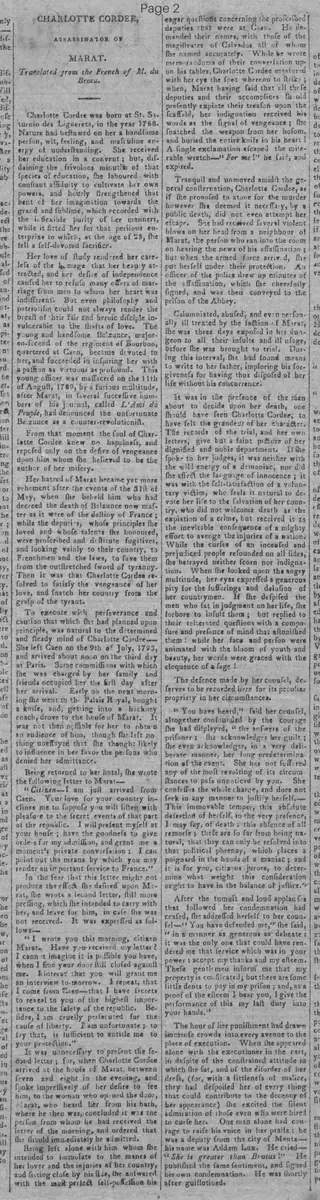
CHARLOTTE CORDAY
MARAT
Translated from the French of M. du Broca.
Charlotte Corday was born at St. Saturnin des Lignerets, in the year 1768. Nature had bestowed on her a handsome person, wit, feeling, and masculine energy of understanding. She received her education in a convent; but, disdaining the frivolous minutiae of that species of education, she laboured with constant assiduity to cultivate her own powers, and hourly strengthened that bent of her imagination towards the grand and sublime, which accorded with the inflexible purity of her manners, while it fitted her for that perilous enterprise to which, at the age of 25, she fell a self-devoted sacrifice.
Her love of study rendered her careless of the homage that her beauty attracted, and her desire of independence caused her to refuse many offers of marriage from men to whom her heart was indifferent. But even philosophy and patriotism could not always render the breast of their fair and heroic disciple invulnerable to the shafts of love. The young and handsome Belzunce, major in the regiment of Bourbon, quartered at Caen, became devoted to her, and succeeded in inspiring her with a passion as virtuous as profound. This young officer was massacred on the 11th of August, 1789, by a furious multitude, after Marat, in several successive numbers of his journal, called L'Ami du Peuple, had denounced the unfortunate Belzunce as a Counter-revolutionist.
From that moment the soul of Charlotte Corday knew no happiness, and reposed only on the desire of vengeance upon him whom she believed to be the author of her misery. Her hatred of Marat became yet more vehement after the events of the 31st of May, when she beheld him who had decreed the death of Belzunce now master as it were of the destiny of France; while the deputies, whose principles she loved and whose talents she honoured, were proscribed and destitute fugitives, and looking vainly to their country, to Frenchmen and the laws, to save them from the outstretched sword of tyranny.
Then it was that Charlotte Corday resolved to satisfy the vengeance of her love, and snatch her country from the grasp of the tyrant. To execute with perseverance and caution that which she had planned upon principle, was natural to the determined and steady mind of Charlotte Corday. She left Caen on the 9th of July, 1793, and arrived about noon on the third day at Paris. Some commissions with which she was charged by her family and friends occupied her the first day after her arrival. Early on the next morning she went to the Palais Royal, bought a knife, and, getting into a hackney coach, drove to the house of Marat. It was not then possible for her to obtain an audience of him, though she left nothing unessayed that she thought likely to influence in her favor the persons who denied her admittance.
Being returned to her hotel, she wrote the following letter to Marat—
"Citizen—I am just arrived from Caen. Your love for your country inclines me to suppose you will listen with pleasure to the secret events of that part of the republic. I will present myself at your house; have the goodness to give orders for my admission, and grant me a moment's private conversation: I can point out the means by which you may render an important service to France."
In the fear that this letter might not produce the effect she desired upon Marat, she wrote a second letter, still more pressing, which she intended to carry with her, and leave for him, in case she was not received. It was expressed as follows—
"I wrote you this morning, citizen Marat. Have you received my letter? I cannot imagine it is possible you have, when I find your door still closed against me. I entreat that you will grant me an interview to-morrow. I repeat, that I come from Caen—that I have secrets to reveal to you of the highest importance to the safety of the republic. Besides, I am cruelly persecuted for the cause of liberty, I am unfortunate; to say that, is sufficient to entitle me to your protection."
It was unnecessary to present the second letter: for, when Charlotte Corday arrived at the house of Marat, between seven and eight in the evening, and spoke impressively of her desire to see him, to the woman who opened the door, Marat, who heard her from his bath, where he then was, concluded it was the person from whom he had received the letter of the morning, and ordered that she should immediately be admitted.
Being left alone with him whom she intended to immolate to the manes of her lover and the injuries of her country, and sitting close by his side, she answered with the most perfect self-possession his eager questions concerning the proscribed deputies that were at Caen. He demanded their names, with those of the magistrates of Calvados, all of whom she named accurately. While he wrote memorandums of their conversation upon his tables, Charlotte Corday measured with her eye the spot whereon to strike: when, Marat having said that all these deputies and their accomplices should presently expiate their treason upon the scaffold, her indignation received his words as the signal of vengeance; she snatched the weapon from her bosom, and buried the entire knife in his heart!
A single exclamation escaped the miserable wretch—"Help me!" he said, and expired.
Tranquil and unmoved amidst the general consternation, Charlotte Corday, as if she proposed to atone for the murder however she deemed it necessary, by a public death, did not even attempt her escape. She had received several violent blows on her head from a neighbour of Marat, the person who ran into the room on hearing the news of his assassination; but when the armed force arrived, she put herself under their protection. An officer of the police drew up minutes of the assassination, which she cheerfully signed, and was then conveyed to the prison of the Abbey.
Calumniated, abused and even personally ill treated by the faction of Marat, she was three days exposed in her dungeon to all their insults and ill usage, before she was brought to trial. During this interval, she had found means to write to her father; imploring his forgiveness; for having thus disposed of her life without his concurrence.
It was in the presence of the men about to decide upon her death, one should have seen Charlotte Corday, to have felt the grandeur of her character. The records of the trial, and her own letters, give but a faint picture of her dignified and noble deportment. If she spoke to her judges, it was neither with the wild energy of a demoniac, nor did she affect the language of innocence; it was with the self-satisfaction of a voluntary victim, who feels it natural to devote her life to the salvation of her country, who did not welcome death as the expiation of a crime, but received it as the inevitable consequence of a mighty effort to avenge the injuries of a nation.
While the curses of an incensed and prejudiced people resounded on all sides, she betrayed neither fear nor indignation. When she looked upon the angry multitude, her eyes expressed a generous pity for the sufferings and delusion of her countrymen. If she replied to the men who sat in judgment on her life, she forbore to insult them; but replied to their reiterated questions with a composure and presence of mind that astonished them: while her face and person were animated with the bloom of youth and beauty, her words were graced with the eloquence of a sage!
The defence made by her counsel, deserves to be recorded here for its peculiar propriety in her circumstances. "You have heard," said her counsel, altogether confounded by the courage she had displayed, "the answers of the prisoner: she acknowledges her guilt; she even acknowledges, in a very deliberate manner, her long predetermination of the event. She has not suffered any of the most revolting of its circumstances to pass unnoticed by you. She confesses the whole charge, and does not seek in any manner to justify herself.—This immovable temper, this absolute desertion of herself, in the very presence, I may say, of death: this absence of all remorse; these are so far from being natural, that they can only be resolved into that political phrenzy, which places a poignard in the hands of a maniac; and it is for you, citizens jurors, to determine what weight this consideration ought to have in the balance of justice."
After the tumult and loud applause that followed her condemnation had ceased, she addressed herself to her counsel—"You have defended me," she said, "in a manner as generous as delicate; it was the only one that could have rendered me that service which was in your power: accept my thanks and my esteem. These gentlemen inform me that my property is confiscated; but there are some little debts to pay in my prison; and, as a proof of the esteem I bear you, I give the performance of this my last duty into your hands."
The hour of her punishment had drawn immense crowds into every avenue to the place of execution. When she appeared alone with the executioner in the cart, in despite of the constrained attitude in which she sat, and of the disorder of her dress, (for, with a littleness of malice, they had despoiled her of every thing that could contribute to the decency of her appearance) she excited the silent admiration of those even who were hired to curse her. One man alone had courage to raise his voice in her praise: he was a deputy from the city of Mentz—his name was Adam Lux. He cried—"She is greater than Brutus!" He published the same sentiment, and signed his own condemnation. He was shortly after guillotined.
MARAT
Translated from the French of M. du Broca.
Charlotte Corday was born at St. Saturnin des Lignerets, in the year 1768. Nature had bestowed on her a handsome person, wit, feeling, and masculine energy of understanding. She received her education in a convent; but, disdaining the frivolous minutiae of that species of education, she laboured with constant assiduity to cultivate her own powers, and hourly strengthened that bent of her imagination towards the grand and sublime, which accorded with the inflexible purity of her manners, while it fitted her for that perilous enterprise to which, at the age of 25, she fell a self-devoted sacrifice.
Her love of study rendered her careless of the homage that her beauty attracted, and her desire of independence caused her to refuse many offers of marriage from men to whom her heart was indifferent. But even philosophy and patriotism could not always render the breast of their fair and heroic disciple invulnerable to the shafts of love. The young and handsome Belzunce, major in the regiment of Bourbon, quartered at Caen, became devoted to her, and succeeded in inspiring her with a passion as virtuous as profound. This young officer was massacred on the 11th of August, 1789, by a furious multitude, after Marat, in several successive numbers of his journal, called L'Ami du Peuple, had denounced the unfortunate Belzunce as a Counter-revolutionist.
From that moment the soul of Charlotte Corday knew no happiness, and reposed only on the desire of vengeance upon him whom she believed to be the author of her misery. Her hatred of Marat became yet more vehement after the events of the 31st of May, when she beheld him who had decreed the death of Belzunce now master as it were of the destiny of France; while the deputies, whose principles she loved and whose talents she honoured, were proscribed and destitute fugitives, and looking vainly to their country, to Frenchmen and the laws, to save them from the outstretched sword of tyranny.
Then it was that Charlotte Corday resolved to satisfy the vengeance of her love, and snatch her country from the grasp of the tyrant. To execute with perseverance and caution that which she had planned upon principle, was natural to the determined and steady mind of Charlotte Corday. She left Caen on the 9th of July, 1793, and arrived about noon on the third day at Paris. Some commissions with which she was charged by her family and friends occupied her the first day after her arrival. Early on the next morning she went to the Palais Royal, bought a knife, and, getting into a hackney coach, drove to the house of Marat. It was not then possible for her to obtain an audience of him, though she left nothing unessayed that she thought likely to influence in her favor the persons who denied her admittance.
Being returned to her hotel, she wrote the following letter to Marat—
"Citizen—I am just arrived from Caen. Your love for your country inclines me to suppose you will listen with pleasure to the secret events of that part of the republic. I will present myself at your house; have the goodness to give orders for my admission, and grant me a moment's private conversation: I can point out the means by which you may render an important service to France."
In the fear that this letter might not produce the effect she desired upon Marat, she wrote a second letter, still more pressing, which she intended to carry with her, and leave for him, in case she was not received. It was expressed as follows—
"I wrote you this morning, citizen Marat. Have you received my letter? I cannot imagine it is possible you have, when I find your door still closed against me. I entreat that you will grant me an interview to-morrow. I repeat, that I come from Caen—that I have secrets to reveal to you of the highest importance to the safety of the republic. Besides, I am cruelly persecuted for the cause of liberty, I am unfortunate; to say that, is sufficient to entitle me to your protection."
It was unnecessary to present the second letter: for, when Charlotte Corday arrived at the house of Marat, between seven and eight in the evening, and spoke impressively of her desire to see him, to the woman who opened the door, Marat, who heard her from his bath, where he then was, concluded it was the person from whom he had received the letter of the morning, and ordered that she should immediately be admitted.
Being left alone with him whom she intended to immolate to the manes of her lover and the injuries of her country, and sitting close by his side, she answered with the most perfect self-possession his eager questions concerning the proscribed deputies that were at Caen. He demanded their names, with those of the magistrates of Calvados, all of whom she named accurately. While he wrote memorandums of their conversation upon his tables, Charlotte Corday measured with her eye the spot whereon to strike: when, Marat having said that all these deputies and their accomplices should presently expiate their treason upon the scaffold, her indignation received his words as the signal of vengeance; she snatched the weapon from her bosom, and buried the entire knife in his heart!
A single exclamation escaped the miserable wretch—"Help me!" he said, and expired.
Tranquil and unmoved amidst the general consternation, Charlotte Corday, as if she proposed to atone for the murder however she deemed it necessary, by a public death, did not even attempt her escape. She had received several violent blows on her head from a neighbour of Marat, the person who ran into the room on hearing the news of his assassination; but when the armed force arrived, she put herself under their protection. An officer of the police drew up minutes of the assassination, which she cheerfully signed, and was then conveyed to the prison of the Abbey.
Calumniated, abused and even personally ill treated by the faction of Marat, she was three days exposed in her dungeon to all their insults and ill usage, before she was brought to trial. During this interval, she had found means to write to her father; imploring his forgiveness; for having thus disposed of her life without his concurrence.
It was in the presence of the men about to decide upon her death, one should have seen Charlotte Corday, to have felt the grandeur of her character. The records of the trial, and her own letters, give but a faint picture of her dignified and noble deportment. If she spoke to her judges, it was neither with the wild energy of a demoniac, nor did she affect the language of innocence; it was with the self-satisfaction of a voluntary victim, who feels it natural to devote her life to the salvation of her country, who did not welcome death as the expiation of a crime, but received it as the inevitable consequence of a mighty effort to avenge the injuries of a nation.
While the curses of an incensed and prejudiced people resounded on all sides, she betrayed neither fear nor indignation. When she looked upon the angry multitude, her eyes expressed a generous pity for the sufferings and delusion of her countrymen. If she replied to the men who sat in judgment on her life, she forbore to insult them; but replied to their reiterated questions with a composure and presence of mind that astonished them: while her face and person were animated with the bloom of youth and beauty, her words were graced with the eloquence of a sage!
The defence made by her counsel, deserves to be recorded here for its peculiar propriety in her circumstances. "You have heard," said her counsel, altogether confounded by the courage she had displayed, "the answers of the prisoner: she acknowledges her guilt; she even acknowledges, in a very deliberate manner, her long predetermination of the event. She has not suffered any of the most revolting of its circumstances to pass unnoticed by you. She confesses the whole charge, and does not seek in any manner to justify herself.—This immovable temper, this absolute desertion of herself, in the very presence, I may say, of death: this absence of all remorse; these are so far from being natural, that they can only be resolved into that political phrenzy, which places a poignard in the hands of a maniac; and it is for you, citizens jurors, to determine what weight this consideration ought to have in the balance of justice."
After the tumult and loud applause that followed her condemnation had ceased, she addressed herself to her counsel—"You have defended me," she said, "in a manner as generous as delicate; it was the only one that could have rendered me that service which was in your power: accept my thanks and my esteem. These gentlemen inform me that my property is confiscated; but there are some little debts to pay in my prison; and, as a proof of the esteem I bear you, I give the performance of this my last duty into your hands."
The hour of her punishment had drawn immense crowds into every avenue to the place of execution. When she appeared alone with the executioner in the cart, in despite of the constrained attitude in which she sat, and of the disorder of her dress, (for, with a littleness of malice, they had despoiled her of every thing that could contribute to the decency of her appearance) she excited the silent admiration of those even who were hired to curse her. One man alone had courage to raise his voice in her praise: he was a deputy from the city of Mentz—his name was Adam Lux. He cried—"She is greater than Brutus!" He published the same sentiment, and signed his own condemnation. He was shortly after guillotined.
What sub-type of article is it?
Essay
What themes does it cover?
Liberty Freedom
Political
Moral Virtue
What keywords are associated?
Charlotte Corday
Marat Assassination
French Revolution
Political Vengeance
Heroic Sacrifice
Tyranny
Patriotism
Guillotine
What entities or persons were involved?
Translated From The French Of M. Du Broca.
Literary Details
Title
Charlotte Corday Marat
Author
Translated From The French Of M. Du Broca.
Subject
Assassination Of Marat By Charlotte Corday
Form / Style
Biographical Narrative In Prose
Key Lines
"Citizen—I Am Just Arrived From Caen. Your Love For Your Country Inclines Me To Suppose You Will Listen With Pleasure To The Secret Events Of That Part Of The Republic. I Will Present Myself At Your House; Have The Goodness To Give Orders For My Admission, And Grant Me A Moment's Private Conversation: I Can Point Out The Means By Which You May Render An Important Service To France."
"I Wrote You This Morning, Citizen Marat. Have You Received My Letter? I Cannot Imagine It Is Possible You Have, When I Find Your Door Still Closed Against Me. I Entreat That You Will Grant Me An Interview To Morrow. I Repeat, That I Come From Caen—That I Have Secrets To Reveal To You Of The Highest Importance To The Safety Of The Republic. Besides, I Am Cruelly Persecuted For The Cause Of Liberty, I Am Unfortunate; To Say That, Is Sufficient To Entitle Me To Your Protection."
A Single Exclamation Escaped The Miserable Wretch—"Help Me!" He Said, And Expired.
"You Have Defended Me," She Said, "In A Manner As Generous As Delicate; It Was The Only One That Could Have Rendered Me That Service Which Was In Your Power: Accept My Thanks And My Esteem."
He Cried—"She Is Greater Than Brutus!"