Thank you for visiting SNEWPapers!
Sign up free
Rutland Herald
Rutland, Rutland County, Vermont
What is this article about?
On December 14, the U.S. House of Representatives organized its 28th Congress. Despite objections to New Hampshire members' election method, John W. Jones of Virginia was elected Speaker (128-59). Rules from the previous Congress were adopted with minor changes, and the gag rule on abolition petitions was retained (91-95).
Clipping
OCR Quality
Full Text
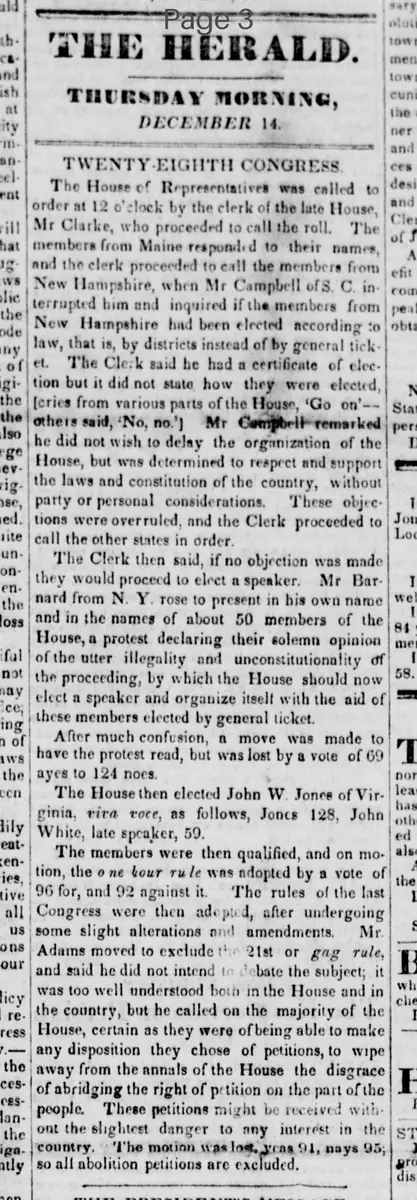
THURSDAY MORNING,
DECEMBER 14.
TWENTY-EIGHTH CONGRESS.
The House of Representatives was called to order at 12 o'clock by the clerk of the late House, Mr. Clarke, who proceeded to call the roll. The members from Maine responded to their names, and the clerk proceeded to call the members from New Hampshire, when Mr. Campbell of S. C. interrupted him and inquired if the members from New Hampshire had been elected according to law, that is, by districts instead of by general ticket. The Clerk said he had a certificate of election but it did not state how they were elected. [cries from various parts of the House, 'Go on'—others said, 'No, no.'] Mr. Campbell remarked he did not wish to delay the organization of the House, but was determined to respect and support the laws and constitution of the country, without party or personal considerations. These objections were overruled, and the Clerk proceeded to call the other states in order.
The Clerk then said, if no objection was made they would proceed to elect a speaker. Mr. Barnard from N. Y. rose to present in his own name and in the names of about 50 members of the House, a protest declaring their solemn opinion of the utter illegality and unconstitutionality of the proceeding, by which the House should now elect a speaker and organize itself with the aid of these members elected by general ticket.
After much confusion, a move was made to have the protest read, but was lost by a vote of 69 ayes to 124 noes.
The House then elected John W. Jones of Virginia, viva voce, as follows: Jones 128, John White, late speaker, 59.
The members were then qualified, and on motion, the one hour rule was adopted by a vote of 96 for, and 92 against it. The rules of the last Congress were then adopted, after undergoing some slight alterations and amendments. Mr. Adams moved to exclude the 21st or gag rule, and said he did not intend to debate the subject; it was too well understood both in the House and in the country, but he called on the majority of the House, certain as they were of being able to make any disposition they chose of petitions, to wipe away from the annals of the House the disgrace of abridging the right of petition on the part of the people. These petitions might be received without the slightest danger to any interest in the country. The motion was lost, yeas 91, nays 95; so all abolition petitions are excluded.
What sub-type of article is it?
What keywords are associated?
What entities or persons were involved?
Domestic News Details
Event Date
December 14
Key Persons
Outcome
john w. jones elected speaker by 128-59 vote; one hour rule adopted 96-92; previous congress rules adopted with alterations; motion to exclude gag rule lost 91-95, retaining exclusion of abolition petitions.
Event Details
The House was called to order at 12 o'clock. Objections raised by Mr. Campbell regarding New Hampshire members' election by general ticket were overruled. A protest by Mr. Barnard and others against organizing with such members was not read (69-124). Speaker election proceeded, qualifying members followed. Rules adopted, including retention of the gag rule despite Mr. Adams' motion.