Thank you for visiting SNEWPapers!
Sign up free
New Hampshire Statesman
Concord, Merrimack County, New Hampshire
What is this article about?
This editorial, part II on 'The Sovereignty of the People,' critiques the Virginia-based 'junto's' dominance in the Republican Party, caucus nominations overriding popular will, and historical elite manipulations, advocating for direct exercise of people's sovereignty in elections and governance.
Merged-components note: This is a continuation of a political opinion piece across pages 1 and 2, originally labeled as 'story' and 'domestic_news'. The content is partisan and opinionated, fitting the 'editorial' label better.
Clippings
1 of 2
OCR Quality
Full Text
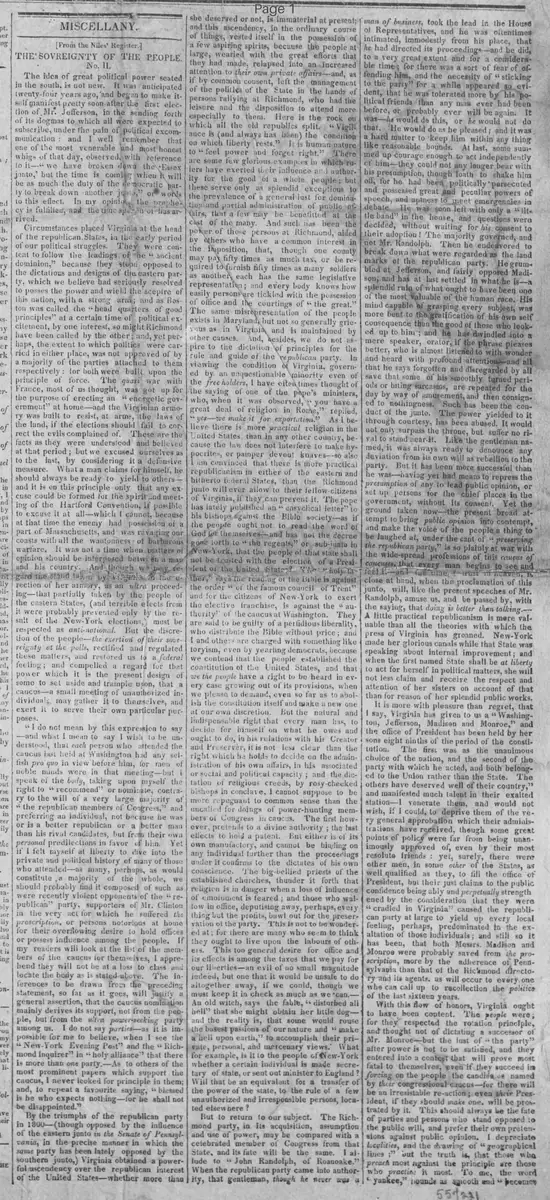
[From the Niles' Register.]
THE SOVEREIGNTY OF THE PEOPLE.
No. II.
The idea of great political power seated in the south, is not new. It was anticipated twenty-four years ago, and began to make itself manifest pretty soon after the first election of Mr. Jefferson, in the sending forth of its dogmas to which all were expected to subscribe, under the pain of political excommunication: and I well remember that one of the most venerable and most honest whigs of that day, observed, with reference to it 'we have broken down the Essex junto,' but the time is coming when it will be as much the duty of the democratic party to break down another junto,' or words to this effect. In my opinion, the prophecy is fulfilled, and the time spoken of has arrived.
Circumstances placed Virginia at the head of the republican States, in the early period of our political struggles. They were content to follow the leadings of the "ancient dominion," because they stood opposed to the dictations and designs of the eastern party, which we believe had seriously resolved to possess the power and wield the sceptre of this nation, with a strong arm; and as Boston was called the "head quarters of good principles" at a certain time of political excitement, by one interest, so might Richmond have been called by the other; and, yet perhaps, the extent to which politics were carried in either place, was not approved of by a majority of the parties attached to them respectively: for both were built upon the principle of force. The quasi war with France, most of us thought, was got up for the purpose of erecting an "energetic government" at home—and the Virginian armory was built to resist, at arms, the laws of the land, if the elections should fail to correct the evils complained of. These are the facts as they were understood and believed at that period; but we excused ourselves as to the last, by considering it a defensive measure. What a man claims for himself, he should always be ready to yield to others and it is on this principle only that any excuse could be formed for the spirit and meeting of the Hartford Convention, if possible to excuse it at all—which I cannot, because at that time the enemy had possession of a part of Massachusetts, and was ravaging our coasts with all the wantonness of barbarous warfare. It was not a time when matters of opinion should be interposed between a man and his country. And though we may regard the stand taken by Virginia in the erection of her armory, as an ultra proceeding—that partially taken by the people of the eastern States, (and terrible effects from it were probably prevented only by the result of the New-York elections,) must be regretted as anti-national. But the discretion of the people—the exertion of their sovereignty at the polls, rectified and regulated these matters, and restored us to a federal feeling; and compelled a regard for that power which it is the present design of some to set aside and trample upon, that a caucus—a small meeting of unauthorized individuals, may gather it to themselves, and exert it to serve their own particular purposes.
"I do not mean by this expression to say—and what I mean to say I wish to be understood, that each person who attended the caucus last held at Washington had any selfish pro quo in view before him, for men of noble minds were in that meeting—but I speak of the body, taking upon myself the right to "recommend" or nominate, contrary to the will of a very large majority of "the republican members of Congress," and preferring an individual, not because he was or is a better republican or a better man than his rival candidates, but from their own personal predilections in favor of him. Yet if I felt myself at liberty to dive into the private and political history of many of those who attended—as many, perhaps, as would constitute a majority of the whole, we should probably find it composed of such as were recently violent opponents of the "republican" party, supporters of Mr. Clinton in the very act for which he suffered the proscription, or persons notorious at home for their overflowing desire to hold offices or possess influence among the people. If my readers will look at the list of the members of the caucus for themselves, I apprehend they will not be at a loss to class and locate the body as is stated above. The inferences to be drawn from the preceding statement, so far as it goes, will justify a general assertion, that the caucus nomination mainly derives its support, not from the people, but from the ultra power-seeking party among us. I do not say parties—as it is impossible for me to believe, when I see the "New-York Evening Post" and the "Richmond Inquirer" in "holy alliance" that there is more than one party.—As to others of the most prominent papers which support the caucus, I never looked for principle in them; and, to repeat a favourite saying, "blessed is he who expects nothing—for he shall not be disappointed."
By the triumphs of the republican party in 1800—(though opposed by the influence of the eastern junto in the Senate of Pennsylvania, in the precise manner in which the same party has been lately opposed by the southern junto,) Virginia obtained a powerful ascendency over the republican interest of the United States whether more than she deserved or not, is immaterial at present; and this ascendency, in the ordinary course of things, vested itself in the possession of a few aspiring spirits, because the people at large, wearied with the great efforts that they had made, relapsed into an increased attention to their own private affairs—and, as if by common consent, left the management of the politics of the State in the hands of persons rallying at Richmond, who had the leisure and the disposition to attend more especially to them. Here is the rock on which all the old republics split. "Vigilance is (and always has been) the condition on which liberty rests." It is human nature to "feel power and forget right." There are some few glorious examples in which rulers have exerted their influence and authority for the good of a whole people; but these serve only as splendid exceptions to the prevalence of a general lust for domination and partial administration of public affairs, that a few may be benefitted at the cost of the many. And such has been the power of those persons at Richmond, aided by others who have a common interest in the imposition, that, though one county may pay fifty times as much tax, or be required to furnish fifty times as many soldiers as another each has the same legislative representation; and every body knows how easily persons are tickled with the possession of office and the courtings of "the great."
The same misrepresentation of the people exists in Maryland, but not so generally grievous as in Virginia, and is maintained by other causes. And, besides, we do not aspire to the dictation of principles for the rule and guide of the republican party. In viewing the condition of Virginia, governed by an unquestionable minority even of the free holders, I have often times thought of the saving of one of the pope's ministers, who, when it was observed, "you have a great deal of religion in Rome," replied, "yes—we make it for exportation." As I believe there is more practical religion in the United States than in any other country, because the law does not interfere to make hypocrites, or pauper devout knaves—so also I am convinced that there is more practical republicanism in either of the eastern and hitherto federal States, than the Richmond junto will ever allow to their fellow-citizens of Virginia, if they can prevent it. The pope has lately published an "encyclical letter" to his bishops against the Bible society—as if the people ought not to read the word of God for themselves—and has not the decree gone forth to "the regents," or sub-junto in New-York, that the people of that state shall not be trusted with the election of a President of the United States? Yet "holy Father, says the reading of the Bible is against the order "of the famous council of Trent" and for the citizens of New-York to exert the elective franchise, is against the "authority" of the caucus at Washington. They are said to be guilty of a perfidious liberality, who distribute the Bible without price; and I and others are charged with something like toryism, even by yearling democrats, because we contend that the people established the constitution of the United States, and that we the people have a right to be heard in every case growing out of its provisions, when we please to demand, even so far as to abolish the constitution itself and make a new one at our own discretion. But the natural and indispensable right that every man has, to decide for himself on what he owes and ought to do, in his relations with his Creator and Preserver, it is not less clear than the right which he holds to decide on the administration of his own affairs, in his associated or social and political capacity; and the dictation of religious creeds, by rosy-cheeked bishops in conclave, I cannot suppose to be more repugnant to common sense than the uncalled for doings of power-hunting members of Congress in caucus. The first however, pretends to a divine authority; the last affects to hold a patent. But either is of its own manufactory, and cannot be binding on any individual further than the proceedings under it conform to the dictates of his own conscience. The big-bellied priests of the established churches, thunder it forth that religion is in danger when a loss of influence or emolument is feared; and those who wallow in office, deputising away, perhaps, every thing but the profits, bawl out for the preservation of the party. This is not to be wondered at; for there are many who seem to think they ought to live upon the labours of others. This too general desire for office and its effects is among the taxes that we pay for our liberties—an evil of no small magnitude indeed, but one that it would be unsafe to do altogether away, if we could, though we must keep it in check as much as we can.—An old witch, says the fable, "disturbed all hell" that she might obtain her little dog—and the reality is, that some would rouse the basest passions of our nature and "make a hell upon earth," to accomplish their private, personal, and mercenary views. What for example, is it to the people of New-York whether a certain individual is made secretary of state, or sent out minister to England? Will that be an equivalent for a transfer of the power of the state, to the rule of a few unauthorized and irresponsible persons, located elsewhere?
But to return to our subject. The Richmond party, in its acquisition, assumption and use of power, may be compared with a celebrated member of Congress from that State, and its fate will be the same. I allude to "John Randolph, of Roanoke."
When the republican party came into authority, that gentleman, though he never was a man of business, took the lead in the House of Representatives, and he was oftentimes intimated, immodestly from his place, that he had directed its proceedings—and he did, to a very great extent and for a considerable time: for there was a sort of fear of offending him, and the necessity of "sticking to the party" or a while appeared so evident, that he was tolerated more by his political friends than any man ever had been before, or probably ever will be again. It was—he would do this, or he would not do that, He would do as he pleased; and it was a hard matter to keep him within any thing like reasonable bounds. At last, some summoned up courage enough to act independently of him—they could not any longer bear with his presumption, though loath to shake him off, for he had been politically persecuted and possessed great and peculiar powers of speech, and aptness to meet emergencies in debate He was soon left with only a "little band" in the house, and questions were decided, without waiting for his consent to their adoption! The majority governed, and not Mr. Randolph. Then he endeavored to break down what were regarded as the land marks of the republican party. He grumbled at Jefferson, and fairly opposed Madison, and has at last settled in what he is—a splendid ruin of what ought to have been one of the most valuable of the human race. His mind capable of grasping every subject, was more bent to the gratification of his own self consequence than the good of those who looked up to him; and he has dwindled into a mere speaker, orator, if the phrase pleases better, who is almost listened to with wonder and heard with profound attention—and all that he says forgotten and disregarded by all save that some of his smoothly turned periods or biting sarcasms, are repeated on the day by way of amusement, and then consigned to nothingness. Such has been the conduct of the junto. The power yielded to it through courtesy, has been abused. It would not only surpass the throne, but suffer no rival to stand near it. Like the gentleman named, it was always ready to denounce any deviation from its own will as rebellion to the party. But it has been more successful than he was—having yet had means to repress the presumption of any to lead public opinion, or set up persons for the chief places in the government, without its consent. Yet the ground taken now—the present broad attempt to bring public opinion into contempt, and make the voice of the people a thing to be laughed at, under the cant of "preserving the republican party," is so plainly at war with the wide-spread professions of this caucus of caucuses. that every man begins to see and feel it—and the time, I trust me leave us, is close at hand, when the proclamation of this junto, will, like the present speeches of Mr. Randolph, amuse us, and be passed by, with the saying, that doing is better than talking.—A little practical republicanism is more valuable than all the theories with which the press of Virginia has groaned. New-York made her glorious canals while that State was speaking about internal improvement; and when the first named State shall be at liberty to act for herself in political matters, she will not less claim and receive the respect and attention of her sisters on account of that than for reason of her splendid public works.
It is more with pleasure than regret, that I say, Virginia has given to us a "Washington, Jefferson, Madison and Monroe," and the office of President has been held by her sons eight ninths of the period of the constitution. The first was as the unanimous choice of the nation, and the second of the party with which he acted, and both belonged to the Union rather than the State. The others have deserved well of their country, and manifested much talent in their exalted station—I venerate them, and would not wish, if I could, to deprive them of the very general approbation which their administrations have received, though some great points of policy were far from being unanimously approved of, even by their most resolute friends: yet, surely, there were other men, in some other of the States, as well qualified as they, to fill the office of President, but their just claims to the public confidence being ably and perpetually strengthened by the consideration that they were "cradled in Virginia" caused the republican party at large to yield up every local feeling, perhaps, predominated in the exaltation of those individuals; and still so it has been, that both Messrs. Madison and Monroe were probably saved from the proscription, more by the adherence of Pennsylvania than that of the Richmond directory and its agents. as will occur to every one who can call up to recollection the politics of the last sixteen years.
With this flow of honors, Virginia ought to have been content. The people were; for they respected the rotation principle, and thought not of dictating a successor of Mr. Monroe—but the lust of "the party" after power is not to be satisfied, and they entered into a contest that will prove most fatal to themselves; even if they succeed in forcing on the people the candidates named by their congressional caucus—for there will be an irresistible re-action; even their President, if they should make one. will be prostrated by it. This should always be the fate of parties and persons who stand opposed to the public will, and prefer their own pretensions against public opinion. I depreciate Localities, and the drawing of "geographical lines;" but the truth is that those who preach most against the principle are those who practise it most. To me, the word "yankee," sounds as smooth and "becomes
the mouth as well as "Virginian;" but I would not like to hear a person recommended to office, or another defended in the administration of that which he holds, and on the floor of the House of Representatives to boot, because he was a Yankee. But little Rhode-Island has many as good and as useful citizens as even the almost titled "John Randolph, of Roanoke"—and, let him boast as he will of it, his blood is not one jot better than a cotton spinner's. He and others ought to look at the population tables. Power must abide where freemen live, and it will—let management do what it can to keep it down.
What sub-type of article is it?
What keywords are associated?
What entities or persons were involved?
Editorial Details
Primary Topic
Critique Of Virginia Junto's Control Over Republican Party And Advocacy For Popular Sovereignty
Stance / Tone
Strongly Pro Popular Sovereignty, Anti Elite Caucus And Junto Manipulation
Key Figures
Key Arguments