Thank you for visiting SNEWPapers!
Sign up free
Editorial
February 22, 1828
Phenix Gazette
Alexandria, Virginia
What is this article about?
An editorial from the New-York National Advocate criticizes the Jackson party's appointment of inexperienced Mr. Hoffman to head the Naval Committee and his proposal to cut pay for inactive naval officers, viewing it as part of a broader hostility toward key U.S. institutions like the Navy. The motion is rejected.
Clipping
OCR Quality
95%
Excellent
Full Text
From the New-York National Advocate.
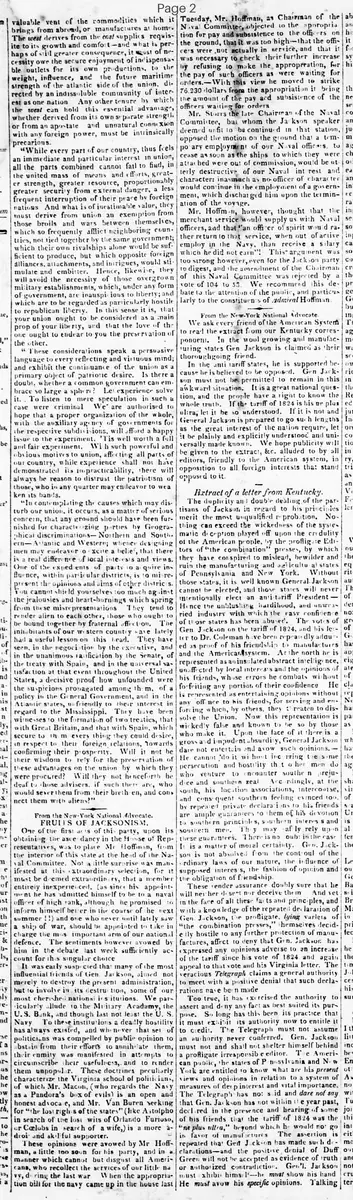
FRUITS OF JACKSONISM
One of the first acts of this party, upon its obtaining the ascendancy in the House of Representatives, was to place Mr. Hoffman, from the interior of this state at the head of the Naval Committee. No little surprise was manifested at this extraordinary selection, for it must be deemed extraordinary, that a member entirely inexperienced, (as since his appointment he has admitted himself to be to a naval officer of high rank, although he promised to inform himself better in the course of the next summer!!) and one who never until lately saw a ship of war, should be appointed to take in charge the most important arm of our national defence. The sentiments however avowed by him in the debate last week sufficiently account for this singular choice.
It was early suspected that many of the most influential friends of Gen. Jackson, aimed not merely to destroy the present administration, but to involve in its destruction, some of our most cherished national institutions. We particularly allude to the Military Academy, the U.S. Bank, and though last not least the U.S. Navy. To these institutions a deadly hostility has always existed, and whenever that set of politicians was compelled by public opinion to abstain from their efforts to annihilate them, their enmity was manifested in attempts to circumscribe their usefulness, and to render them unpopular. These doctrines peculiarly characterize the Virginia school of politicians, of which Mr. Macon, (who regards the Navy as a Pandora's box of evils) is an open and honest advocate, and Mr. Van Buren seeking for "the lost rights of the states" (like Astolpho in search of the lost wits of Orlando Furioso, or Caleb in search of a wife,) is a more adroit and skilful supporter.
These opinions were avowed by Mr. Hoffman, a little too soon for his party, and in a manner which cannot but disgust all Americans, who recollect the services of our little navy, during the last war. When the appropriation bill for the navy came up in the house last Tuesday, Mr. Hoffman, as Chairman of the Naval Committee, objected to the appropriation for pay and subsistence to the officers on the ground, that it was too high-that the officers were not actually in service, and that it was necessary to check their further increase by refusing to make the appropriation, for the pay of such officers as were waiting for orders. With this view he moved to strike 76,230 dollars from the appropriation it being the amount of the pay and subsistence of the officers waiting for orders.
Mr. Storrs the late Chairman of the Naval Committee, but whom the Jackson speaker deemed unfit to be continued in that station, opposed the motion on the ground that a temporary employment of our Naval officers, to cease as soon as the ships to which they were attached were out of commission, would be utterly destructive of our Naval interest and character: inasmuch as no officer of character would continue in the employment of a government, which discharged him upon the termination of the voyage.
Mr. Hoffman, however, thought that the merchant service would supply us with Naval officers, and that "an officer of spirit would rather return to that service, when out of active employ in the Navy, than receive a salary which he did not earn"! This argument was too strong however, even for the Jackson party to digest, and the amendment of the Chairman of this Naval Committee was rejected by a vote of 104 to 53. We recommend his debate to the attention of the public, and particularly to the constituents of admiral Hoffman.
FRUITS OF JACKSONISM
One of the first acts of this party, upon its obtaining the ascendancy in the House of Representatives, was to place Mr. Hoffman, from the interior of this state at the head of the Naval Committee. No little surprise was manifested at this extraordinary selection, for it must be deemed extraordinary, that a member entirely inexperienced, (as since his appointment he has admitted himself to be to a naval officer of high rank, although he promised to inform himself better in the course of the next summer!!) and one who never until lately saw a ship of war, should be appointed to take in charge the most important arm of our national defence. The sentiments however avowed by him in the debate last week sufficiently account for this singular choice.
It was early suspected that many of the most influential friends of Gen. Jackson, aimed not merely to destroy the present administration, but to involve in its destruction, some of our most cherished national institutions. We particularly allude to the Military Academy, the U.S. Bank, and though last not least the U.S. Navy. To these institutions a deadly hostility has always existed, and whenever that set of politicians was compelled by public opinion to abstain from their efforts to annihilate them, their enmity was manifested in attempts to circumscribe their usefulness, and to render them unpopular. These doctrines peculiarly characterize the Virginia school of politicians, of which Mr. Macon, (who regards the Navy as a Pandora's box of evils) is an open and honest advocate, and Mr. Van Buren seeking for "the lost rights of the states" (like Astolpho in search of the lost wits of Orlando Furioso, or Caleb in search of a wife,) is a more adroit and skilful supporter.
These opinions were avowed by Mr. Hoffman, a little too soon for his party, and in a manner which cannot but disgust all Americans, who recollect the services of our little navy, during the last war. When the appropriation bill for the navy came up in the house last Tuesday, Mr. Hoffman, as Chairman of the Naval Committee, objected to the appropriation for pay and subsistence to the officers on the ground, that it was too high-that the officers were not actually in service, and that it was necessary to check their further increase by refusing to make the appropriation, for the pay of such officers as were waiting for orders. With this view he moved to strike 76,230 dollars from the appropriation it being the amount of the pay and subsistence of the officers waiting for orders.
Mr. Storrs the late Chairman of the Naval Committee, but whom the Jackson speaker deemed unfit to be continued in that station, opposed the motion on the ground that a temporary employment of our Naval officers, to cease as soon as the ships to which they were attached were out of commission, would be utterly destructive of our Naval interest and character: inasmuch as no officer of character would continue in the employment of a government, which discharged him upon the termination of the voyage.
Mr. Hoffman, however, thought that the merchant service would supply us with Naval officers, and that "an officer of spirit would rather return to that service, when out of active employ in the Navy, than receive a salary which he did not earn"! This argument was too strong however, even for the Jackson party to digest, and the amendment of the Chairman of this Naval Committee was rejected by a vote of 104 to 53. We recommend his debate to the attention of the public, and particularly to the constituents of admiral Hoffman.
What sub-type of article is it?
Partisan Politics
Military Affairs
What keywords are associated?
Jacksonism
Naval Committee
Hoffman
Us Navy
Appropriations
Partisan Politics
Military Academy
Us Bank
What entities or persons were involved?
Mr. Hoffman
Gen. Jackson
Mr. Macon
Mr. Van Buren
Mr. Storrs
U.S. Navy
Military Academy
U.S. Bank
Editorial Details
Primary Topic
Criticism Of Jackson Party's Naval Policies And Appointments
Stance / Tone
Strongly Anti Jackson, Pro Navy
Key Figures
Mr. Hoffman
Gen. Jackson
Mr. Macon
Mr. Van Buren
Mr. Storrs
U.S. Navy
Military Academy
U.S. Bank
Key Arguments
Appointment Of Inexperienced Mr. Hoffman To Naval Committee Due To Anti Navy Sentiments
Jackson Party's Hostility Toward National Institutions Like The Navy
Hoffman's Motion To Cut Pay For Inactive Naval Officers To Limit Their Numbers
Such Cuts Would Destroy Naval Character And Deter Qualified Officers
Merchant Service Cannot Adequately Replace Naval Officers
Hoffman's Amendment Rejected 104 To 53