Thank you for visiting SNEWPapers!
Sign up free
Richmond Enquirer
Richmond, Richmond County, Virginia
What is this article about?
On Feb. 21, the Senate debated the tax bill, maintaining the land tax at 10 cents per $100, adopting amendments for separate levy lists, rejecting a surplus pledge proposal, and passing the bill 15-12 amid concerns over surplus use and excess revenue.
Clipping
OCR Quality
Full Text
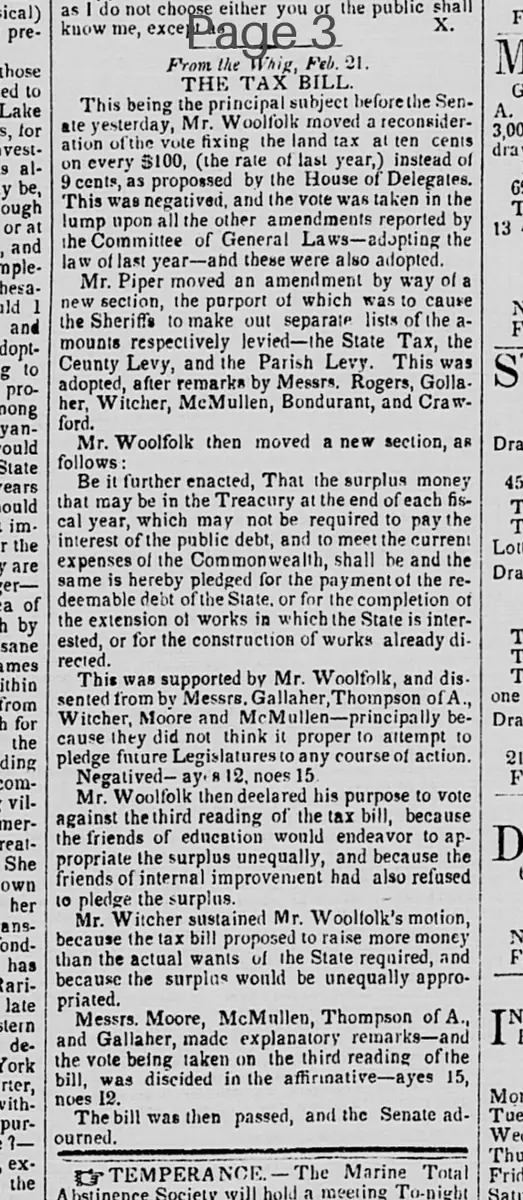
THE TAX BILL.
This being the principal subject before the Senate yesterday, Mr. Woolfolk moved a reconsideration of the vote fixing the land tax at ten cents on every $100, (the rate of last year,) instead of 9 cents, as proposed by the House of Delegates. This was negatived, and the vote was taken in the lump upon all the other amendments reported by the Committee of General Laws-adopting the law of last year-and these were also adopted.
Mr. Piper moved an amendment by way of a new section, the purport of which was to cause the Sheriff to make out separate lists of the amounts respectively levied-the State Tax, the County Levy, and the Parish Levy. This was adopted, after remarks by Messrs. Rogers, Gallaher, Witcher, McMullen, Bondurant, and Crawford.
Mr. Woolfolk then moved a new section, as follows:
Be it further enacted, That the surplus money that may be in the Treasury at the end of each fiscal year, which may not be required to pay the interest of the public debt, and to meet the current expenses of the Commonwealth, shall be and the same is hereby pledged for the payment of the redeemable debt of the State, or for the completion of the extension of works in which the State is interested, or for the construction of works already directed.
This was supported by Mr. Woolfolk, and dissented from by Messrs. Gallaher, Thompson of A., Witcher, Moore and McMullen—principally because they did not think it proper to attempt to pledge future Legislatures to any course of action. Negatived—ayes 8, noes 15.
Mr. Woolfolk then declared his purpose to vote against the third reading of the tax bill, because the friends of education would endeavor to appropriate the surplus unequally, and because the friends of internal improvement had also refused to pledge the surplus.
Mr. Witcher sustained Mr. Woolfolk's motion because the tax bill proposed to raise more money than the actual wants of the State required, and because the surplus would be unequally appropriated.
Messrs. Moore, McMullen, Thompson of A., and Gallaher, made explanatory remarks—and the vote being taken on the third reading of the bill, was decided in the affirmative—ayes 15, noes 12.
The bill was then passed, and the Senate adjourned.
What sub-type of article is it?
What keywords are associated?
What entities or persons were involved?
Domestic News Details
Event Date
Feb. 21.
Key Persons
Outcome
the tax bill was passed on third reading with ayes 15, noes 12.
Event Details
The Senate debated the tax bill, rejecting reconsideration of the land tax rate at 10 cents per $100, adopting other amendments from the Committee of General Laws mirroring last year's law, adopting Mr. Piper's amendment for separate lists of levies, and rejecting Mr. Woolfolk's proposal to pledge surplus money for debt or works. Mr. Woolfolk and Mr. Witcher opposed the bill due to concerns over surplus appropriation and excess revenue.