Thank you for visiting SNEWPapers!
Sign up free
Virginia Argus
Richmond, Virginia
What is this article about?
President Madison submits to Congress a December 1811 letter from British envoy Foster to Secretary Monroe, providing evidence of Canada's Governor Craig warning the US about potential Indian attacks and denying British instigation, with Monroe's January 1812 response accepting the disavowal.
Clipping
OCR Quality
Full Text
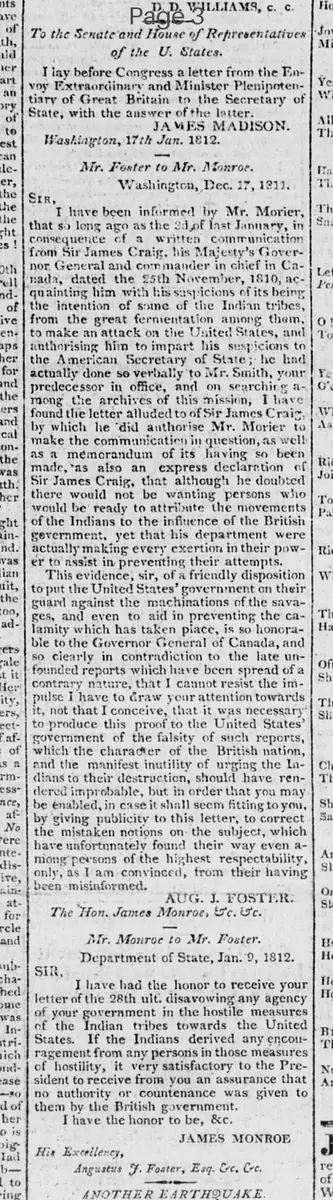
I lay before Congress a letter from the Envoy Extraordinary and Minister Plenipotentiary of Great Britain to the Secretary of State, with the answer of the latter.
JAMES MADISON.
Washington, 17th Jan. 1812.
Mr. Foster to Mr. Monroe.
Washington, Dec. 17, 1811.
SIR,
I have been informed by Mr. Morier, that so long ago as the 3d of last January, in consequence of a written communication from Sir James Craig, his Majesty's Governor General and commander in chief in Canada, dated the 25th November, 1810, acquainting him with his suspicions of its being the intention of some of the Indian tribes, from the great fermentation among them, to make an attack on the United States, and authorising him to impart his suspicions to the American Secretary of State; he had actually done so verbally to Mr. Smith, your predecessor in office, and on searching among the archives of this mission, I have found the letter alluded to of Sir James Craig by which he did authorise Mr. Morier to make the communication in question, as well as a memorandum of its having so been made, as also an express declaration of Sir James Craig, that although he doubted there would not be wanting persons who would be ready to attribute the movements of the Indians to the influence of the British government, yet that his department were actually making every exertion in their power to assist in preventing their attempts.
This evidence, sir, of a friendly disposition to put the United States' government on their guard against the machinations of the savages, and even to aid in preventing the calamity which has taken place, is so honorable to the Governor General of Canada, and so clearly in contradiction to the late unfounded reports which have been spread of a contrary nature, that I cannot resist the impulse I have to draw your attention towards it, not that I conceive, that it was necessary to produce this proof to the United States' government of the falsity of such reports, which the character of the British nation, and the manifest inutility of urging the Indians to their destruction, should have rendered improbable, but in order that you may be enabled, in case it shall seem fitting to you, by giving publicity to this letter, to correct the mistaken notions on the subject, which have unfortunately found their way even among persons of the highest respectability only, as I am convinced, from their having been misinformed.
AUG. J. FOSTER.
The Hon. James Monroe, &c.
Mr. Monroe to Mr. Foster.
Department of State, Jan. 9, 1812.
SIR,
I have had the honor to receive your letter of the 28th ult. disavowing any agency of your government in the hostile measures of the Indian tribes towards the United States. If the Indians derived any encouragement from any persons in those measures of hostility, it very satisfactory to the President to receive from you an assurance that no authority or countenance was given to them by the British government.
I have the honor to be, &c.
JAMES MONROE
His Excellency,
Augustus F. Foster, Esq. &c. &c.
What sub-type of article is it?
What keywords are associated?
What entities or persons were involved?
Where did it happen?
Foreign News Details
Primary Location
Canada
Event Date
November 1810 To January 1812
Key Persons
Outcome
british disavowal of involvement in indian hostilities; assurance of efforts to prevent attacks; us acceptance of the assurance.
Event Details
British envoy Foster informs US Secretary Monroe of prior warnings from Canada's Governor Craig about suspected Indian attacks on the US, provides evidence of verbal communication to predecessor Smith, and denies British influence, countering unfounded reports. Monroe acknowledges the disavowal and expresses satisfaction with the assurance of no British support for the Indians.