Thank you for visiting SNEWPapers!
Sign up free
Sacramento Daily Record Union
Sacramento, Sacramento County, California
What is this article about?
Observations from Lick Observatory on July 19 detail Mr. Barnard's measurements of a comet he discovered last September, now disintegrating post-perihelion, with fragments forming a sunward tail over 430,000 miles long, highlighting solar forces on comets.
Clipping
OCR Quality
Full Text
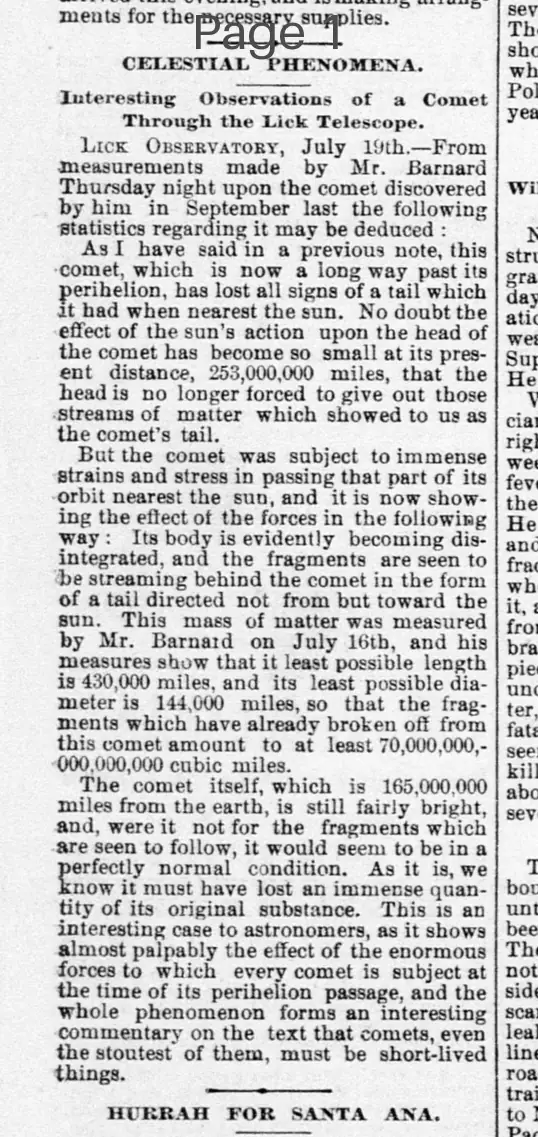
Interesting Observations of a Comet Through the Lick Telescope.
LICK OBSERVATORY, July 19th.—From measurements made by Mr. Barnard Thursday night upon the comet discovered by him in September last the following statistics regarding it may be deduced:
As I have said in a previous note, this comet, which is now a long way past its perihelion, has lost all signs of a tail which it had when nearest the sun. No doubt the effect of the sun's action upon the head of the comet has become so small at its present distance, 253,000,000 miles, that the head is no longer forced to give out those streams of matter which showed to us as the comet's tail.
But the comet was subject to immense strains and stress in passing that part of its orbit nearest the sun, and it is now showing the effect of the forces in the following way: Its body is evidently becoming disintegrated, and the fragments are seen to be streaming behind the comet in the form of a tail directed not from but toward the sun. This mass of matter was measured by Mr. Barnard on July 16th, and his measures show that its least possible length is 430,000 miles, and its least possible diameter is 144,000 miles, so that the fragments which have already broken off from this comet amount to at least 70,000,000,000,000,000 cubic miles.
The comet itself, which is 165,000,000 miles from the earth, is still fairly bright, and, were it not for the fragments which are seen to follow, it would seem to be in a perfectly normal condition. As it is, we know it must have lost an immense quantity of its original substance. This is an interesting case to astronomers, as it shows almost palpably the effect of the enormous forces to which every comet is subject at the time of its perihelion passage, and the whole phenomenon forms an interesting commentary on the text that comets, even the stoutest of them, must be short-lived things.
What sub-type of article is it?
What keywords are associated?
What entities or persons were involved?
Where did it happen?
Domestic News Details
Primary Location
Lick Observatory
Event Date
July 19th
Key Persons
Event Details
Measurements made by Mr. Barnard Thursday night on the comet discovered by him in September last show it is 253,000,000 miles from the sun, past perihelion, without a tail, but disintegrating with fragments streaming toward the sun forming a tail of at least 430,000 miles long and 144,000 miles diameter, totaling 70,000,000,000,000,000 cubic miles. The comet is 165,000,000 miles from earth and still bright.