Thank you for visiting SNEWPapers!
Sign up free
Letter to Editor
June 23, 1857
The Daily Manchester American
Manchester, Hillsboro County, New Hampshire
What is this article about?
Reflection on New Hampshire legislators' talent from 1810-1857, praising past figures like Webster, Mason, and others for their abilities, noting fewer great debates post-1820 until slavery issues in 1854-1855, and affirming the 1857 legislature's sound judgment despite fewer debaters.
Clipping
OCR Quality
98%
Excellent
Full Text
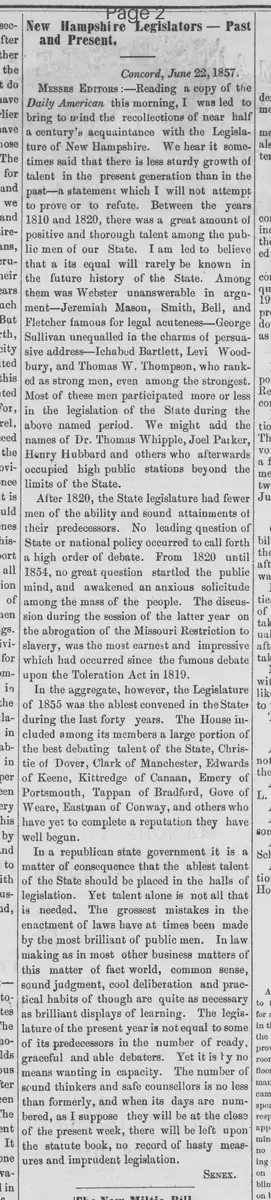
New Hampshire Legislators - Past and Present.
Concord, June 22, 1857.
Messrs. Editors:—Reading a copy of the Daily American this morning, I was led to bring to mind the recollections of near half a century's acquaintance with the Legislature of New Hampshire. We hear it sometimes said that there is less sturdy growth of talent in the present generation than in the past—a statement which I will not attempt to prove or to refute. Between the years 1810 and 1820, there was a great amount of positive and thorough talent among the public men of our State. I am led to believe that its equal will rarely be known in the future history of the State. Among them was Webster unanswerable in argument—Jeremiah Mason, Smith, Bell, and Fletcher famous for legal acuteness—George Sullivan unequalled in the charms of persuasive address—Ichabod Bartlett, Levi Woodbury, and Thomas W. Thompson, who ranked as strong men, even among the strongest. Most of these men participated more or less in the legislation of the State during the above named period. We might add the names of Dr. Thomas Whipple, Joel Parker, Henry Hubbard and others who afterwards occupied high public stations beyond the limits of the State.
After 1820, the State legislature had fewer men of the ability and sound attainments of their predecessors. No leading question of State or national policy occurred to call forth a high order of debate. From 1820 until 1854, no great question startled the public mind, and awakened an anxious solicitude among the mass of the people. The discussion during the session of the latter year on the abrogation of the Missouri Restriction to slavery, was the most earnest and impressive which had occurred since the famous debate upon the Toleration Act in 1819.
In the aggregate, however, the Legislature of 1855 was the ablest convened in the State during the last forty years. The House included among its members a large portion of the best debating talent of the State, Christie of Dover, Clark of Manchester, Edwards of Keene, Kittredge of Canaan, Emery of Portsmouth, Tappan of Bradford, Gove of Weare, Eastman of Conway, and others who have yet to complete a reputation they have well begun.
In a republican state government it is a matter of consequence that the ablest talent of the State should be placed in the halls of legislation. Yet talent alone is not all that is needed. The grossest mistakes in the enactment of laws have at times been made by the most brilliant of public men. In law making as in most other business matters of this matter of fact world, common sense, sound judgment, cool deliberation and practical habits of thought are quite as necessary as brilliant displays of learning. The legislature of the present year is not equal to some of its predecessors in the number of ready, graceful and able debaters. Yet it is by no means wanting in capacity. The number of sound thinkers and safe counsellors is no less than formerly, and when its days are numbered, as I suppose they will be at the close of the present week, there will be left upon the statute book, no record of hasty measures and imprudent legislation.
SENEX.
Concord, June 22, 1857.
Messrs. Editors:—Reading a copy of the Daily American this morning, I was led to bring to mind the recollections of near half a century's acquaintance with the Legislature of New Hampshire. We hear it sometimes said that there is less sturdy growth of talent in the present generation than in the past—a statement which I will not attempt to prove or to refute. Between the years 1810 and 1820, there was a great amount of positive and thorough talent among the public men of our State. I am led to believe that its equal will rarely be known in the future history of the State. Among them was Webster unanswerable in argument—Jeremiah Mason, Smith, Bell, and Fletcher famous for legal acuteness—George Sullivan unequalled in the charms of persuasive address—Ichabod Bartlett, Levi Woodbury, and Thomas W. Thompson, who ranked as strong men, even among the strongest. Most of these men participated more or less in the legislation of the State during the above named period. We might add the names of Dr. Thomas Whipple, Joel Parker, Henry Hubbard and others who afterwards occupied high public stations beyond the limits of the State.
After 1820, the State legislature had fewer men of the ability and sound attainments of their predecessors. No leading question of State or national policy occurred to call forth a high order of debate. From 1820 until 1854, no great question startled the public mind, and awakened an anxious solicitude among the mass of the people. The discussion during the session of the latter year on the abrogation of the Missouri Restriction to slavery, was the most earnest and impressive which had occurred since the famous debate upon the Toleration Act in 1819.
In the aggregate, however, the Legislature of 1855 was the ablest convened in the State during the last forty years. The House included among its members a large portion of the best debating talent of the State, Christie of Dover, Clark of Manchester, Edwards of Keene, Kittredge of Canaan, Emery of Portsmouth, Tappan of Bradford, Gove of Weare, Eastman of Conway, and others who have yet to complete a reputation they have well begun.
In a republican state government it is a matter of consequence that the ablest talent of the State should be placed in the halls of legislation. Yet talent alone is not all that is needed. The grossest mistakes in the enactment of laws have at times been made by the most brilliant of public men. In law making as in most other business matters of this matter of fact world, common sense, sound judgment, cool deliberation and practical habits of thought are quite as necessary as brilliant displays of learning. The legislature of the present year is not equal to some of its predecessors in the number of ready, graceful and able debaters. Yet it is by no means wanting in capacity. The number of sound thinkers and safe counsellors is no less than formerly, and when its days are numbered, as I suppose they will be at the close of the present week, there will be left upon the statute book, no record of hasty measures and imprudent legislation.
SENEX.
What sub-type of article is it?
Reflective
Historical
Informative
What themes does it cover?
Politics
What keywords are associated?
New Hampshire Legislature
Historical Legislators
Political Talent
Debate Sessions
Slavery Restriction
State Governance
What entities or persons were involved?
Senex
Messrs. Editors
Letter to Editor Details
Author
Senex
Recipient
Messrs. Editors
Main Argument
while past new hampshire legislators (1810-1820) featured exceptional talents like webster and mason, recent sessions have fewer debaters but maintain sound judgment and practical wisdom, ensuring no imprudent laws in 1857.
Notable Details
Mentions Webster, Jeremiah Mason, Smith, Bell, Fletcher, George Sullivan, Ichabod Bartlett, Levi Woodbury, Thomas W. Thompson, Dr. Thomas Whipple, Joel Parker, Henry Hubbard.
References 1855 Legislature Members: Christie Of Dover, Clark Of Manchester, Edwards Of Keene, Kittredge Of Canaan, Emery Of Portsmouth, Tappan Of Bradford, Gove Of Weare, Eastman Of Conway.
Discusses Debates On Missouri Restriction (1854) And Toleration Act (1819).