Thank you for visiting SNEWPapers!
Sign up free
Public Ledger
Memphis, Shelby County, Tennessee
What is this article about?
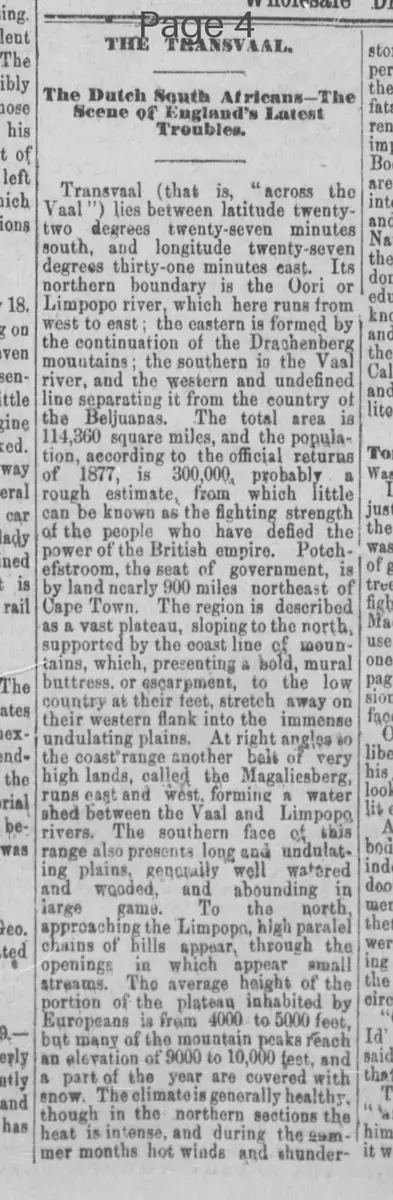
Geographical and demographic overview of Transvaal, described as the scene of England's latest troubles. Details its location between 22°27' S and 27°31' E, boundaries including the Vaal and Limpopo rivers, area of 114,360 square miles, population around 300,000 per 1877 estimates, and healthy plateau climate with high elevations.
Clipping
OCR Quality
Full Text
The Dutch South Africans—The
Scene of England's Latest
Troubles.
Transvaal (that is, "across the
Vaal") lies between latitude twenty-two
degrees twenty-seven minutes
south, and longitude twenty-seven
degrees thirty-one minutes east. Its
northern boundary is the Olifants or
Limpopo river, which here runs from
west to east; the eastern is formed by
the continuation of the Drakensberg
mountains; the southern is the Vaal
river, and the western and undefined
line separating it from the country of
the Bechuanas. The total area is
114,360 square miles, and the popula-
tion, according to the official returns
of 1877, is 300,000, probably a
rough estimate, from which little
can be known as the fighting strength
of the people who have defied the
power of the British empire. Potchef-
stroom, the seat of government, is
by land nearly 900 miles northeast of
Cape Town. The region is described
as a vast plateau, sloping to the north,
supported by the coast line of moun-
tains, which, presenting a bold, mural
buttress, or escarpment, to the low
country at their feet, stretch away on
their western flank into the immense
undulating plains. At right angles to
the coast range another belt of very
high lands, called the Magaliesberg,
runs east and west, forming a water
shed between the Vaal and Limpopo
rivers. The southern face of this
range also presents long and undulat-
ing plains, generally well watered
and wooded, and abounding in
large
game. To the north,
approaching the Limpopo, high parallel
chains of hills appear, through the
openings in which appear small
streams. The average height of the
portion of the plateau inhabited by
Europeans is from 4000 to 5000 feet,
but many of the mountain peaks reach
an elevation of 9000 to 10,000 feet, and
a part of the year are covered with
snow. The climate is generally healthy,
though in the northern sections the
heat is intense, and during the sum-
mer months hot winds and thunder-
storms prevail.
What sub-type of article is it?
What keywords are associated?
Where did it happen?
Foreign News Details
Primary Location
Transvaal
Event Details
Transvaal lies between latitude twenty-two degrees twenty-seven minutes south and longitude twenty-seven degrees thirty-one minutes east. Northern boundary: Olifants or Limpopo river. Eastern: Drakensberg mountains. Southern: Vaal river. Western: undefined line from Bechuanas country. Area: 114,360 square miles. Population: 300,000 per 1877 returns, rough estimate. Seat of government: Potchefstroom, 900 miles northeast of Cape Town by land. Vast plateau sloping north, supported by coastal mountains with escarpment, undulating plains. Magaliesberg range east-west, watershed between Vaal and Limpopo. Southern face: well-watered, wooded plains with game. North: high parallel hills with streams. Average height: 4000-5000 feet for European areas; peaks to 9000-10,000 feet, sometimes snow-covered. Healthy climate, intense heat in north, summer hot winds and thunderstorms.