Thank you for visiting SNEWPapers!
Sign up free
Letter to Editor
November 3, 1802
The National Intelligencer And Washington Advertiser
Washington, District Of Columbia
What is this article about?
A claimant writes to refute a published extract from a London house, alleging falsehoods about the payment process for claims under the seventh article of the British treaty. He defends the integrity of national agent Mr. Erving and criticizes merchants Williams and Cabot for potential deceit in handling awards.
Clipping
OCR Quality
95%
Excellent
Full Text
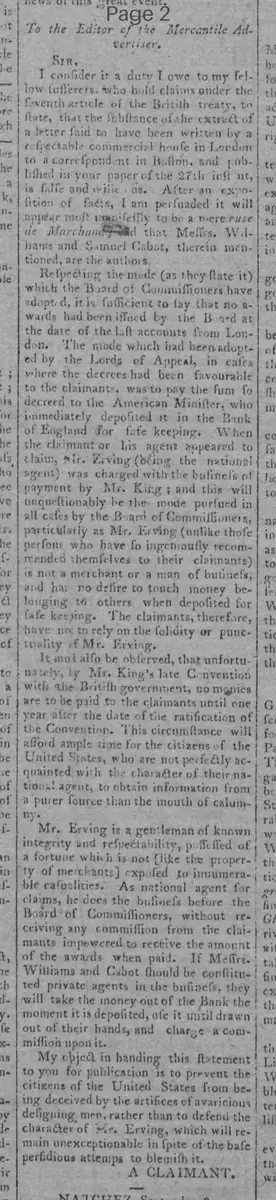
To the Editor of the Mercantile Advertiser.
SIR,
I consider it a duty I owe to my fellow sufferers, who hold claims under the seventh article of the British treaty, to state, that the substance of the extract of a letter said to have been written by a respectable commercial house in London to a correspondent in Boston, and published in your paper of the 27th instant, is false and vicious. After an exposition of facts, I am persuaded it will appear most manifestly to be a mere ruse de Marchandé that Messrs. Williams and Samuel Cabot, therein mentioned, are the authors.
Respecting the mode (as they state it) which the Board of Commissioners have adopted, it is sufficient to say that no arrests had been issued by the Board at the date of the last accounts from London. The mode which had been adopted by the Lords of Appeal, in cases where the decrees had been favourable to the claimants, was to pay the sum decreed to the American Minister, who immediately deposited it in the Bank of England for safe keeping. When the claimant or his agent appeared to claim, Mr. Erving (being the national agent) was charged with the business of payment by Mr. King; and this will unquestionably be the mode pursued in all cases by the Board of Commissioners, particularly as Mr. Erving (unlike those persons who have so ingeniously recommended themselves to their claimants) is not a merchant or a man of business, and has no desire to touch money belonging to others when deposited for safe keeping. The claimants, therefore, have only to rely on the solidity or punctuality of Mr. Erving.
It must also be observed, that unfortunately, by Mr. King's late Convention with the British government, no monies are to be paid to the claimants until one year after the date of the ratification of the Convention. This circumstance will afford ample time for the citizens of the United States, who are not perfectly acquainted with the character of their national agent, to obtain information from a purer source than the mouth of calumny.
Mr. Erving is a gentleman of known integrity and respectability, possessed of a fortune which is not [like the property of merchants] exposed to innumerable casualties. As national agent for claims, he does the business before the Board of Commissioners, without receiving any commission from the claimants empowered to receive the amount of the awards when paid. If Messrs. Williams and Cabot should be constituted private agents in the business, they will take the money out of the Bank the moment it is deposited, use it until drawn out of their hands, and charge a commission upon it.
My object in handing this statement to you for publication is to prevent the citizens of the United States from being deceived by the artifices of avaricious designing men, rather than to defend the character of Mr. Erving, which will remain unexceptionable in spite of the base perfidious attempts to blemish it.
A CLAIMANT.
SIR,
I consider it a duty I owe to my fellow sufferers, who hold claims under the seventh article of the British treaty, to state, that the substance of the extract of a letter said to have been written by a respectable commercial house in London to a correspondent in Boston, and published in your paper of the 27th instant, is false and vicious. After an exposition of facts, I am persuaded it will appear most manifestly to be a mere ruse de Marchandé that Messrs. Williams and Samuel Cabot, therein mentioned, are the authors.
Respecting the mode (as they state it) which the Board of Commissioners have adopted, it is sufficient to say that no arrests had been issued by the Board at the date of the last accounts from London. The mode which had been adopted by the Lords of Appeal, in cases where the decrees had been favourable to the claimants, was to pay the sum decreed to the American Minister, who immediately deposited it in the Bank of England for safe keeping. When the claimant or his agent appeared to claim, Mr. Erving (being the national agent) was charged with the business of payment by Mr. King; and this will unquestionably be the mode pursued in all cases by the Board of Commissioners, particularly as Mr. Erving (unlike those persons who have so ingeniously recommended themselves to their claimants) is not a merchant or a man of business, and has no desire to touch money belonging to others when deposited for safe keeping. The claimants, therefore, have only to rely on the solidity or punctuality of Mr. Erving.
It must also be observed, that unfortunately, by Mr. King's late Convention with the British government, no monies are to be paid to the claimants until one year after the date of the ratification of the Convention. This circumstance will afford ample time for the citizens of the United States, who are not perfectly acquainted with the character of their national agent, to obtain information from a purer source than the mouth of calumny.
Mr. Erving is a gentleman of known integrity and respectability, possessed of a fortune which is not [like the property of merchants] exposed to innumerable casualties. As national agent for claims, he does the business before the Board of Commissioners, without receiving any commission from the claimants empowered to receive the amount of the awards when paid. If Messrs. Williams and Cabot should be constituted private agents in the business, they will take the money out of the Bank the moment it is deposited, use it until drawn out of their hands, and charge a commission upon it.
My object in handing this statement to you for publication is to prevent the citizens of the United States from being deceived by the artifices of avaricious designing men, rather than to defend the character of Mr. Erving, which will remain unexceptionable in spite of the base perfidious attempts to blemish it.
A CLAIMANT.
What sub-type of article is it?
Persuasive
Informative
Ethical Moral
What themes does it cover?
Commerce Trade
Economic Policy
Morality
What keywords are associated?
British Treaty Claims
Mr Erving Integrity
Board Commissioners
False London Letter
Claimant Payments
Mercantile Deceit
What entities or persons were involved?
A Claimant.
Editor Of The Mercantile Advertiser
Letter to Editor Details
Author
A Claimant.
Recipient
Editor Of The Mercantile Advertiser
Main Argument
the published extract from a london house is false and a ruse by williams and cabot to deceive claimants; the payment process via mr. erving is secure and reliable, unlike private merchants who would charge commissions and risk funds.
Notable Details
Seventh Article Of The British Treaty
Board Of Commissioners
Mr. Erving As National Agent
Mr. King's Convention
Lords Of Appeal Payment Method
Criticism Of Williams And Samuel Cabot