Thank you for visiting SNEWPapers!
Sign up free
Daily National Intelligencer
Washington, District Of Columbia
What is this article about?
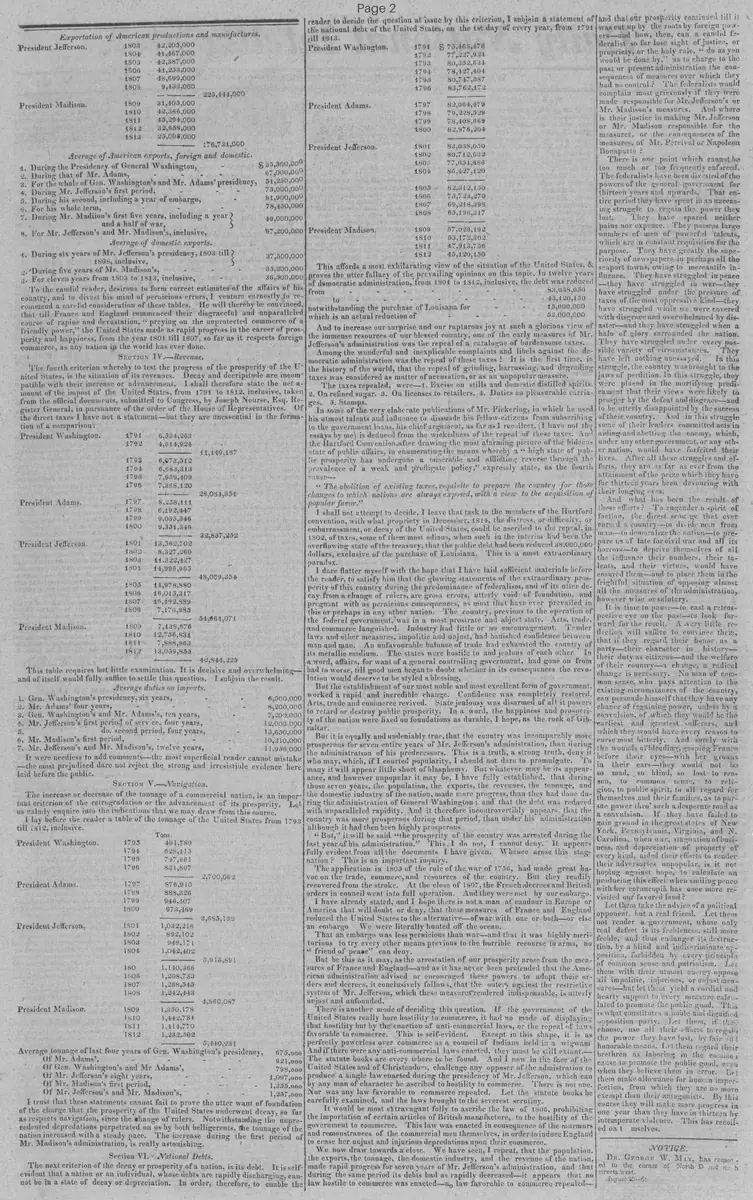
This editorial uses historical tables on US exports, domestic production, revenues, tonnage, and national debt from 1791-1812 to defend the economic prosperity under Presidents Jefferson and Madison against Federalist accusations of decay. It attributes disruptions to British and French aggressions, praises tax repeals, and urges Federalists to end factional opposition.
Merged-components note: Long editorial essay on US economic prosperity under different presidents, with multiple embedded tables; merging all related components across columns and sections for coherence.
Clipping
OCR Quality
Full Text
| Exportation of American productions and manufactures. | ||
| President Jefferson. | 1803 | 42,205,000 |
| 1804 | 41,467,000 | |
| 1805 | 42,387,000 | |
| 1806 | 41,253,000 | |
| 1807 | 48,699,000 | |
| 1808 | 9,433,000 | |
| President Madison. | 1809 | 31,405,000 |
| 1810 | 42,366,000 | |
| 1811 | 45,294,000 | |
| 1812 | 32,658,000 | |
| 1813 | 25,008,000 |
| President Washington. | 1791 | $75,463,476 |
| 1792 | 77,227,924 | |
| 1793 | 80,352,634 | |
| 1794 | 78,427,404 | |
| 1795 | 80,747,587 | |
| 1796 | 83,762,172 | |
| President Adams. | 1797 | 82,064,479 |
| 1798 | 79,228,529 | |
| 1799 | 78,408,669 | |
| 1800 | 82,976,204 | |
| President Jefferson. | 1801 | 83,038,050 |
| 1802 | 80,712,632 | |
| 1803 | 77,054,686 | |
| 1804 | 86,427,120 | |
| 1805 | 82,312,150 | |
| 1806 | 75,723,270 | |
| 1807 | 69,218,398 | |
| 1808 | 65,196,317 | |
| President Madison. | 1809 | 57,023,192 |
| 1810 | 53,172,302 | |
| 1811 | 47,913,756 | |
| 1812 | 45,120,150 |
| Average of American exports, foreign and domestic. | ||
| 4. During the Presidency of General Washington, 2. During that of Mr. Adams, 3. For the whole of Gen. Washington's and Mr. Adams' presidency, 4. During Mr. Jefferson's first period, 5. During his second, including a year of embargo, 6. For his whole term, 7. During Mr. Madison's first five years, including a year and a half of war, 8. For Mr. Jefferson's and Mr. Madison's, inclusive, | $35,500,000 | 67,000,000 |
| 51,250,000 | 75,000,000 | |
| 81,900,000 | 78,450,000 | |
| 49,000,000 | 67,200,000 | |
| Average of domestic exports. | ||
| 4. During six years of Mr. Jefferson's presidency, 1803 till 1808, inclusive, 2. During five years of Mr. Madison's, | 37,500,000 | 35,300,000 |
| President Washington. | 1791 | 6,534,263 |
| 1792 | 4,614,924 | |
| 1793 | 11,149,187 | |
| 1794 | 6,073,512 | |
| 1795 | 6,683,313 | |
| 1796 | 7,959,409 | |
| 1797 | 7,368,120 | |
| President Adams. | 1797 | 28,081,854 |
| 1798 | 8,258,111 | |
| 1799 | 6,192,447 | |
| 1800 | 9,035,346 | |
| President Jefferson. | 1801 | 32,837,252 |
| 1802 | 13,362,702 | |
| 1803 | 8,327,260 | |
| 1804 | 11,322,427 | |
| 1805 | 14,996,965 | |
| 1806 | 14,978,880 | |
| 1807 | 16,015,317 | |
| 1808 | 16,492,989 | |
| President Madison. | 1809 | 7,138,676 |
| 1810 | 12,756,931 | |
| 1811 | 7,888,863 | |
| 1812 | 13,059,855 |
To the candid reader, desirous to form correct estimates of the affairs of his country, and to divest his mind of pernicious errors, I venture earnestly to recommend a careful consideration of these tables. He will thereby be convinced that till France and England commenced their disgraceful and unparalleled course of rapine and devastation, "preying on the unprotected commerce of a friendly power," the United States made as rapid progress in the career of prosperity and happiness, from the year 1801 till 1807, so far as it respects foreign commerce, as any nation in the world has ever done.
SECTION IV.—Revenue.
The fourth criterion whereby to test the progress of the prosperity of the United States, is the situation of its revenues. Decay and decrepitude are incompatible with their increase or advancement. I shall therefore state the net amount of the impost of the United States, from 1791 to 1812, inclusive, taken from the official documents, submitted to Congress, by Joseph Nourse, Esq. Register General, in pursuance of the order of the House of Representatives. Of the direct taxes I have not a statement—but they are unessential in the formation of a comparison:
40,511,225
This table requires but little examination. It is decisive and overwhelming and of itself would fully suffice to settle this question. I subjoin the result.
Average duties on imports.
1. Gen. Washington's presidency, six years,
6,500,000
2. Mr. Adams' four years,
8,200,000
3. Gen. Washington's and Mr. Adams's, ten years,
7,200,000
4. Mr. Jefferson's first period of service, four years.
12,000,000
5. [His] second period, four years
13,650,000
6. Mr. Madison's first period,
10,210,000
7. Mr. Jefferson's and Mr. Madison's, twelve years,
11,936,000
… It were needless to add comments—the most superficial reader cannot mistake -the most prejudiced dare not reject the strong and irresistible evidence here laid before the public.
SECTION V.—Navigation.
The increase or decrease of the tonnage of a commercial nation, is an important criterion of the retrogradation or the advancement of its prosperity. Let us calmly enquire into the indications that we may draw from this source. … I lay before the reader a table of the tonnage of the United States from 1793 till 1812, inclusive.
5,110,231
Average tonnage of last four years of Gen. Washington's presidency,
675,000
Of Mr. Adams
921,000
Of Gen. Washington's and Mr. Adams
798,000
Of Mr. Jefferson's eight years,
1,097,000
Of Mr. Madison's first period,
1,355,000
Of Mr. Jefferson's and Mr. Madison's,
1,257,000
I trust that these statements cannot fail to prove the utter want of foundation of the charge that the prosperity of the United States underwent decay, so far as respects navigation, since the change of rulers. Notwithstanding the unprecedented depredations perpetrated on us by both belligerents, the tonnage of the nation increased with a steady pace. The increase during the first period of Mr. Madison's administration, is really astonishing—
SECTION VI.—National Debts.
The next criterion of the decay or prosperity of a nation, is its debt. It is self-evident that a nation or an individual, whose debts are rapidly discharging, cannot be in a state of decay or depreciation. In order, therefore, to enable the
| Tons. | ||
| President Washington | 1793 | 491,789 |
| 1794 | 628,415 | |
| 1795 | 747,961 | |
| 1796 | 831,897 | |
| President Adams | 1797 | 876,910 |
| 1798 | 888,326 | |
| 1799 | 946,407 | |
| 1800 | 973,489 | |
| President Jefferson | 1801 | 1,032,216 |
| 1802 | 892,102 | |
| 1803 | 949,171 | |
| 1804 | 1,042,402 | |
| 1805 | 1,140,366 | |
| 1806 | 1,208,733 | |
| 1807 | 1,268,545 | |
| 1808 | 1,242,443 | |
| President Madison | 1809 | 1,350,178 |
| 1810 | 1,442,781 | |
| 1811 | 1,414,770 | |
| 1812 | 1,232,502 |
from … notwithstanding the purchase of Louisiana for which is an actual reduction of
And to increase our surprise and our rapturous joy at such a glorious view of the immense resources of our blessed country, one of the early measures of Mr. Jefferson's administration was the repeal of a catalogue of burdensome taxes.
Among the wonderful and inexplicable complaints and libels against the democratic administration was the repeal of these taxes! It is the first time in the history of the world, that the repeal of grinding, harassing, and degrading taxes was considered as matter of accusation, or as an unpopular measure.
The taxes repealed, were—1. Excise on stills and domestic distilled spirits. 2. On refined sugar. 3. On licenses to retailers. 4. Duties on pleasurable carriages. 5. Stamps.
In some of the very elaborate publications of Mr. Pickering, in which he used his utmost talents and influence to dissuade his fellow-citizens from subscribing to the government loans, his chief argument, as far as I recollect, (I have not the essays by me) is deduced from the wickedness of the repeal of these taxes. And the Hartford Convention, after drawing the most alarming picture of the hideous state of public affairs, in enumerating the means whereby a "high state of public prosperity has undergone a miserable and afflicting reverse through the prevalence of a weak and profligate policy," expressly state, as the fourth cause—
"The abolition of existing taxes, requisite to prepare the country for those changes to which nations are always exposed, with a view to the acquisition of popular favor."
I shall not attempt to decide, I leave that task to the members of the Hartford convention, with what propriety in December, 1814, the distress, or difficulty, or embarrassment, or decay of the United States, could be ascribed to the repeal, in 1802, of taxes, some of them most odious, when such in the interim had been the overflowing state of the treasury, that the public debt had been reduced 38,000,000 dollars, exclusive of the purchase of Louisiana. This is a most extraordinary paradox.
I dare flatter myself with the hope that I have laid sufficient materials before the reader, to satisfy him that the glowing statements of the extraordinary prosperity of this country during the predominance of federalism, and of its utter decay from a change of rulers, are gross errors, utterly void of foundation, and pregnant with as pernicious consequences, as most that have ever prevailed in this or perhaps in any other nation. The country, previous to the operation of the federal government, was in a most prostrate and abject state. Arts, trade, and commerce languished. Industry had little or no encouragement. Tender laws and other measures, impolitic and unjust, had banished confidence between man and man. An unfavourable balance of trade had exhausted the country of its metallic medium. The states were hostile to and jealous of each other. In a word, affairs, for want of a general controlling government, had gone on from bad to worse, till good men began to doubt whether in its consequences the revolution would deserve to be styled a blessing.
But the establishment of our most noble and most excellent form of government, worked a rapid and incredible change. Confidence was completely restored. Arts, trade and commerce revived. State jealousy was disarmed of all its powers to retard or destroy public prosperity. In a word, the happiness and prosperity of the nation were fixed on foundations as durable, I hope, as the rock of Gibraltar.
But it is equally and undeniably true, that the country was incomparably more prosperous for seven entire years of Mr. Jefferson's administration, than during the administration of his predecessors. This is a truth, a strong truth, deny it who may, which, if I courted popularity, I should not dare to promulgate. To many it will appear little short of blasphemy. But whatever may be its appearance, and however unpopular it may be, I have fully established, that during those seven years, the population, the exports, the revenues, the tonnage, and the domestic industry of the nation, made more progress, than they had done during the administration of General Washington; and that the debt was reduced with unparalleled rapidity. And it therefore incontrovertibly appears, that the country was more prosperous during that period, than under his administration although it had then been highly prosperous
, "But," it will be said "the prosperity of the country was arrested during the last year of his administration." This I do not, I cannot deny. "It appears fully evident from all the documents I have given. Whence arose this stagnation? This is an important inquiry.
The application in 1805 of the rule of the war of 1756, had made great havoc on the trade, commerce, and resources of the country. But they readily recovered from the stroke. At the close of 1807, the French decrees and British orders in council went into full operation. And they were met by our embargo.
I have already stated, and I hope there is not a man of candour in Europe or America that will doubt or deny, that these measures of France and England reduced the United States to the alternative—of war with one or both or else an embargo. We were literally hunted off the ocean.
That an embargo was less pernicious than war—and that it was highly meritorious to try every other means previous to the horrible recourse to arms, no "friend of peace" can deny.
But be this as it may, as the arrestation of our prosperity arose from the measures of France and England—and as it has never been pretended that the American administration advised or encouraged these powers to adopt their orders and decrees, it conclusively follows, that the outcry against the restrictive system of Mr. Jefferson, which these measures rendered indispensable, is utterly unjust and unfounded.
There is another mode of deciding this question. If the government of the United States really bore hostility to commerce, it had no mode of displaying that hostility but by the enaction of anti-commercial laws, or the repeal of laws favorable to commerce. This is self-evident. Except in this shape, it is as perfectly powerless over commerce as a council of Indians held in a wigwam
And if there were any anti-commercial laws enacted, they must be still extant.— The statute books are every where to be found. And I now in the face of the United States and of Christendom, challenge any opposer of the administration to produce a single law enacted during the presidency of Mr. Jefferson, which can by any man of character be ascribed to hostility to commerce. There is not one.
Nor was any law favorable to commerce repealed. Let the statute books be carefully examined, and the laws brought to the severest scrutiny.
It would be most extravagant folly to ascribe the law of 1806, prohibiting the importation of certain articles of British manufacture, to the hostility of the government to commerce. This law was enacted in consequence of the murmurs and remonstrances of the commercial men themselves, in order to induce England to cease her unjust and injurious depredations upon their commerce.
We now draw towards a close. We have seen, I repeat, that the population, the exports, the tonnage, the domestic industry, and the revenue of the nation, made rapid progress for seven years of Mr. Jefferson's administration, and that during the same period its debts had as rapidly decreased—it appears that no
and that our prosperity continued till it was cut up by the roots by foreign powers—and how, then, can a candid federalist so far lose sight of justice, or propriety, or the holy rule, "do as you would be done by," as to charge to the past or present administration the consequences of measures over which they had no control. The federalists would complain most grievously if they were made responsible for Mr. Jefferson's or Mr. Madison's measures. And where is their justice in making Mr. Jefferson or Mr. Madison responsible for the measures, or the consequences of the measures, of Mr. Perceval or Napoleon Bonaparte?
There is one point which cannot be too much or too frequently enforced. The federalists have been divested of the powers of the general government for thirteen years and upwards. That entire period they have spent in an unceasing struggle to regain the power they lost. They have spared neither pains nor expense. They possess large numbers of men of powerful talents, which are in constant requisition for the purpose. They have greatly the superiority of newspapers in perhaps all the seaport towns, owing to mercantile influence. They have struggled in peace—they have struggled in war—they have struggled under the pressure of taxes of the most oppressive kind—they have struggled while we were covered with disgrace and overwhelmed by disaster—and they have struggled when a halo of glory surrounded the nation. They have struggled under every possible variety of circumstances. They have left nothing unessayed. In this struggle, the country was brought to the jaws of perdition. In this struggle, they were placed in the mortifying predicament that their views were likely to prosper by the defeat and disgrace—and to be utterly disappointed by the success of their country. And in this struggle some of their leaders committed acts in aiding and abetting the enemy, which, under any other government, or any other nation, would have forfeited their lives. After all these struggles and efforts, they are as far as ever from the attainment of the prize which they have for thirteen years been devouring with their longing eyes.
And what has been the result of these efforts? To engender a spirit of faction, the direst scourge that ever cursed a country—to divide man from man—to demoralize the nation—to prepare us of late for civil war and all its horrors—to deprive themselves of all the influence their numbers, their talents, and their virtues, would have ensured them—and to place them in the frightful situation of opposing almost all the measures of the administration, however wise or salutary.
It is time to pause—to cast a retrospective eye on the past—to look forward for the result. A very little reflection will suffice to convince them, that if they regard their honor as a party—their character in history— their duty as citizens—and the welfare of their country—a change, a radical change is necessary. No man of common sense, who pays attention to the existing circumstances of the country, can persuade himself that they have any chance of regaining power, unless by a convulsion, of which they would be the earliest and greatest sufferers, and which they would have every reason to curse most bitterly. And surely with the wounds of bleeding, gasping France before their eyes—with her groans in their ears—they would not be so mad, so blind, so lost to reason, to common sense, to religion, to public spirit, to all regard for themselves and their families, as to pursue power thro' such a desperate road as a convulsion. If they have failed to gain ground in the great states of New York, Pennsylvania, Virginia, and N. Carolina, when war, stagnation of business, and depreciation of property of every kind, aided their efforts to render their adversaries unpopular, is it not hoping against hope, to calculate on producing this effect when smiling peace with her cornucopia has once more revisited our favored land?
Let them take the advice of a political opponent, but a real friend. Let them not render a government, whose only real defect is its feebleness, still more feeble, and thus endanger its destruction, by a blind and indiscriminate opposition, forbidden by every principle of common sense and patriotism. Let them with their utmost energy oppose all impolitic, injurious, or unjust measures—but let them yield a cordial and hearty support to every measure calculated to promote the public good. This is what constitutes a noble and dignified opposition party. Let them, if they choose, use all their efforts to regain the power they have lost, by fair and honorable means. Let them regard their brethren as laboring in the common cause to promote the public good, even when they believe them in error. Let them make allowance for human imperfection, from which they are no more exempt than their antagonists. By this course they will make more progress in one year than they have in thirteen by intemperate violence. This has recoiled on themselves.
What sub-type of article is it?
What keywords are associated?
What entities or persons were involved?
Editorial Details
Primary Topic
Defense Of Economic Prosperity Under Jefferson And Madison Administrations
Stance / Tone
Strongly Supportive Of Democratic Republican Policies, Critical Of Federalist Factionalism
Key Figures
Key Arguments