Thank you for visiting SNEWPapers!
Sign up free
Editorial
July 24, 1846
The Liberator
Boston, Suffolk County, Massachusetts
What is this article about?
The Liberator editorial announces William Lloyd Garrison's departure on July 16, 1846, aboard the Hibernia for an anti-slavery mission to Britain. It endorses the trip's importance for international abolitionist cooperation, outlines planned activities including conferences and meetings, critiques pro-slavery American churches, and notes editorial arrangements during his absence.
Clipping
OCR Quality
98%
Excellent
Full Text
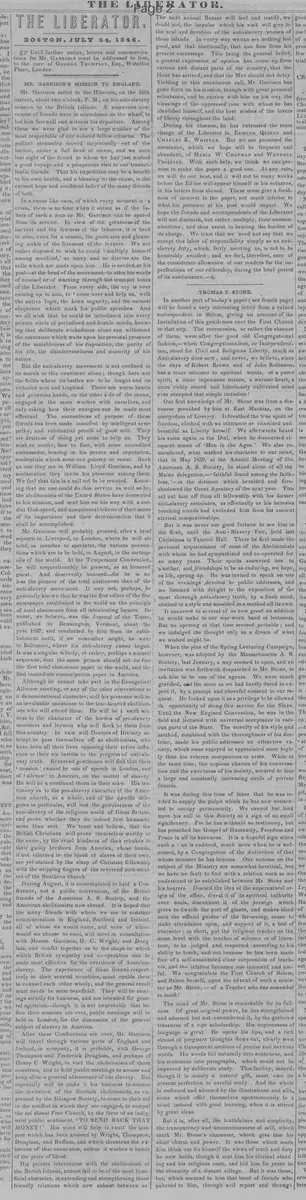
THE LIBERATOR:
BOSTON, JULY 24, 1846.
Until further notice, letters and communications for Mr. Garrison must be addressed to him, to the care of George Thompson, Esq., Waterloo Place, London.
MR. GARRISON'S MISSION TO ENGLAND.
Mr. Garrison sailed in the Hibernia, on the 16th instant, about two o'clock, P. M., on his anti-slavery mission to the British Islands. A numerous concourse of friends were in attendance on the wharf, to bid him farewell and witness his departure. Among them we were glad to see a large number of the most respectable of our colored fellow-citizens. The gallant steamship moved majestically out of the harbor, under a full head of steam, and we soon lost sight of the friend to whom we had just wished a good voyage and a prosperous visit to our transatlantic friends. That his expedition may be a benefit to his own health, and a blessing to the cause, is the earnest hope and confident belief of the many friends of both.
In a cause like ours, of which every moment is 'a crisis,' there is no time when it seems as if the labors of such a man as Mr. Garrison can be spared from its service. In view of the greatness of the harvest and the fewness of the laborers, it is hard to miss, even for a season, the giant arm and gleaming sickle of the foremost of the reapers. We are rather disposed to wish he could multiply himself among mankind,' so many and so diverse are the calls which are made upon him. He is needed at his post—at the head of the movement—to utter his words of counsel or of warning through the trumpet tones of the Liberator. From every side, the cry is ever coming up to him, to 'come over and help us,' with the native logic, the keen sagacity, and the earnest eloquence which mark his public speeches. And we all wish that he could be introduced into every private circle of prejudiced and hostile minds, knowing that deliberate wickedness alone can withstand the assurance which waits upon his personal presence of the amiableness of his disposition, the purity of his life, the disinterestedness and sincerity of his nature.
But the anti-slavery movement is not confined in its march to this continent alone; though here are the fields where its battles are to be fought and its victories won and trophied. There are warm hearts and generous hands, on the other side of the ocean, engaged in the same warfare with ourselves, and only asking how their energies can be made most effectual. The earnestness of purpose of these friends has been made manifest by intelligent sympathy, and substantial proofs of good will. They are desirous of doing yet more to help us. They wish to confer, face to face, with some accredited ambassador, bearing in his person and reputation, credentials which none can gainsay or resist. Such an one they see in William Lloyd Garrison, and by acclamation they invite his presence among them.
We feel that this is a call not to be resisted. Knowing that no one could do this service as well as he, the abolitionists of the United States have consented to his mission, and sent him on his way with a cordial God-speed, and unequivocal tokens of their sense of its importance and their determination that it shall be accomplished.
Mr. Garrison will probably proceed, after a brief sojourn in Liverpool, to London, where he will attend, as member or spectator, the various conventions which are to be held, in August, in the metropolis of the world. At the Temperance Convention, he will unquestionably be present, as an honored guest. And deservedly honored—for he is no less the pioneer of the total abstinence than of the anti-slavery movement. It may not, perhaps, be generally known that he was the first editor of the first newspaper established in the world on the principle of total abstinence from all intoxicating liquors. Its name, we believe, was the Journal of the Times, published in Bennington, Vermont, about the year 1827, and conducted by him from its establishment until, if we remember aright, he went to Baltimore, where his anti-slavery career began. It was a singular felicity, or rather, perhaps a natural sequence, that the same person should set on foot the first total abstinence paper in the world, and the first immediate emancipation paper in America.
Although he cannot take part in the Evangelical Alliance meeting, or any of the other conventions of a denominational character, still his presence will be an invaluable assistance to the true-hearted abolitionists who will attend them. He will be a swift witness to the character of the hordes of pro-slavery ministers and laymen who will flock to them from this country. In vain will Doctors of Divinity attempt to pass themselves off as abolitionists, who have been all their lives opposing their active influence or their vis inerti to the progress of anti-slavery truth. Reverend gentlemen will find that their 'mission' cannot be one of speech in London, and of silence' in America, on the matter of slavery. He will be a continual thorn in their sides. His testimony as to the pro-slavery character of the American church, as a whole, and of the specific delegates in particular, will test the genuineness of the anti-slavery of the religious world of Great Britain, and prove whether they do indeed love humanity more than sect. We trust and believe, that the British Christians will prove themselves worthy of the name, by the cruel kindness of their rebukes to their guilty brethren from America, whose hands, if not imbrued in the blood of slaves of their own, are yet stained by the clasp of Christian fellowship with the dripping fingers of the reverend men-stealers of the Southern church.
During August, it is contemplated to hold a Conference, not a public convention, of the British friends of the American A. S. Society, and the American abolitionists now abroad. It is hoped that the many friends with whom we are in constant communication in England, Scotland and Ireland all of whom we would name, and none of whom would we choose to omit, will meet in consultation with Messrs. Garrison, H. C. Wright, and Douglass, and confer together as to the shape in which British sympathy and co-operation can be made most effective for the overthrow of American slavery. The experience of these friends respectively in their several countries, must enable them to counsel each other wisely, and the general result must needs be most beneficial. They will be meetings strictly for business, and not intended for general agitation—though it is not improbable that before their sessions are over, public meetings will be held in London, for the discussion of the general subject of slavery in America.
After these Conferences are over, Mr. Garrison will travel through various parts of England and Ireland, in company, it is probable, with George Thompson and Frederick Douglass, and perhaps of Henry C. Wright, to visit the abolitionists of those countries, and to hold public meetings to arouse and keep alive a general abhorrence of our slavery. But especially will he make it his business to answer the invitation of the Scottish abolitionists, as expressed by the Glasgow Society, to come to their aid in the conflict in which they are engaged, to compel the soi disant Free Church, by the force of an indignant public sentiment, 'TO SEND BACK THAT MONEY!' His voice will help to swell the tempest which has been aroused by Wright, Thompson, Douglass, and Buffum, and which threatens the existence of that connexion, unless it washes its hands of the price of blood.
His private intercourse with the abolitionists of the British Islands, cannot fail to be of the most beneficial character, in extending and strengthening those friendly relations which now subsist between us. The next annual Bazaar will feel and testify, we doubt not, the impulse which his visit will give to the zeal and devotion of the anti-slavery women of those islands. In every way we can see nothing but good, and that continually, that can flow from his present embassage. This being the general belief a general expression of opinion has come up from various and distant parts of the country, that the Hour has arrived, and that the Man should not delay. Yielding to this unanimous call, Mr. Garrison has gone forth on his mission, though with great personal reluctance, and he carries with him on his way the blessings of the oppressed race with whom he has identified himself, and the best wishes of the lovers of liberty throughout the land.
During his absence, he has entrusted the main charge of the Liberator to Edmund Quincy and Charles K. Whipple. But we are promised the assistance, which we hope will be frequent and abundant, of Maria W. Chapman and Wendell Phillips. With such help, we think we can promise to make the paper a good one. At any rate, we will do our best, and it will not be many weeks before the Editor will appear himself in his columns, in his letters from abroad. These must give a freshness of interest to the paper, not much inferior to what his presence at his post would impart. We hope the friends and correspondents of the Liberator will not diminish, but rather multiply, their communications; and thus assist in bearing the burden of its charge. We trust that we need not say that we accept this labor of responsibility simply as an anti-slavery duty, which, fairly meeting us, is not to be honorably avoided; and we feel, therefore, sure of the considerate allowance of our readers for the imperfections of our editorship, during the brief period of its continuance.—Q.
BOSTON, JULY 24, 1846.
Until further notice, letters and communications for Mr. Garrison must be addressed to him, to the care of George Thompson, Esq., Waterloo Place, London.
MR. GARRISON'S MISSION TO ENGLAND.
Mr. Garrison sailed in the Hibernia, on the 16th instant, about two o'clock, P. M., on his anti-slavery mission to the British Islands. A numerous concourse of friends were in attendance on the wharf, to bid him farewell and witness his departure. Among them we were glad to see a large number of the most respectable of our colored fellow-citizens. The gallant steamship moved majestically out of the harbor, under a full head of steam, and we soon lost sight of the friend to whom we had just wished a good voyage and a prosperous visit to our transatlantic friends. That his expedition may be a benefit to his own health, and a blessing to the cause, is the earnest hope and confident belief of the many friends of both.
In a cause like ours, of which every moment is 'a crisis,' there is no time when it seems as if the labors of such a man as Mr. Garrison can be spared from its service. In view of the greatness of the harvest and the fewness of the laborers, it is hard to miss, even for a season, the giant arm and gleaming sickle of the foremost of the reapers. We are rather disposed to wish he could multiply himself among mankind,' so many and so diverse are the calls which are made upon him. He is needed at his post—at the head of the movement—to utter his words of counsel or of warning through the trumpet tones of the Liberator. From every side, the cry is ever coming up to him, to 'come over and help us,' with the native logic, the keen sagacity, and the earnest eloquence which mark his public speeches. And we all wish that he could be introduced into every private circle of prejudiced and hostile minds, knowing that deliberate wickedness alone can withstand the assurance which waits upon his personal presence of the amiableness of his disposition, the purity of his life, the disinterestedness and sincerity of his nature.
But the anti-slavery movement is not confined in its march to this continent alone; though here are the fields where its battles are to be fought and its victories won and trophied. There are warm hearts and generous hands, on the other side of the ocean, engaged in the same warfare with ourselves, and only asking how their energies can be made most effectual. The earnestness of purpose of these friends has been made manifest by intelligent sympathy, and substantial proofs of good will. They are desirous of doing yet more to help us. They wish to confer, face to face, with some accredited ambassador, bearing in his person and reputation, credentials which none can gainsay or resist. Such an one they see in William Lloyd Garrison, and by acclamation they invite his presence among them.
We feel that this is a call not to be resisted. Knowing that no one could do this service as well as he, the abolitionists of the United States have consented to his mission, and sent him on his way with a cordial God-speed, and unequivocal tokens of their sense of its importance and their determination that it shall be accomplished.
Mr. Garrison will probably proceed, after a brief sojourn in Liverpool, to London, where he will attend, as member or spectator, the various conventions which are to be held, in August, in the metropolis of the world. At the Temperance Convention, he will unquestionably be present, as an honored guest. And deservedly honored—for he is no less the pioneer of the total abstinence than of the anti-slavery movement. It may not, perhaps, be generally known that he was the first editor of the first newspaper established in the world on the principle of total abstinence from all intoxicating liquors. Its name, we believe, was the Journal of the Times, published in Bennington, Vermont, about the year 1827, and conducted by him from its establishment until, if we remember aright, he went to Baltimore, where his anti-slavery career began. It was a singular felicity, or rather, perhaps a natural sequence, that the same person should set on foot the first total abstinence paper in the world, and the first immediate emancipation paper in America.
Although he cannot take part in the Evangelical Alliance meeting, or any of the other conventions of a denominational character, still his presence will be an invaluable assistance to the true-hearted abolitionists who will attend them. He will be a swift witness to the character of the hordes of pro-slavery ministers and laymen who will flock to them from this country. In vain will Doctors of Divinity attempt to pass themselves off as abolitionists, who have been all their lives opposing their active influence or their vis inerti to the progress of anti-slavery truth. Reverend gentlemen will find that their 'mission' cannot be one of speech in London, and of silence' in America, on the matter of slavery. He will be a continual thorn in their sides. His testimony as to the pro-slavery character of the American church, as a whole, and of the specific delegates in particular, will test the genuineness of the anti-slavery of the religious world of Great Britain, and prove whether they do indeed love humanity more than sect. We trust and believe, that the British Christians will prove themselves worthy of the name, by the cruel kindness of their rebukes to their guilty brethren from America, whose hands, if not imbrued in the blood of slaves of their own, are yet stained by the clasp of Christian fellowship with the dripping fingers of the reverend men-stealers of the Southern church.
During August, it is contemplated to hold a Conference, not a public convention, of the British friends of the American A. S. Society, and the American abolitionists now abroad. It is hoped that the many friends with whom we are in constant communication in England, Scotland and Ireland all of whom we would name, and none of whom would we choose to omit, will meet in consultation with Messrs. Garrison, H. C. Wright, and Douglass, and confer together as to the shape in which British sympathy and co-operation can be made most effective for the overthrow of American slavery. The experience of these friends respectively in their several countries, must enable them to counsel each other wisely, and the general result must needs be most beneficial. They will be meetings strictly for business, and not intended for general agitation—though it is not improbable that before their sessions are over, public meetings will be held in London, for the discussion of the general subject of slavery in America.
After these Conferences are over, Mr. Garrison will travel through various parts of England and Ireland, in company, it is probable, with George Thompson and Frederick Douglass, and perhaps of Henry C. Wright, to visit the abolitionists of those countries, and to hold public meetings to arouse and keep alive a general abhorrence of our slavery. But especially will he make it his business to answer the invitation of the Scottish abolitionists, as expressed by the Glasgow Society, to come to their aid in the conflict in which they are engaged, to compel the soi disant Free Church, by the force of an indignant public sentiment, 'TO SEND BACK THAT MONEY!' His voice will help to swell the tempest which has been aroused by Wright, Thompson, Douglass, and Buffum, and which threatens the existence of that connexion, unless it washes its hands of the price of blood.
His private intercourse with the abolitionists of the British Islands, cannot fail to be of the most beneficial character, in extending and strengthening those friendly relations which now subsist between us. The next annual Bazaar will feel and testify, we doubt not, the impulse which his visit will give to the zeal and devotion of the anti-slavery women of those islands. In every way we can see nothing but good, and that continually, that can flow from his present embassage. This being the general belief a general expression of opinion has come up from various and distant parts of the country, that the Hour has arrived, and that the Man should not delay. Yielding to this unanimous call, Mr. Garrison has gone forth on his mission, though with great personal reluctance, and he carries with him on his way the blessings of the oppressed race with whom he has identified himself, and the best wishes of the lovers of liberty throughout the land.
During his absence, he has entrusted the main charge of the Liberator to Edmund Quincy and Charles K. Whipple. But we are promised the assistance, which we hope will be frequent and abundant, of Maria W. Chapman and Wendell Phillips. With such help, we think we can promise to make the paper a good one. At any rate, we will do our best, and it will not be many weeks before the Editor will appear himself in his columns, in his letters from abroad. These must give a freshness of interest to the paper, not much inferior to what his presence at his post would impart. We hope the friends and correspondents of the Liberator will not diminish, but rather multiply, their communications; and thus assist in bearing the burden of its charge. We trust that we need not say that we accept this labor of responsibility simply as an anti-slavery duty, which, fairly meeting us, is not to be honorably avoided; and we feel, therefore, sure of the considerate allowance of our readers for the imperfections of our editorship, during the brief period of its continuance.—Q.
What sub-type of article is it?
Slavery Abolition
Moral Or Religious
Foreign Affairs
What keywords are associated?
Anti Slavery Mission
Garrison England
Abolition Cooperation
Free Church Scandal
Pro Slavery Church
Temperance Pioneer
International Conferences
What entities or persons were involved?
William Lloyd Garrison
George Thompson
Frederick Douglass
Henry C. Wright
Edmund Quincy
Charles K. Whipple
Maria W. Chapman
Wendell Phillips
Scottish Abolitionists
Glasgow Society
Free Church
American A. S. Society
Pro Slavery Ministers
Editorial Details
Primary Topic
William Lloyd Garrison's Anti Slavery Mission To England
Stance / Tone
Enthusiastic Endorsement And Support For The Mission
Key Figures
William Lloyd Garrison
George Thompson
Frederick Douglass
Henry C. Wright
Edmund Quincy
Charles K. Whipple
Maria W. Chapman
Wendell Phillips
Scottish Abolitionists
Glasgow Society
Free Church
American A. S. Society
Pro Slavery Ministers
Key Arguments
Garrison's Mission Will Strengthen International Anti Slavery Cooperation
His Presence Will Expose Pro Slavery Elements In American Churches At British Conventions
The Trip Responds To Invitations From British Abolitionists For Direct Consultation
Garrison's Role In Temperance And Abolition Highlights His Pioneering Contributions
Conferences Will Plan Effective British Support Against American Slavery
His Visit Will Aid Campaigns Like Pressuring The Free Church To Return Slave Money
Arrangements Ensure The Liberator Continues Effectively During His Absence